 Read More
20 Nov 2026
|8 min
Meta's Muse and the Agentic Shopper: What It Means for Australian Brands on Meta

Keep ahead of the curve via our latest trends newsletter.
Contact us nowFor as long as we have run Meta campaigns, the path has been simple: someone sees an ad, clicks, lands on your site and buys, and the Meta pixel records it. Meta's new personal AI agent, Muse, puts a new step in the middle of that path. Before long, the shopper won't be the one doing the clicking. Their agent will.
With its launch in Australia on 18 November 2026 (Australian time), bringing local giants like Kogan, MECCA, Officeworks and ShopBack on board as initial shopping partners, the local market has started to shift. For Australian businesses, agentic shopping is no longer a distant trend; it is already in your customers' pockets, and it touches everything we do as a paid social team: tracking, attribution, creative, product feeds, and the systems that join them together. Here's what we're seeing from our desk in Brisbane, and how BFJ is helping Australian brands use it, defend against it, and stay ahead of it.

Meta marked the Australian launch with Jolly, the Muse mascot, on the beach. Image: Meta Newsroom.
What Muse is, and how it shops
Muse is an agent that acts, not a chatbot that answers. You give it a goal and it goes off and does the work: it researches, compares, fills out forms and checks out. It keeps going after you close the app and only comes back when it needs you to approve something like a purchase. It runs on Meta's Muse Spark model, uses its own cloud browser, and remembers your preferences and goals over time.
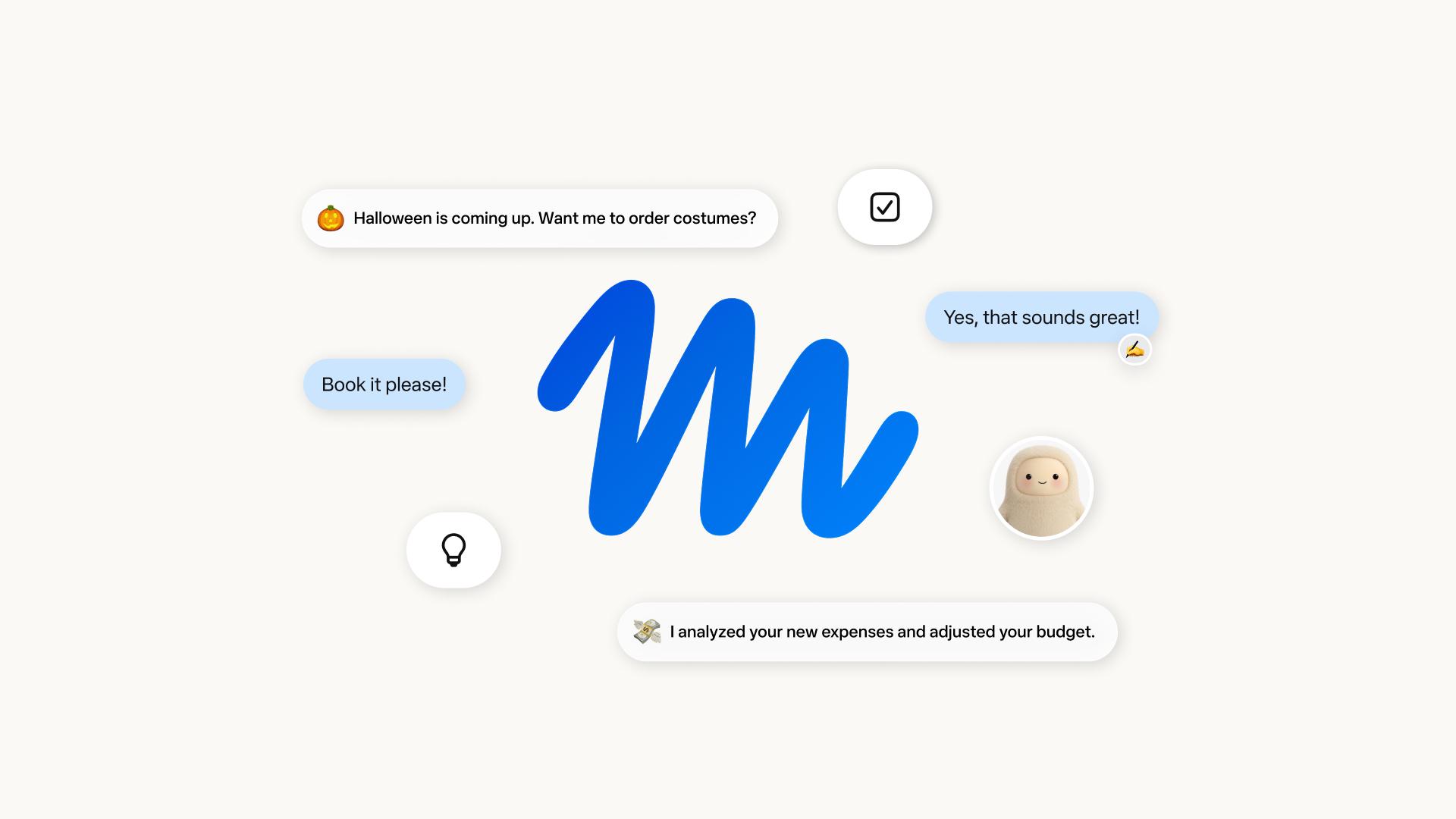
Muse works through tasks in the background and checks in for approval. Image: Meta Newsroom.
The part that matters most to marketers is that shopping turned out to be one of its top use cases. Meta's own product team didn't expect that. In a recent interview on Lenny's Podcast, Mona Sarantakos, VP of Product at Meta Superintelligence Labs and head of product for Muse, described a change in her own buying. She used to order five pairs of kids' trackpants from one brand's site. Now Muse spreads the same order across five or more retailers, picked against her specifications. Repeat purchases from a single brand site give way to the agent comparing the options for her.
Australian shoppers are warming to the idea, but they aren't handing over their wallets yet. A Commerce and PayPal Australia survey of 1,000 online shoppers found that 63% want to try an agentic AI shopping tool, but only 4% want AI involved at payment. Adyen's 2026 research found that 64% of Australians have used AI assistants to browse or compare products, yet 64% are uncomfortable letting AI complete a purchase for them.
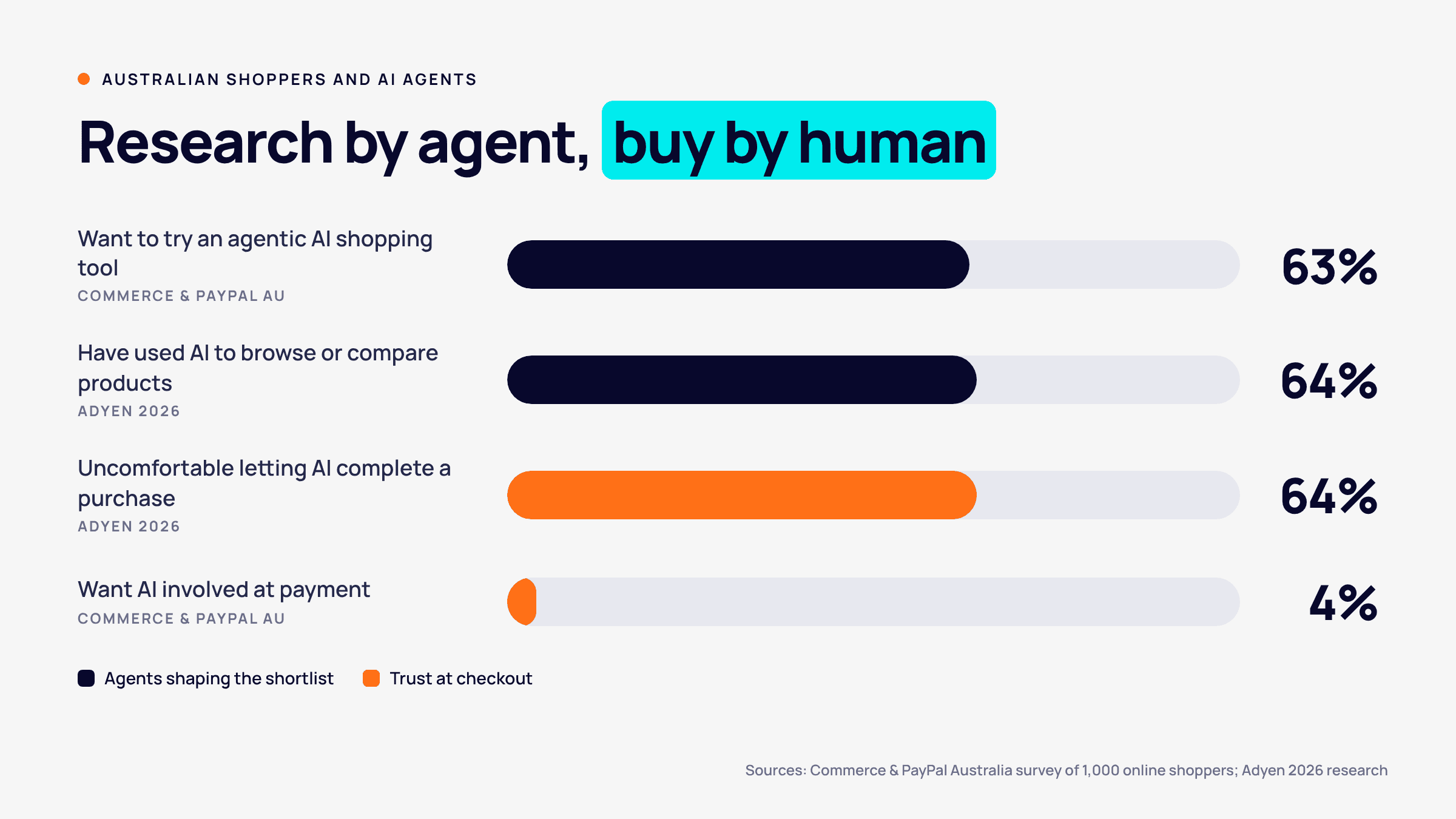
For now, that makes Australia a research-by-agent, buy-by-human market. Agents are shaping the shortlist well before they're trusted with checkout, which gives Australian brands a window to get ready.
That is the real change for marketers. The shopper still decides what they want, but the agent increasingly does the searching, comparing and buying. That reshapes the customer journey.
The customer journey has a new middle step
In the traditional journey, the person does the searching, comparing and buying themselves. In the agent-mediated journey, they hand that work to an agent.
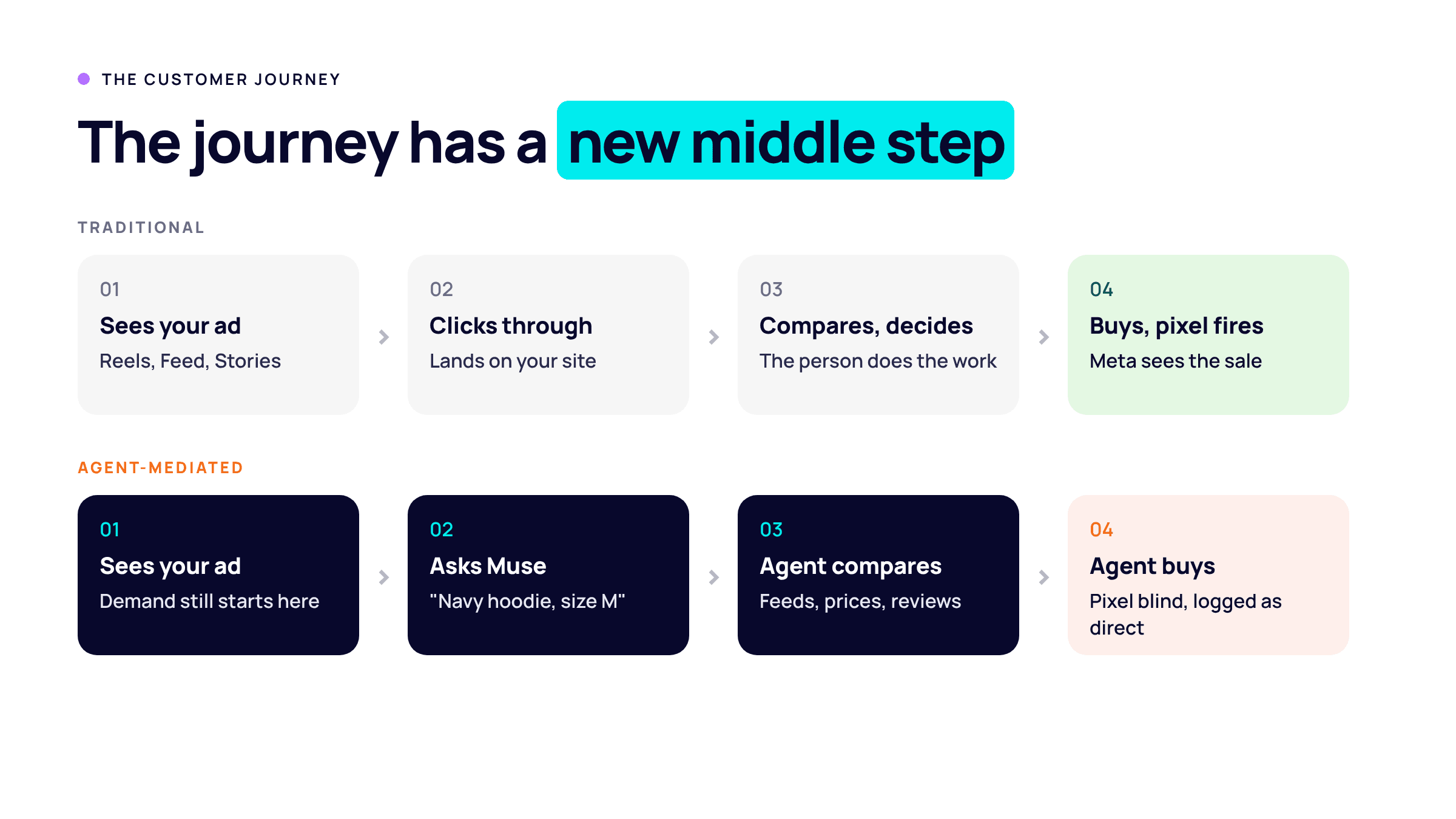
Advertising still sparks the demand. But the agent increasingly decides which brands make the shortlist, what gets compared and what is finally bought. The brand the agent can read, trust and buy from easily wins the sale.
Four ways Muse changes Meta advertising
1. Tracking: the pixel can't see the agent
Browser tracking depends on a person clicking an ad, your site loading, and the Meta pixel firing on the confirmation page. Muse can break every one of those steps. It shops from a headless cloud browser with no cookies and no ad-click history. Agents often strip out third-party scripts so pages load faster. And website firewalls often flag agent traffic as bots and block it. In any of those cases the pixel and GA4 never fire, and the sale goes unrecorded on both platforms.
Australian retail sites already put up these barriers. In a late-2025 study of browser agents on 11 Australian retailers, including JB Hi-Fi, Bunnings and Chemist Warehouse, AI agency Time Under Tension found that nearly half of the test runs hit a human-verification challenge. Bot blocking was the single biggest barrier the study found.
That makes the Meta Conversions API (CAPI) essential rather than optional. CAPI sends purchase events from your ecommerce backend or CRM straight to Meta, server to server, with no browser involved. If a sale happens, Meta hears about it, whoever completed the checkout. We explain the set-up behind this in the benefits of server-side GTM and in how we upgraded BFJ's own tracking architecture.
2. Attribution: paid creates the demand, the report credits direct
Picture a shopper who sees your Reels ad on Tuesday night. On Wednesday they tell Muse to "order that hoodie in navy, size M", and Muse buys it. Analytics records the sale as direct or organic. The ad that created the demand gets no credit, ROAS looks worse than it really is, and the obvious reaction is to cut the very campaign that is working. As more shopping goes through agents, last-click reporting will steadily undercount paid social. It's the same problem we cover in marketing attribution in a post-cookie world, and agents make it worse.
3. Creative persuades people, data persuades agents
An agent doesn't respond to an emotional hook or a clever headline. When Muse is asked for the best running shoes under $150, it reads product feeds, specifications, prices, stock levels, reviews and returns policies. Your catalogue becomes your sales pitch to the agent. Creative still matters, because it's what makes a person want something in the first place. But the final decision is increasingly made on data.
4. A new gatekeeper decides who gets considered
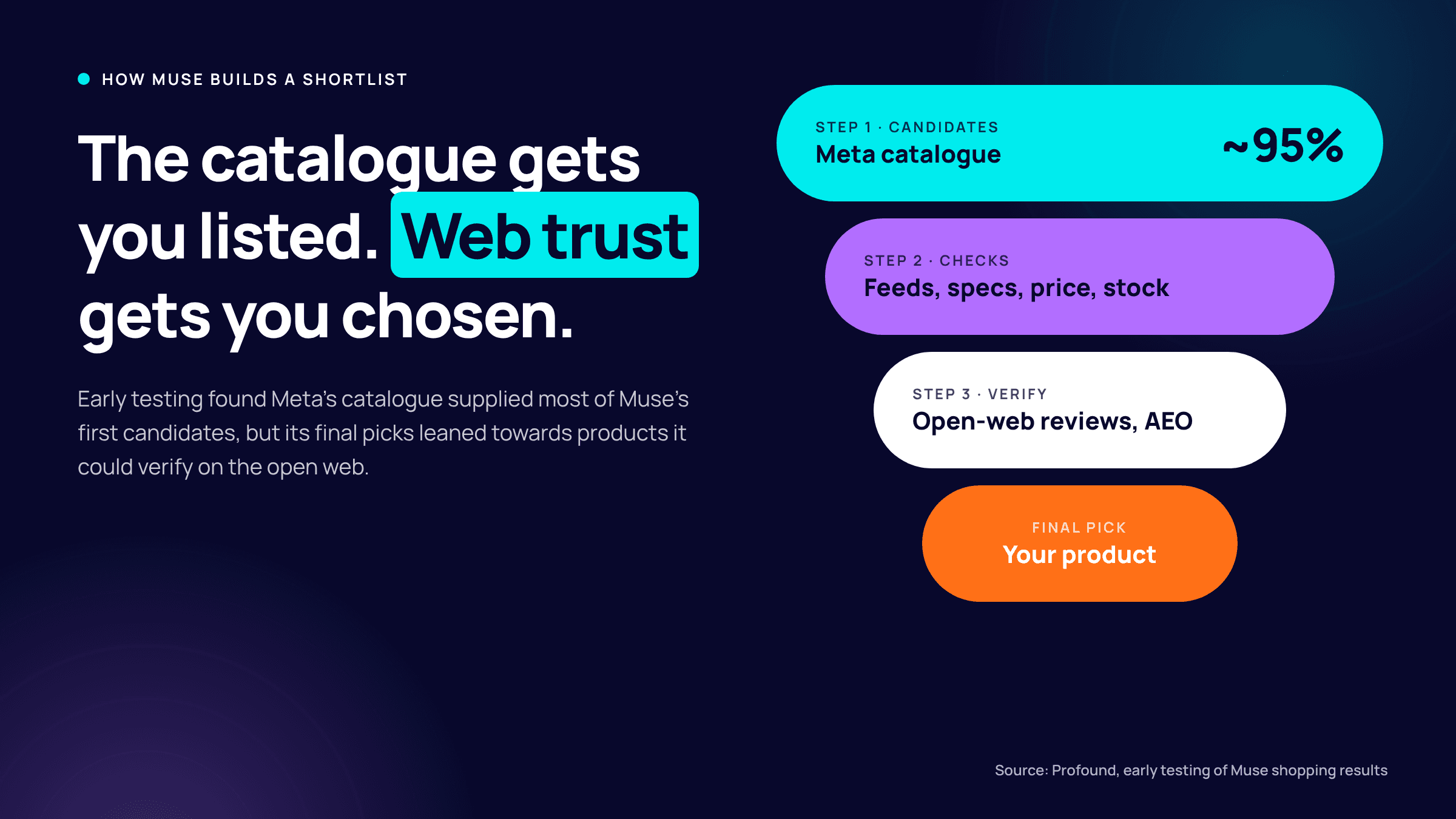
An agent increasingly shapes which brands make the shortlist, what information gets weighed, and what is finally chosen. Early testing by AI visibility firm Profound found that Meta's catalogue supplied about 95% of Muse's first candidates, but its final picks leaned towards products it could verify on the open web. Being in the catalogue gets you onto the list. Being trusted across the web is what gets you chosen. That's why we build websites that work for people and AI at the same time.
The BFJ playbook: use it, defend against it, stay ahead of it
Winning in 2027 means joining up the things that both AI agents and ad algorithms rely on: your ads, your website structure, your CRM and your real revenue data. Most agencies cover one of those, which is the problem with running separate agencies for each channel. BFJ covers all four under one roof, and that's why we can respond to Muse from every angle.
Use it: make your brand easy for agents to choose
It's no longer enough to be easy for people to find and evaluate. Brands now need to be easy for AI agents to find, understand, compare and buy from.
- Product feeds and catalogue ads. We clean up and enrich your catalogue with full titles, specifications, live pricing, stock levels, product identifiers and policies, so agents can read it and compare it fairly. The same work strengthens Facebook Shopping Ads and Google Shopping Ads.
- Shopify development. We make sure your store, catalogue and checkout are ready for AI agents to find and buy from, and decide with you which agent channels suit your margins and customer relationships.
- AEO audit and AEO strategy. Agents check what they find on the open web before they buy. Our AEO (Answer Engine Optimisation) work, together with Technical SEO, structured data and helpful content, makes your brand the one an agent can verify and trust. More in SEO, AEO and GEO: the new search stack.
- Ad Creative and Video Production. Agents choose, but people still decide what they want in the first place. Thumb-stopping creative on Meta, TikTok and Reddit keeps your brand on the shopping list a person hands to their agent.
Defend: protect your measurement and your margins
The biggest risk right now isn't losing sales to Muse. It's losing sight of the sales you're already making.
- Meta Conversions API and server-side tracking. We connect your ecommerce backend or CRM straight to Meta, so every purchase is counted no matter who, or what, completes the checkout. This keeps Meta's algorithm learning from real results.
- GA4 auditing. We separate likely agent traffic from human traffic, check whether firewall rules are blocking agent checkouts, and fix gaps on the confirmation page. Given how often Australian sites put bot checks in front of agents, this is often the quickest win. See our guide to tracking AI traffic in Google Analytics.
- Marketing and revenue attribution. We move clients beyond last click with blended reporting such as MER (marketing efficiency ratio), incrementality testing and post-purchase "how did you hear about us?" surveys. When an agent completes a sale that your Reels ad started, your reporting gives the ad the credit. It also means optimising for profit, not just revenue: see ROAS vs POAS.
- First-Party Data Strategy. Hand-raisers, email and SMS subscribers, and CRM audiences become more valuable as agents take over more browsing. We help you build that data now, in line with Australia's privacy shift.
Stay ahead: keep the customer relationship yours
Agents threaten to come between you and your customer. We help you keep the relationship direct.
- HubSpot, Salesforce and CRM development. We feed offline and CRM revenue back into Meta, so its algorithm optimises for real profit, not just clicks. More in offline revenue attribution.
- Email and SMS marketing. Owned channels you control, and which an agent can't intermediate, become more important for repeat purchases and loyalty.
- Branding. When an agent compares like for like, being a brand people ask for by name is the best protection you have.
- BFJ Labs and the Revenue System Audit. We keep watching how Muse and other agents change your traffic, conversion rates and search demand, so you can respond to evidence rather than hype.
Prepare for the behaviour, not the platform
Muse may or may not last as part of the customer journey. The shift it represents is much harder to dismiss: AI is moving from helping people find information to actually acting for them. Advertising doesn't disappear, and neither does the consumer. But the brands that win will be the ones that are easy to find, easy to understand, easy to recommend and easy to buy from, in every AI experience, not just Muse.
The good news is that the groundwork is the same groundwork that makes your Meta campaigns perform better today: clean data, server-side tracking, honest attribution and creative that makes people want what you sell. Because BFJ operates as a full-stack digital agency across paid media, creative, web development, data and CRM, we connect every piece of that puzzle so your brand stays visible to AI agents and your revenue stays measurable.
Not sure whether your tracking and product data are ready now that Muse has landed in Australia? Book a Revenue System Audit with BFJ. We'll show you what Meta can and can't see today, and what to fix first. Or get in touch to talk it through.
Ready to See the Bigger Picture?
Want to understand how your digital and real-world marketing impact each other?
Not sure if your CRM is supporting your paid media efforts? Just need some clarity and a clear plan to better ROI?
Book your free strategy session today for an in-depth audit and action plan to double your digital marketing ROI.