SEO, AEO and GEO: How to Stay Visible When Search Stops Sending Clicks
Sarah Halliday
Digital Account Manager at BFJ Digital
Keep ahead of the curve via our latest trends newsletter.
Contact us nowKey takeaways
- Search has moved through three eras: keywords, intent, and now answers. Each era kept what came before and added a new layer.
- SEO is still the foundation. AEO and GEO sit on top of it. If the technical foundations are broken, the new layers do not work.
- Citations now matter more than clicks on most informational queries. Visibility is decoupling from traffic.
- AI systems credit named experts more readily than corporate entities. Author identity is a ranking factor in everything but name.
- Off-site signals are doing more of the work. Reviews, listicles, podcasts, industry contributions and aggregator listings all feed how AI builds trust.
In November 2022, ChatGPT reached one million users in five days. It hit 100 million monthly users two months later. No consumer product had ever grown that fast. Search has been quietly catching up ever since.
The way people find information has shifted. Around 60% of Google searches now end without a click. About one in three users start research inside an AI chat tool before they ever open Google. AI Overviews are the default on most informational queries. The blue-link era is not over, but it is no longer the centre of the conversation.
For any business paying for content, advertising or SEO, the question is not whether to keep investing. The question is what to invest in. This article breaks down the three lenses search now sits behind, what is actually driving visibility in 2026, and the practical work that gets a brand cited rather than just crawled.
A short history of search
It helps to look at how we got here. Search has been evolving for almost three decades, and the current shift is the third major reset, not the first.
The keyword era ran from roughly 1998 to 2010. Google launched with PageRank, links counted as votes of trust, and exact-match keywords drove ranking. Success meant your position in the SERP. Black-hat SEO worked for a while, until it didn't.
The intent era followed, from about 2010 to 2022. Google's Panda update started rewarding quality over thin content. Hummingbird introduced semantic search. BERT brought genuine natural-language understanding. Featured snippets, rich results and voice search reshaped what success looked like. The goal moved from position to quality clicks.
The answer era began in late 2022 and is where we are now. ChatGPT made conversational, AI-generated answers a mainstream behaviour. Google followed with AI Overviews in 2024. By 2026, the success metric on most informational queries is no longer where you rank or how much traffic you get. It is whether your brand is cited as the answer.
The eras are cumulative, not replacements. Technical SEO still matters. Quality content still matters. Intent still matters. The new layer is whether you are credible enough to be selected as the source.
SEO, AEO and GEO: what each one actually optimises for
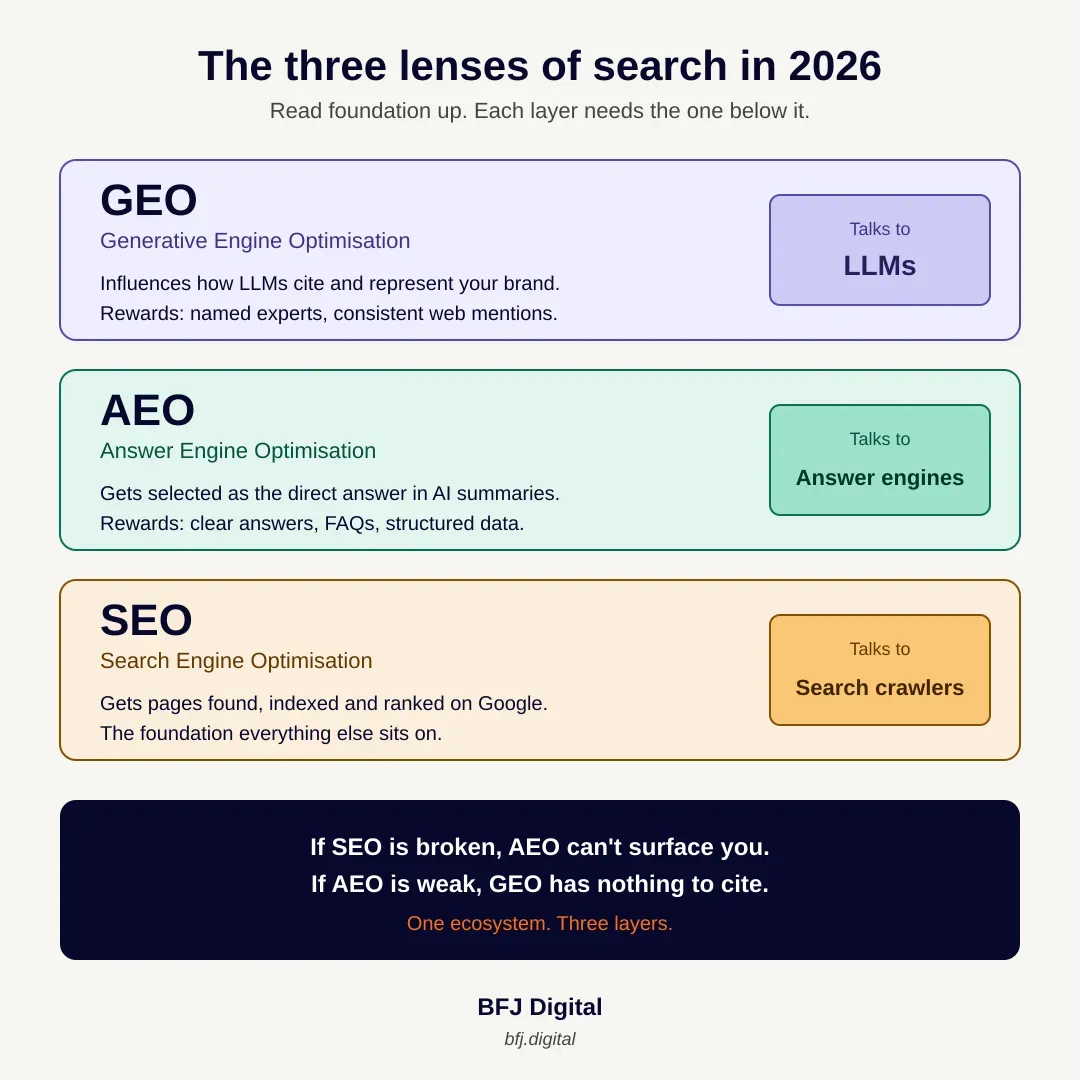
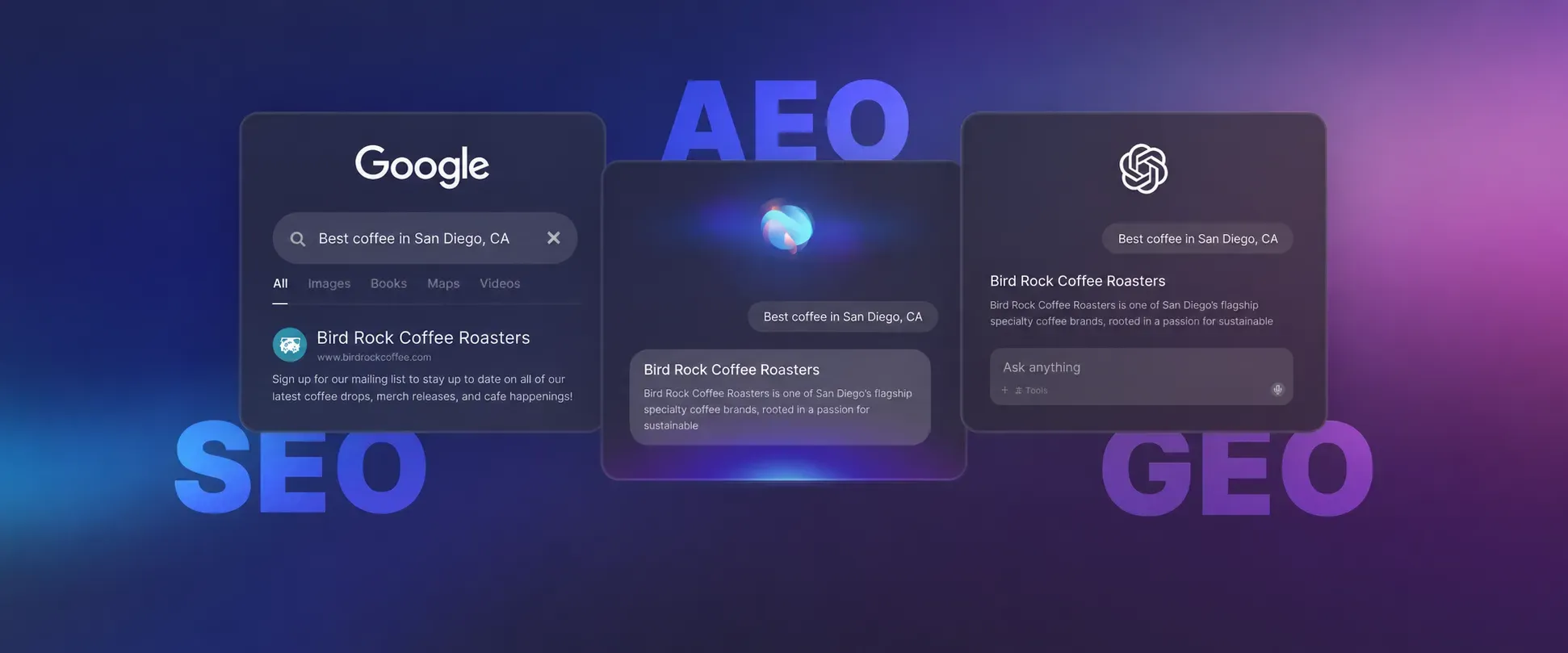
The acronyms are easy to confuse. They sit on top of each other, and they each talk to a different audience.
- SEO (Search Engine Optimisation) is the work of getting pages found, indexed and ranked in traditional search results. It talks to search engine crawlers. Most discovery still starts on Google, and technical health, crawlability and structure remain non-negotiable. SEO is the foundation everything else sits on.
- AEO (Answer Engine Optimisation) is the work of structuring content so it gets selected for AI Overviews, featured snippets, voice results and home-device responses like Alexa and Siri. It talks to answer engines. It rewards clear, scannable answers, question-led headings, defined terms and clean structured data. Siri, for what it's worth, still pulls a lot of its local data from Yelp, which is part of why directory and aggregator signals matter more than most marketers realise.
- GEO (Generative Engine Optimisation) is the work of influencing how large language models like ChatGPT, Claude, Gemini and Perplexity understand, cite and represent a brand. It talks to LLMs. It rewards recognised expertise tied to named people, consistent mentions across the wider web, and clear factual writing that is easy to summarise.
Different LLMs train on different sources. ChatGPT leans heavily on user-generated content from places like Reddit, LinkedIn and forums. Claude and others tend to weight high-authority government and education domains more. That changes where visibility work pays off.
Here is the stack, foundation up:
- SEO: findable, indexable, technically sound.
- AEO: selected as the direct answer in AI Overviews and snippets.
- GEO: present and cited inside LLM-generated answers.
If SEO is broken, AEO cannot surface you. If AEO is weak, GEO has nothing to cite. None of these are separate retainers in any sensible sense. They are layers of the same job.
The four shifts changing search in 2026
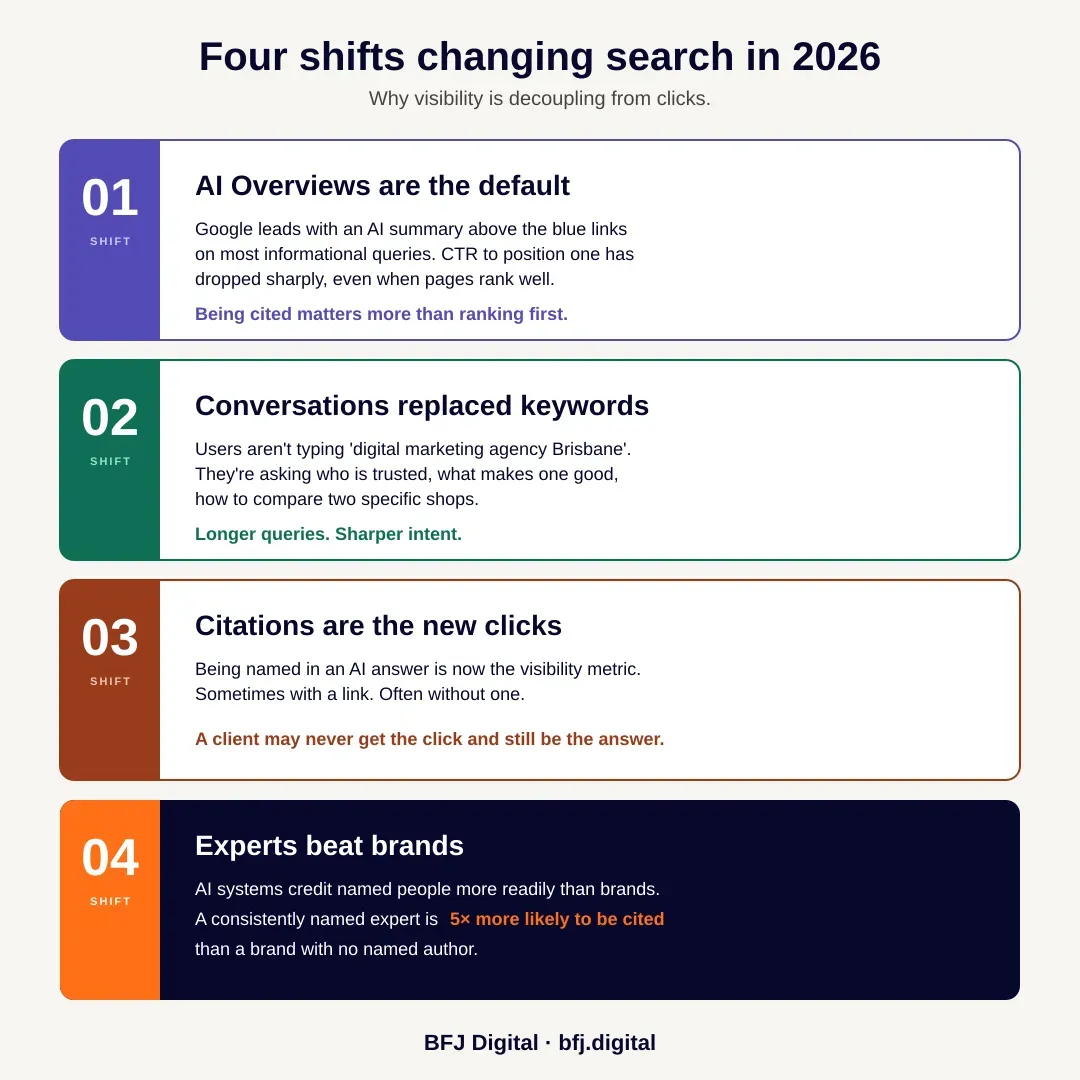
Four things have changed in practice. Each one has commercial consequences.
AI Overviews are the default
Google now leads with an AI summary above the blue links on most informational queries. Click-through rate to position one has dropped sharply, even when the page ranks well. AI Overviews can also surface content from pages ranking on page two, three or four if the content directly answers the intent. Ranking number one matters less. Being cited matters more.
Conversations have replaced keywords
Users are not typing 'digital marketing agency Brisbane' any more. They're asking who is a trusted digital marketing agency in Brisbane, what makes a good one, how to compare two specific shops. The query is longer, more specific and more revealing of intent. That changes which content gets selected.
Citations are the new clicks
Being named in an AI answer is now the visibility metric. Sometimes that comes with a link. Often it does not. A client may never get the traffic and still be the answer.
Experts beat brands
AI systems credit named people more readily than corporate entities. Author identity is doing real work in selection. Someone consistently associated with a topic across the web is roughly five times more likely to be cited on that topic than a brand with no named author behind the content. The flipside: AI-generated content without expert oversight is increasingly easy to spot and discount, which is part of why authored content carries more weight.
The net effect: visibility is decoupling from clicks. Around 60% of Google searches now end without a click. Reporting on AI visibility is still catching up. ChatGPT, to its credit, automatically tags links it sends to external sites with UTMs, so referral data is starting to appear in analytics. For now, the right answer for most clients is to build the foundations, generate the citations, and measure visibility in ways that are not solely traffic-based.
There is a commercial point hiding inside this shift. If AI Overviews answer the informational question before the user clicks, the click-through-rate value of ranking on broad informational keywords is shrinking. The keywords still worth chasing are the higher-intent ones, where the user needs to verify, compare or transact. Content investment should follow accordingly. Stop writing thin explainers that AI Overviews will simply absorb. Invest in pieces that earn the citation and pull qualified users through to a decision.
Authority over volume: why entities beat pages
In traditional SEO, pages rank. In AEO and GEO, entities get cited.
An entity, in this context, is one of three things:
- A person: a named partner, specialist, founder or expert.
- A business: the firm or brand itself.
- A concept: the topic, service or domain.
The question AI is asking on every query is simple: who is a credible source on this topic? It looks for repeated, consistent association between an entity and a topic across multiple credible sources.
That changes content strategy in a few practical ways:
- Fewer, better articles beat dozens of thin posts.
- Real expertise beats keyword-optimised filler.
- Demonstrated experience beats claims of authority.
- A specific point of view beats a generic explainer.
- Depth on a few topics beats breadth across many.
For most businesses, the entity build-out runs in the opposite order to what people expect. Most clients should start with the concept (the service or topic), build out the business entity, and only then layer in named-person entities. Personal-brand-led firms are the exception, not the rule. Every business still benefits from at least one named expert tied to each major topic.
A useful test before publishing: can a reader (or an AI) tell who is qualified to be writing this, and what the writer's actual experience is? If not, the content is unlikely to be cited.
How author authority compounds
Author authority is built through repetition of association. AI systems get more confident about an expert the more consistently they see that expert associated with a topic. Four steps build it on-site.
- Assign topics. Every key topic the business wants to be known for has a named expert behind it. Not a list of five people. One clear lead.
- Use named bylines. Author name, role and area of expertise on every article. Author schema, author pages and consistent attribution all reinforce the signal.
- Reinforce internally. Articles link to expert profile pages. Expert profiles list the articles. Internal linking patterns make the relationships explicit so AI systems don't need to infer them.
- Reinforce externally. Industry contributions, panels, quotes, partnerships, podcast appearances and any external mention all feed back into the entity's authority.
A word on tone. Authority is implied through demonstrated experience, not exaggerated through claims. Writing 'we are the leading experts in' is a marketer's voice. Writing 'in practice, we often see business owners delay succession planning because day-to-day operations take priority' is an advisor's voice. The second signals expertise. The first signals insecurity.
Off-site signals: where authority actually lives
The website is where you control the message. The wider web is where AI builds confidence in the message. Both matter.
Four categories of off-site signal carry the most weight in 2026:
- Industry contributions: bylined articles, columns or commentary in respected publications inside the client's vertical.
- Quotes and commentary: even short 'X comments on Y' mentions reinforce expertise over time.
- Event presence: panels, webinars, conferences and podcasts where the expert speaks on the record.
- Associations and partners: professional bodies, advisory boards and recognised collaborations.
Reviews count too. Google Business Profile reviews are an external trust signal, not just a sales asset. Aggregator sites like Clutch, Yelp, Yellow Pages and similar directories carry disproportionate weight because they have spent two decades collating verified business data.
Underneath all of this is what we'd call cooperative data. When the same business information appears consistently across multiple credible sources, the same name, the same address, the same described services, the same authors, AI systems treat that consistency as a trust signal. When the data conflicts, the confidence drops. The basics still matter. Domain age, a real physical address, accurate NAP data across directories, the same biography on the website and on LinkedIn. Boring fundamentals, but they feed the model.
AI systems look at where else a person or business appears. Build the web of references around them and let the repetition do the work.
Writing for the answer era: voice and structure
If a human can quickly understand it, the machines can too. The structure that wins now is also the structure that helps real readers.
Use this structure on every long-form piece
- Key takeaways at the top of the page, three to four bullets.
- Opening context: what is the issue and why does it matter now.
- Explanation: break the concept down logically, no jargon.
- Practical guidance: next steps a reader can actually take.
- FAQs: three or four real client questions, answered briefly.
A useful rule: each paragraph should make sense if read on its own, out of context. LLMs surface paragraphs and sentences, not whole articles. If a paragraph only works when read in sequence, it is harder to pull as an answer.
Write like an advisor, not a marketer
Advisor voice: "In practice, we often see business owners delay succession planning because day-to-day operations take priority. Unfortunately, this can limit options later."
Marketer voice: "We deliver market-leading, best-in-class estate planning solutions for discerning business owners across regional Australia."
The first gets read, gets remembered, gets cited. The second is wallpaper.
Avoid generic AI-style filler. Phrases like 'in today's ever-changing landscape' or 'in the fast-paced world of' signal that the content was generated, not written. Avoid sales-led CTAs disguised as content. Avoid 'Overview' or 'Introduction' as headings. They tell the reader (and the LLM) nothing.
The implementation playbook
What this looks like in practice, ordered by effort.
Phase 01: quick wins, this quarter, on-site
- Add author bylines to every article. Name, role, area of expertise.
- Link articles to author profile pages, not to LinkedIn.
- List each expert's articles on their profile page.
- Add a 'what they commonly see' section to expert bios. It reads as advisory experience, not marketing puff.
- Restructure existing top-performing pages with key takeaways at the top and FAQs at the bottom. Some of the biggest visibility gains come from reworking content that already ranks.
- Add author schema, FAQ schema and organisation schema where they are missing.
Phase 02: the longer play, six to twelve months, off-site
- Place expert commentary in industry publications.
- Pitch experts as podcast and panel guests.
- Build profiles on relevant professional bodies and advisory boards.
- Develop original research, even small in scope, that is worth citing.
- Diversify the review profile across Google, industry directories and trusted aggregators.
- Identify and earn placements in listicle-style pages relevant to the client's category.
Where a client has weak technical foundations, the only sensible work is to fix those first. There is no point talking about brand mentions in ChatGPT to a business whose site is not crawlable. Once the foundations are in place, the off-site authority work becomes the next investment.
What to measure when clicks are not the goal
Reporting is the hardest part of the shift. Visibility is showing up in places that don't always send a click, and the tools haven't caught up. A workable interim setup includes a few moving parts.
- Tracked AI referrals. ChatGPT auto-tags outbound links with UTMs. Pin those in GA4 and watch the volume trend, even if it's small today.
- Branded search trends. If citation work is doing its job, branded search volume should lift over time. Google Search Console branded query impressions are a useful proxy.
- Manual citation audits. Run target prompts in ChatGPT, Claude, Perplexity and Gemini monthly. Note which brand and which experts get named. Track movement quarter over quarter.
- Lead quality signals. Self-reported attribution at form submission ('how did you hear about us?') is unscientific but cheap, and it catches AI sources that don't show in analytics.
- Share of voice in listicles and aggregator pages. Audit the 'top 10' style pages in the client's category. The ones that get cited inside AI Overviews are the leverage points worth earning a place on.
None of these are perfect. Together they describe a visibility picture that traffic alone does not.
Where this leaves you
Search has not become harder. It has become more honest. The brands that get cited in 2026 are the ones with real expertise, named experts, structured content and a web of credible mentions around them. Volume of content matters less. Authority matters more.
For most businesses, the work is not new. It is the same SEO, content and PR work that has always built credibility. The difference is that AI systems are now reading the signals more carefully than ever. Get the foundations right, name the experts, write like an advisor and measure visibility on its own terms. That is the playbook. For more on how this is playing out across digital marketing, browse the BFJ Digital Insights library.
FAQs
Is SEO dead?
No. SEO is the foundation everything else sits on. Without strong technical SEO, AEO and GEO have nothing to surface. What has changed is the success metric. Position one matters less. Being cited matters more.
Should I stop measuring traffic?
No, but stop measuring traffic alone. Traffic still indicates demand and intent. Visibility, citations, branded search and lead quality are where the new value is showing up. Build a reporting view that includes both.
Which AI tool should I optimise for?
Optimise for the user, not the tool. Each LLM weights different sources, but the underlying signals are the same: strong technical SEO, structured content, named experts, off-site mentions and consistent topic association. Do that work well and you appear across the major models.
How long does it take to get cited in AI Overviews?
There is no fixed timeline. AI Overviews can surface content from pages ranking below the first page if the content directly answers the intent. For most clients we work with, citation patterns start to shift within two to four months of restructured content and author entity work going live.
Can you game AI search the way people gamed early SEO?
People are trying. Some are temporarily succeeding. Operators have already been caught spinning up networks of AI-generated sites to push themselves into citations, and the major platforms are catching up quickly. The pattern is cyclical. Every new layer of search invites a wave of gaming, then a correction. The businesses that come out ahead are the ones investing in genuine expertise, named experts and credible off-site presence. That work compounds. Short-cuts get cleaned up.
Sarah Halliday
Sarah Halliday is a Digital Account Manager at BFJ Digital, bringing ten years of experience across digital marketing, SEO, client management, and project delivery. Based in Brisbane, Sarah specialises in helping clients connect marketing performance to tangible business outcomes through strategic planning and execution.
Her career progression demonstrates her versatility and expertise, having previously served as an SEO Specialist and Account Manager, where she developed strategies that improved visibility, traffic, and conversions for diverse client portfolios. Earlier roles included Digital Marketing Manager, Client Marketing Manager, and Digital Projects Manager, where she coordinated websites, SEO initiatives, and creative deliverables across multiple concurrent projects.
Sarah's dual degree in Business and Creative Industries, with concentrations in Marketing and Art History and Design, provides her with a unique perspective that combines analytical rigour with creative thinking.
Known for her strong work ethic and people-first approach, Sarah excels at bridging technical execution with meaningful client relationships. Her professional interests span SEO, digital strategy, client engagement, and sustainable business growth, making her an invaluable partner for clients seeking both strategic insight and reliable project delivery.
Ready to See the Bigger Picture?
Want to understand how your digital and real-world marketing impact each other? Not sure if your CRM is supporting your paid media efforts? Just need some clarity and a clear plan to better ROI? Book your free strategy session today for an in-depth audit and action plan to double your digital marketing ROI.
- Meet with a strategy specialist to build a growth plan
- Increase your media performance by up to 200%
- Improve business efficiencies to increase ROI via automation and increase profit
- We cut to the chase. What digital marketing is actually working?