The Problem With Running Separate Agencies for Each Marketing Channel

Sarah Halliday
Digital Account Manager at BFJ Digital

Keep ahead of the curve via our latest trends newsletter.
Contact us nowKey takeaways
- Strong channel results do not always add up to strong overall marketing performance.
- Customers move across multiple touchpoints, so strategy, measurement and budget decisions need a connected view of the full journey.
- Platform-reported conversions should be reconciled with CRM data, lead quality, sales and actual revenue.
- Multiple agencies can work well when responsibilities are clear, data is centralised and one person or team owns the overall commercial result.
- Consolidation should address a genuine performance or coordination problem. The right solution may involve fewer agencies, a lead agency or stronger internal governance.
Running a different agency for every marketing channel can make sense at first. You hire specialists for SEO, Google Ads, social media, programmatic, web development and other areas as the business grows. The problem often starts when each agency works towards its own strategy, targets and reporting.
That separation might work behind the scenes, but it doesn’t reflect how people actually interact with your business. A customer might discover you through a Meta ad, search for you on Google, visit your website, see a retargeting ad and return later through organic search before making an enquiry.
It’s one customer journey, spread across several channels. And when different agencies manage those channels separately, it becomes much harder to see how they are working together, where your budget is having the most impact and what is actually driving the result.
When specialist agencies start creating marketing silos
Specialist agencies exist for a good reason. Paid search, technical SEO, paid social, programmatic and CRM are deep disciplines that reward focus. A team working on Meta all day will usually run a better Meta account than a generalist who touches it once a fortnight. Buying that depth is a reasonable decision, and for many businesses it is the right one.
The trouble is that depth in a channel is only a channel-level answer to a business-level problem. Marketing is planned and reported channel by channel. It is experienced by the customer as one thing.
As soon as the operating model splits along channel lines, the boundary between agencies becomes the boundary between decisions. The SEO agency plans against its own targets. The paid search agency plans against its own. Their plans are almost never on the same page when they are being written, because the two teams have never been asked to sit in the same room. Neither is wrong at their level. But neither is looking at the whole either.
The commercial cost of a fragmented marketing operation
Channel KPI conflicts
Every specialist agency optimises to the KPIs it controls, because that is what its contract is written against. For instance, the SEO agency chases rankings and non-brand organic leads. The paid search agency chases conversions and ROAS inside Google Ads. The paid social agency chases in-platform conversions and cost per lead. The media agency chases delivery, viewability, brand safety and reach curves.
All of those numbers can be healthy while the blended cost of acquisition is climbing and revenue growth is flat, because each agency is measuring a slice rather than the outcome.
Branded search is the clearest example. A well-run brand campaign on YouTube and Meta lifts searches for the company name. The paid search agency then reports strong branded conversions at low cost, because branded queries are cheap to win and almost always convert.
If nobody stitches the two together, the paid search performance reads as an SEM win when it is largely a brand story. The budget follows the reporting. The awareness campaign gets cut. Branded search volume softens a quarter later. Paid search performance follows it down, and nobody quite knows why.
Attribution becomes political
Platform-reported performance is not the same as business performance. Google, Meta, display and other platforms can all claim the same conversion, making individual channels look stronger than they really are.
The problem comes when those numbers drive budget decisions. Spend gets shifted towards channels reporting the best return, even when several platforms may be taking credit for the same revenue.
It also makes reporting harder. Marketing reports strong results, but the numbers don’t match actual leads, sales or revenue. Finance can’t reconcile them, and marketing managers are left explaining the difference.
A better approach is to use one source of truth and agreed attribution rules across every channel. Revenue attribution helps connect marketing spend to actual revenue, so budget decisions are based on business results rather than platform claims.
The data does not connect
A fragmented agency model often creates fragmented data. Each agency may use different conversion definitions, tracking setups and reporting tools. CRM and offline sales data may also sit separately from advertising platforms.
That makes it difficult to answer basic commercial questions: What did we spend? What revenue did it generate? Where should we invest next?
It can also affect campaign performance. If CRM data isn’t fed back into advertising platforms, campaigns may optimise for the highest number of leads rather than the leads most likely to become customers.
A consistent first-party data strategy helps connect customer and performance data across channels. Where that requires a CRM build or extension, the same principle applies: someone needs to own the integration across the whole marketing system.
This is a common attribution challenge. Ruler Analytics reports that almost half of marketers see cross-channel customer journeys as their biggest attribution barrier, while almost a third point to siloed data.
Budget decisions stall
In a fragmented model, budget decisions become a negotiation between agencies rather than a business decision. Each is defending its own patch, which is what a channel specialist is meant to do.
The person allocating the budget has almost no basis on which to compare them because channel-level reports do not translate into commercial contribution. The default is to keep the spend where it was, or move it toward the loudest advocate. That is a compromise dressed as a strategy.
Duplication that never shows on any invoice
Fragmentation is not automatically expensive on the invoice line. Where the cost stacks up is duplication that never appears on any single one:
- Strategy work being done by more than one agency, in slightly different frames, without either being definitive
- Account management, weekly meetings and monthly reporting duplicated across three or four suppliers
- Reporting infrastructure and tracking setups rebuilt in each agency's preferred format, often with conflicts
- Creative briefed and produced in parallel workflows that do not share assets
- Client-side coordination time, which is often the biggest hidden cost of the lot
The hidden cost: your marketing team becomes the middleman
This is one of the biggest hidden costs of running multiple agencies: someone on the client side has to keep them all connected.
That job usually falls to the marketing manager, head of marketing or CMO. They become the link between SEO, paid media, social, content, web and internal teams. They chase briefs, resolve campaign clashes, reconcile reporting and make sure everyone is working to the same calendar.
The more agencies involved, the more time this coordination takes. A week can quickly fill with status meetings, follow-ups and reporting, leaving less time to step back and look at what the business actually needs from marketing.
You won’t see that cost on an agency invoice. You see it in slower decisions, missed opportunities and strategic work that keeps getting pushed back.
Why good channel results do not always mean good marketing results
Channel results measure the performance of one channel against the goals set for that channel. Marketing results measure the performance of the whole system against the commercial goals set for the business. The two can move in different directions.
A paid search account can hit its ROAS target while blended CAC across the business rises, because paid search is farming demand generated by other channels. The same account can hit its ROAS target while profit is going backwards, because ROAS treats every dollar of revenue the same and ignores margin. That is one of the reasons profit on ad spend has become the sharper metric to run against at a board level. An SEO account, meanwhile, can grow organic sessions while organic revenue flattens, because the traffic being won is the wrong kind.
The board is rarely helped by a report that adds up ten channel views. What it needs is a single commercial view. Total marketing investment. Total pipeline and revenue generated, with the marketing contribution measured against a defensible attribution position. Blended CAC (Client Acquisition Cost). A view on where the next marginal dollar should go.
Building that view is a systems job. It requires connected analytics, a defined attribution model, agreed conversion definitions and CRM data flowing back into media platforms. Tools like BFJ Labs exist because no single ad platform will ever produce this view on its own.
Is it bad to use multiple marketing agencies?
Not automatically. Multiple specialists work well when the business has built the conditions for them to work well. Those conditions include a sophisticated internal marketing team that can hold overall strategy, a centralised measurement layer that every agency feeds into, clearly documented roles including who owns what data, and a single person client-side who is accountable for the blended commercial outcome.
Some categories of work will almost always benefit from a genuine specialist. Deep technical SEO on a very large site. Programmatic execution at national scale. Complex CRM builds. Regulated categories with unusual creative constraints.
The distinction that matters is not the number of agency logos on the invoice. It is how integrated the operation is as a whole. Two agencies that share commercial goals and sit on the same measurement stack can outperform six agencies that are all quietly optimising away from each other.
Signs your agency model has become too fragmented
Use this as a working diagnostic. Not every item will apply.
- The agencies you work with rarely, if ever, speak directly to each other
- Monthly reports from different agencies present numbers that do not reconcile
- More than one platform or supplier is claiming the same conversion
- Nobody in the business can confidently state your true blended cost of customer acquisition
- Lead quality data from sales or CRM is not flowing back into the media accounts
- The website team ships changes that break conversion tracking, and it takes weeks for anyone to notice
- SEO landing pages differ from paid landing pages for the same query without a deliberate reason
- Creative and messaging is inconsistent across paid social, paid search and email
- Budget allocation is driven by whichever agency argued hardest in the last quarterly
- No single person is accountable for the blended commercial outcome
- Your internal team spends a material share of its week coordinating suppliers rather than shaping strategy
If four or more ring true, the model has drifted. That does not automatically mean consolidating. It does mean the integration layer needs attention.
What integrated marketing should actually look like
Before jumping to "hire an integrated agency", describe the operating model. Any business can build toward this with any mix of internal team and external partners.
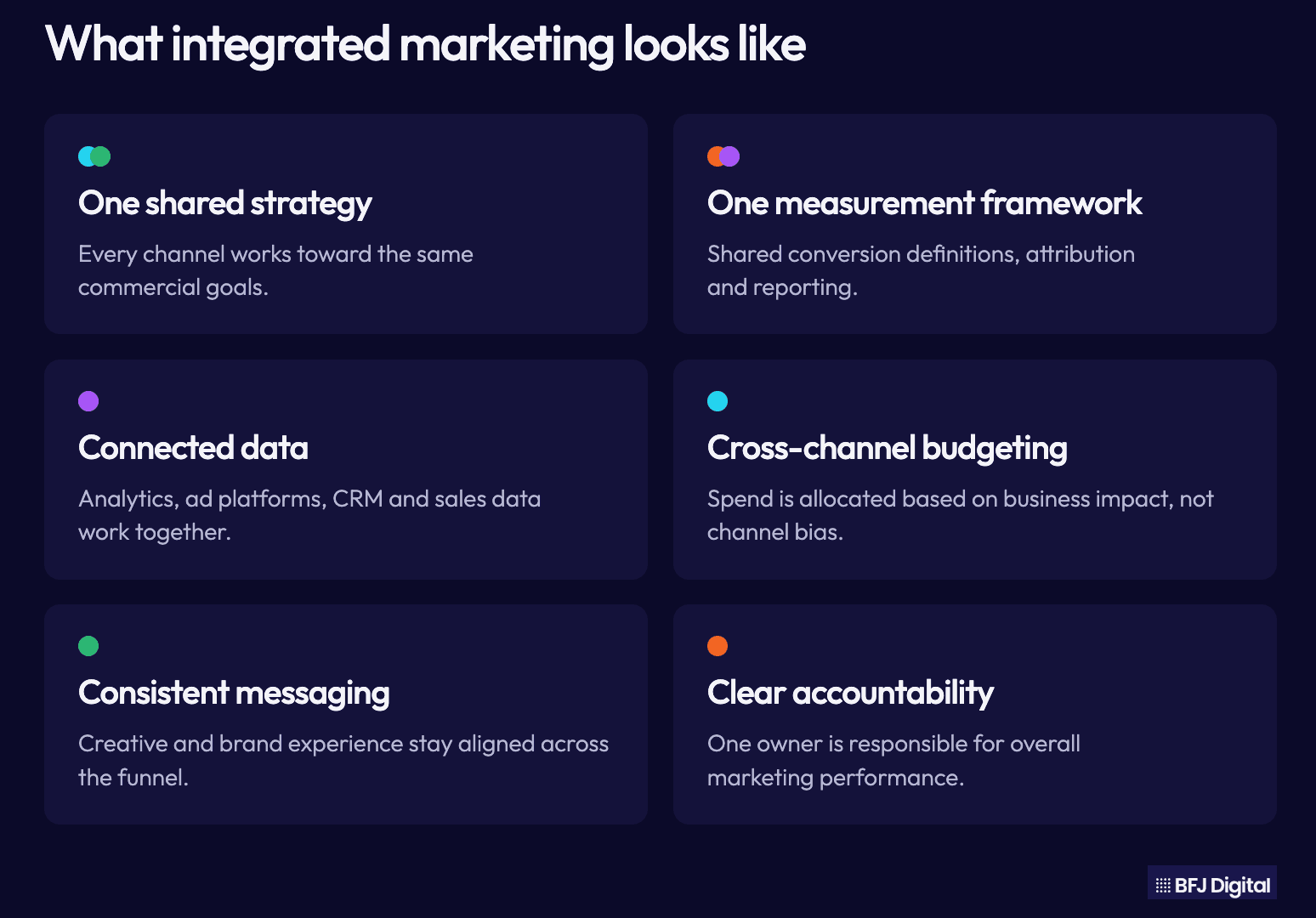
A connected marketing operation, at a minimum, has:
- One overarching commercial strategy that all marketing activity ladders back to
- Consistent measurement across channels, including shared conversion definitions and an agreed attribution position
- Connected data plumbing between analytics, ad platforms, CRM and, where relevant, the point of sale
- A cross-channel budgeting process that compares channels on their commercial contribution rather than on their own reports
- Coordinated creative and messaging, so the customer meets a recognisable brand across the funnel
- One clear owner of the overall performance number
The business should be able to answer three questions at any point. What did we spend last month? What did it generate? Where should the next dollar go? A marketing operation that can answer those questions well is integrated, regardless of how many agencies are in the picture. One that cannot is not, no matter how many logos are on the invoice.
BFJ's omnichannel approach is built around that operating model.
What is an integrated digital marketing agency?
An integrated digital marketing agency plans, executes and measures across multiple digital channels from a single strategy and a single measurement layer, rather than operating each channel in isolation. In practice, that usually means combining paid search, paid social, SEO, content, email or CRM, and often web and analytics work, inside one team accountable for a shared commercial outcome.
The label matters less than what it describes. A single agency that runs channels in walled-off teams with different KPIs is not meaningfully integrated. A pair of agencies that share a commercial goal and a measurement stack can be. Look at the operating model, not the label.
When should you consider consolidating your marketing agencies?
Consider it when the cost of client-side coordination has grown to the point where it distorts the marketing leader's role. When several agencies are duplicating strategy, reporting or account management, and the invoice line has quietly become material. When the measurement problem cannot be solved without moving the data layer under one accountable owner. When the channels being run are close enough in mechanic that separating them is creating friction.
Hold off when an existing specialist is genuinely outperforming and the fix is a better integration layer, not a replacement. Hold off when the business does not yet have a commercial strategy for a consolidated partner to execute against. Hold off when incumbents are open to working differently and the coordination problem can be solved with better process and better data plumbing.
A short structured review is usually the right first step. It should look at total marketing spend, the contribution of each channel and supplier, the state of the measurement infrastructure, and the time cost of coordination. It should not start from the assumption that the answer is fewer agencies. A digital marketing audit run against the question of what operating model would produce the strongest commercial result is a useful shape for it.
Bringing the channels back together
The point of all of this is not that marketing should be run by one agency. It is that marketing should be run as one operation.
If reading this has surfaced a few too many familiar signs, the useful next step is not to fire anyone. It is to look at the operating model honestly, ask where fragmentation has taken hold, and decide what changes at the integration layer would produce the biggest lift.
BFJ works with businesses that have reached this point and want a commercial view of what their marketing operation is actually producing. We build the measurement, connect the data and coordinate the channels around the outcomes the business cares about. Where a specialist is doing excellent work, we work with them. Where consolidation makes sense, we take the work on.
For a quick read on where your operation sits, the digital marketing maturity assessment is a short self-diagnostic. Our wider digital marketing services show how we bring the channels back together from there.
Sarah Halliday
Sarah Halliday is a Digital Account Manager at BFJ Digital, bringing ten years of experience across digital marketing, SEO, client management, and project delivery. Based in Brisbane, Sarah specialises in helping clients connect marketing performance to tangible business outcomes through strategic planning and execution.
Her career progression demonstrates her versatility and expertise, having previously served as an SEO Specialist and Account Manager, where she developed strategies that improved visibility, traffic, and conversions for diverse client portfolios. Earlier roles included Digital Marketing Manager, Client Marketing Manager, and Digital Projects Manager, where she coordinated websites, SEO initiatives, and creative deliverables across multiple concurrent projects.
Sarah's dual degree in Business and Creative Industries, with concentrations in Marketing and Art History and Design, provides her with a unique perspective that combines analytical rigour with creative thinking.
Known for her strong work ethic and people-first approach, Sarah excels at bridging technical execution with meaningful client relationships. Her professional interests span SEO, digital strategy, client engagement, and sustainable business growth, making her an invaluable partner for clients seeking both strategic insight and reliable project delivery.
Ready to See the Bigger Picture?
Want to understand how your digital and real-world marketing impact each other? Not sure if your CRM is supporting your paid media efforts? Just need some clarity and a clear plan to better ROI? Book your free strategy session today for an in-depth audit and action plan to double your digital marketing ROI.
- Meet with a strategy specialist to build a growth plan
- Increase your media performance by up to 200%
- Improve business efficiencies to increase ROI via automation and increase profit
- We cut to the chase. What digital marketing is actually working?