Model Context Protocol (MCP): What It Means for Marketing, and How we Use It in BF J Labs

Ben Henzell
Owner at BFJ Digital
Keep ahead of the curve via our latest trends newsletter.
Contact us now
Three years ago we started building BFJ Labs, our own marketing intelligence platform. The problem was simple to describe and hard to fix: clicks, calls, leads and revenue sat in different systems, and nobody could see them together without days of manual work.
Labs now pulls data from more than 13 marketing platforms, checks it every night and links it back to revenue. This year we added an MCP server, so our team can ask Labs questions in plain English and get answers from live data.
This post explains what MCP is and how it works. It also covers what building Labs has taught us about AI in marketing, and why it has made our people more valuable, not less.
What does MCP stand for?
MCP stands for Model Context Protocol. It's an open standard for connecting AI assistants to outside tools and data.
The model is the AI, like Claude or ChatGPT. Context is the information it needs to do the job. Protocol is the set of rules for how they talk to each other.
Anthropic released MCP in November 2024. Google, Microsoft, HubSpot, Slack, Atlassian and hundreds of others now run MCP servers for their products.
What is MCP?
MCP is a standard way for AI to connect to the software your business already uses.
Before MCP, every connection between an AI tool and a platform was a custom build. Google Ads needed one. HubSpot needed another. Ten platforms meant ten integrations to build and maintain.
With MCP, a platform builds one server. Any AI app that supports MCP can use it.

Does MCP replace APIs?
No. An API (application programming interface) is how one piece of software talks to another. Google Ads has one. Meta has one.
An MCP server sits on top of the API. It tells the AI what the platform can do and passes requests through. The API still does the work.
How does MCP work?
There are three parts.
- Host. The AI app you're using, such as Claude or ChatGPT.
- Client. The part of the host that manages each connection. You won't see it.
- Server. Runs on the platform's side. It lists what the AI can do and handles requests.

A server can give the AI three things:
- Tools. Actions, like pulling campaign spend or creating a CRM deal.
- Resources. Information to read, like files or records.
- Prompts. Saved instructions the server provides.
For marketing, tools matter most. They let AI work with your actual data, not talk about data in general.
What happens when you ask a question?
Take the question: "Which campaigns drove the most phone calls last month?"
- The AI recognises it needs live data.
- It checks which MCP tools are connected and picks one.
- It sends the request to the MCP server.
- The server gets the numbers from the platform.
- The AI reads the result and answers.
MCP doesn't do any thinking. The AI decides which tool to use and what the result means. MCP only provides the connection. That matters when things go wrong, which we cover below.
Connecting AI is easy. Trustworthy data is hard.
Most major marketing platforms now run their own MCP server. Meta launched one in April 2026. Google has one for Google Ads and one for GA4. You can connect Claude to any of them in minutes.
What you get back is each platform's own version of events. Google Ads claims the sale. Meta claims it too. GA4 credits something else. None of them see the phone call that closed the deal, or the CRM record that shows what it was worth.
That gap is what BFJ Labs exists to close. It's taken three years to build, and it's the reason the rest of this post is about more than plugging in tools.
Why MCP matters for marketing
Most MCP content is written for developers. The bigger change is in how marketing decisions get made.
A typical mid-sized business runs Google Ads, Meta, GA4, a CRM, call tracking, Search Console and Google Business Profile. Each has its own login and its own numbers. Every report means someone exporting CSVs and stitching them together. We covered the cost of that split in The Problem With Running Separate Agencies Per Channel.
MCP changes three things.
Answers come faster. You ask a question and the AI pulls live numbers. No waiting for the monthly report.
Cross-channel questions get practical. Did the Meta campaign lift branded search? That needs Meta and Search Console together. With MCP, the AI can query both.
The report stops being the product. When anyone can query the data, the value is in what you do with the answer.
Which marketing platforms have MCP servers?
As of September 2026:
- Google Ads MCP. Google's official server. Campaigns, keywords, spend.
- Meta Ads MCP. Meta's hosted server, launched April 2026. Facebook and Instagram campaigns.
- Google Analytics (GA4) MCP. Google's official server. Sessions, conversions, events.
- HubSpot MCP. HubSpot's hosted server. Contacts, deals, pipeline, email.
- DataForSEO MCP. DataForSEO's official server. Rankings, SERPs, keyword volumes.
- Slack, Google Drive, Notion, Canva, Figma. Where your team works.

AI agents for marketing
An AI agent is AI that takes steps on its own. It checks something, makes a call, then acts.
An agent is limited by what it can reach. Without connections, it writes general advice about campaign optimisation. Connected through MCP, it can look at your campaigns and show which keywords are wasting budget.
Marketing tools will increasingly be judged on how well they connect to AI, not on their dashboards.
What MCP doesn't do
It doesn't fix bad data. If your tracking is wrong, MCP reports the wrong numbers faster.
It doesn't solve attribution. Google Ads, Meta and GA4 will each claim the same conversion. MCP shows all three claims. It doesn't tell you which is right. That needs proper revenue attribution and someone who understands it.
It doesn't replace judgement. AI can be confidently wrong. The most common case we see: a tool returns an empty result and the AI reports it as zero. Someone needs to know when an answer doesn't add up.
We built Labs with those three limits in mind.
What it took to build BFJ Labs
Labs has taken three years of planning, building and rebuilding. From the outside it looks like a dashboard with an AI chat on top. The AI is the smallest part of it.
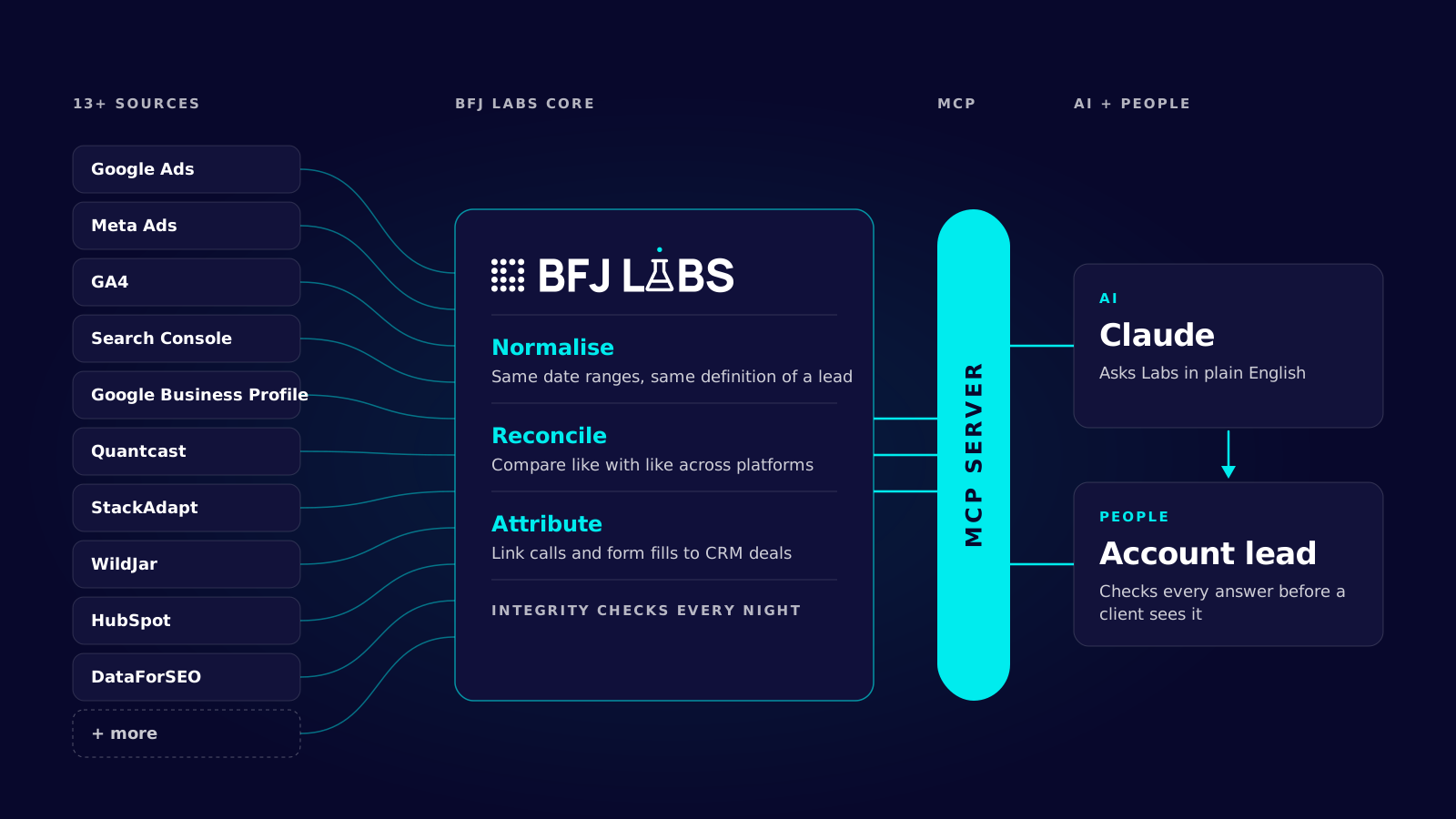
Connecting the platforms. Labs pulls from Google Ads, Meta, GA4, Search Console, Google Business Profile, Quantcast, StackAdapt, WildJar, HubSpot, DataForSEO and more. Each has its own API, its own way of logging in, and its own limits on how much data you can pull and how fast. Google and Meta retire API versions on a regular schedule, so connections we built early on have been rebuilt more than once.
Every account is different. No two clients have their ad accounts, analytics and CRM set up the same way. Some sit under our manager accounts and some don't. Time zones, currencies and naming conventions all vary. Every new client means mapping their accounts properly before we trust a single number.
Making the numbers agree. Google Ads, Meta and GA4 each count conversions their own way, so a lead in one platform isn't a lead in another. Labs reconciles them so we compare like with like, then links calls and form fills through to deals in the CRM.
Monitoring, every day. Syncs fail, tokens expire, and platforms rename fields without warning. Labs runs integrity checks every night and our team watches sync health daily. Most of the work on Labs isn't new features. It's keeping what's already there accurate.
It keeps growing. Over time we've added AI search visibility tracking, competitor ad monitoring, a page-by-page SEO inventory for every client site, and now the MCP server. Every addition is more data to connect, check and maintain.
Security. Labs now holds more than 20 million rows of marketing data across nearly 300 database tables. Access is scoped to each client, and the team treats every connection as a live credential.
MCP sits on top of all of that. It's the newest part of Labs, and the only part someone else could copy in an afternoon.
Never finish with AI
BFJ's mandate is "never finish with AI". AI can start the work: pull the data, draft the first cut, spot the pattern. A person finishes it.
Every report, campaign change and recommendation that leaves BFJ has been checked by someone who knows the client, knows the numbers and is accountable for the result.
The same rule applies to Labs. When Claude answers a question from Labs data, the answer goes to an account lead as a starting point. It doesn't go to a client unread.
Will AI replace digital marketers?
No. Building Labs has convinced us of that more than anything else.
AI has made our team faster. Questions that took a morning now take minutes. But every hour it saves gets spent on work it can't do:
- deciding what matters to this client this month
- knowing a number is wrong when it looks fine
- telling a client something they don't want to hear
- weighing budget, brand and timing against each other
- owning the outcome
The marketers at risk are the ones whose job was moving numbers from a platform into a slide. The ones who understand the business, question the data and make the call have never been more useful.
Labs is the most technical thing we've built. It has made our people better at their jobs, and just as important as they were before it existed.
How our team uses Labs with MCP
Our team connects Claude to Labs alongside HubSpot, so one conversation reaches paid, organic, SEO and CRM data.
Google Ads and Meta Ads
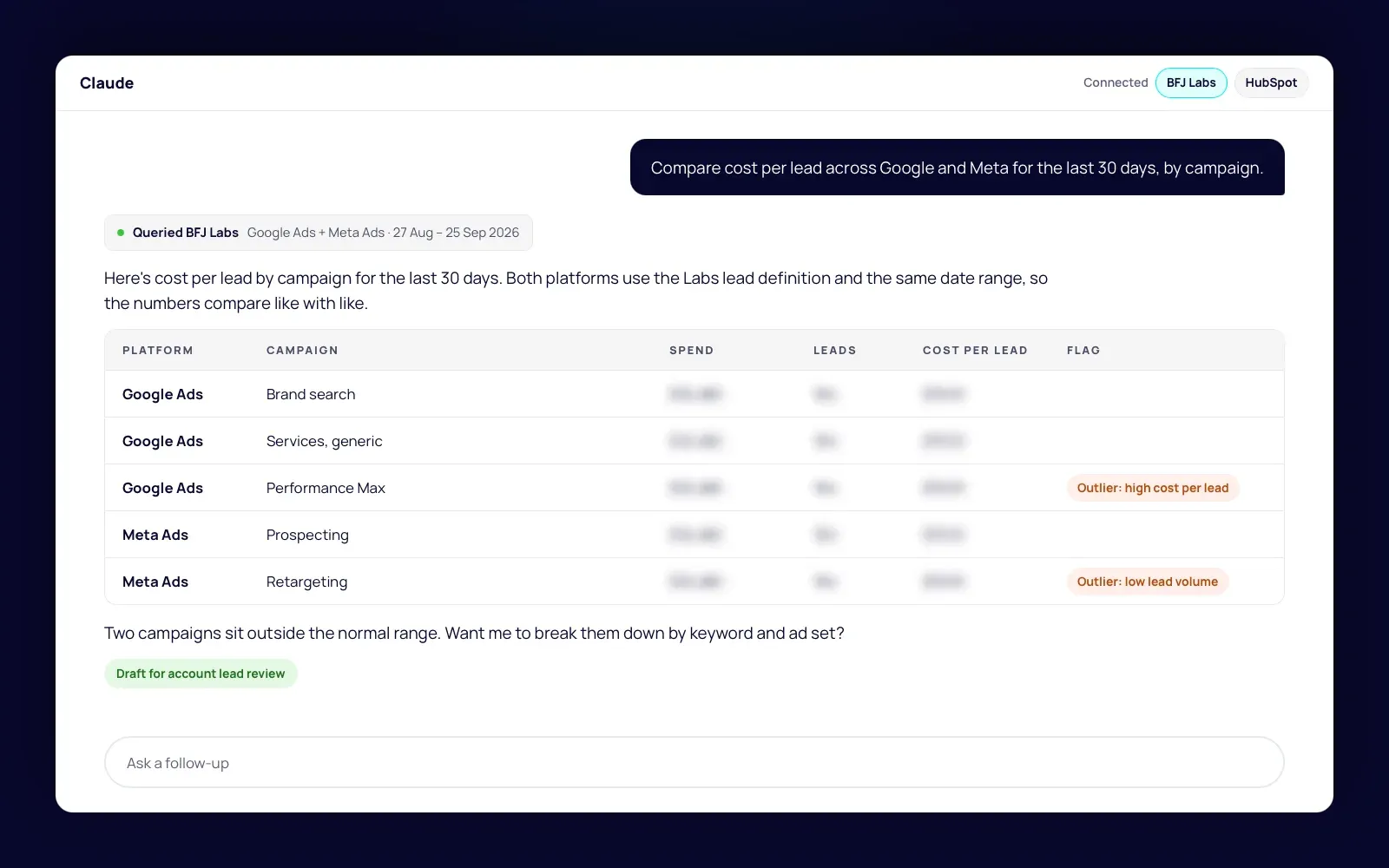
An account lead asks: "Compare cost per lead across Google and Meta for the last 30 days, by campaign."
Labs returns both, normalised to the same date range and the same definition of a lead. The AI puts them side by side and flags the outliers.
Google and Meta each have their own MCP servers. Connect them separately and the AI compares two platforms that count conversions differently. Labs reconciles them first, so the comparison holds up.
GA4 and Search Console
Organic questions run through Search Console data in Labs. "Which pages lost clicks this month, and which queries caused it?"
Search Console only keeps 16 months of data. Ask for a two-year trend and the AI will either come back short or compare the wrong periods. We lock year-on-year comparisons to fixed date ranges. The AI won't do that unless it's told to.
More on this in How to Use ChatGPT & Gemini to Analyse GSC Data.
HubSpot pipeline
We're a HubSpot Diamond partner, so most of our pipeline work happens in HubSpot. The HubSpot MCP answers questions like "Which open deals have had no activity in 21 days?"
CRM data is messy. Stages get skipped and activity counts run low. We filter by stage and source before quoting any pipeline number.
SEO rankings with DataForSEO
Labs tracks rankings through DataForSEO. When a client asks why rankings dropped, the AI pulls the history straight away.
Rank data has gaps. A missed check can look like a ranking loss. Labs flags thin data before it's reported, and we confirm any movement in Search Console before it goes to a client.
What we learned building an MCP server
Empty isn't zero. A misconfigured connection can return "no data" when the data exists. The AI will report that nothing happened. Any "no data" on an active account gets checked before anyone acts on it.
Set the dates. "Last month" means different things to different platforms. We pass exact start and end dates every time.
Is MCP secure?
MCP is as secure as the setup behind it. A connection gives AI access to real business data, and sometimes the ability to change it.
Our rules:
- Least privilege. Grant only the access a task needs. Read-only by default.
- Official servers. Use the platform's own MCP server over third-party versions.
- No credentials in chat. Keys and tokens live in secure settings.
- Rotate keys. On a schedule, and straight away if anything looks wrong.
- Sign-off before changes. Anything that writes data needs a person to approve it.
In healthcare, finance or any regulated industry, check where the data goes before you connect anything. Start with our guide to Australia's Privacy Principles in digital marketing.
How to start with MCP without a developer
No code needed.
- Pick a question you ask every month. "Where did our leads come from?" works.
- Find the platform that holds the answer. Check whether it has an official MCP server. Most major platforms do.
- Connect it. In Claude, go to Settings, then Connectors. Sign in and approve access.
- Ask the question. Check the answer against the platform itself the first few times.
- Add a second platform. The value shows when the AI can compare two sources.
Connecting is the easy part. The data underneath has to be right: clean conversion tracking, consistent UTMs, a CRM your team actually updates. If that's not in place, start with a GA4 audit.
What's new in MCP in 2026
The July 2026 specification made MCP stateless. Each request now carries everything it needs, so MCP servers are much easier to run at scale.
It also added support for long-running tasks, stronger authentication for remote servers, and extensions that add features without changing the core.
MCP is now production infrastructure. The platforms you pay for will expect you to connect AI to them. Businesses with clean data will get more out of it, sooner.
What this means for BFJ clients
Labs sits behind all our client work. It's how we measure campaign effectiveness, track offline revenue attribution and build monthly reports. Ainslie Bullion shows what connected data looks like over time.
With MCP, our account leads spend less time pulling numbers and more time on what they mean. Questions that used to wait for the monthly meeting get answered the same day.
We're rolling this out with a small group of clients first. If you want to ask your marketing data questions directly and trust the answers, talk to us.
FAQ
What does MCP stand for?
Model Context Protocol. An open standard for connecting AI assistants to external tools and data.
What is an MCP server?
The connector on a platform's side. It tells an AI app what the platform can do and passes requests to its API.
Is MCP only for developers?
No. Apps like Claude let you connect MCP servers from the settings menu.
Is there a Google Ads MCP?
Yes. Google publishes an official Google Ads MCP server. Meta, HubSpot, DataForSEO and Google Analytics have official servers too.
Does MCP replace APIs?
No. MCP sits on top of APIs and standardises how AI uses them.
Can MCP fix marketing attribution?
No. It shows every platform's claim side by side. Deciding which claims hold up still needs a proper attribution setup.
Is MCP safe for business data?
With least-privilege access, official servers, secure credentials and sign-off before changes, yes.
Ask your data
Want to see what your marketing data can tell you when you can query it directly?
Book 30 minutes with Fabian
Or read more about BFJ Labs, our digital marketing and our data and analysis work.

Ben Henzell
Ben Henzell founded BFJ Digital with a simple belief: great marketing should help businesses genuinely grow, not just look good on paper. With over 20 years in the industry, Ben has seen marketing evolve from billboards and print ads to the complex digital ecosystem we navigate today. That perspective is invaluable.
He's worked across traditional and digital channels, giving him a real understanding of what actually moves the needle for businesses. Ben's approach is refreshingly straightforward—he'd rather have an honest conversation about what will work than oversell a flashy strategy.
His Bachelor of Business in Advertising and Marketing gave him the foundation, but it's the two decades of real-world experience that make him someone clients trust when big decisions need to be made.
At BFJ Digital, Ben has built a team that shares his values: do great work, be honest with clients, and focus on results that matter. If you're looking for someone who genuinely cares about your business success and has the experience to back it up, that's Ben.
Ready to See the Bigger Picture?
Want to understand how your digital and real-world marketing impact each other? Not sure if your CRM is supporting your paid media efforts? Just need some clarity and a clear plan to better ROI? Book your free strategy session today for an in-depth audit and action plan to double your digital marketing ROI.
- Meet with a strategy specialist to build a growth plan
- Increase your media performance by up to 200%
- Improve business efficiencies to increase ROI via automation and increase profit
- We cut to the chase. What digital marketing is actually working?