Where Does Pinterest Fit in the Marketing Mix?

Hardeep Gill
Performance Media Specialist at BFJ Digital
Keep ahead of the curve via our latest trends newsletter.
Contact us nowKey Takeaways
- Pinterest sits between search, social and discovery. People often use it when they know what they want to achieve, but haven't decided which product, brand or supplier will get them there.
- Its strongest opportunity is often before the conventional search begins. Pinterest can help a brand influence preferences while someone is researching, planning and comparing ideas.
- Pinterest can work across the marketing funnel. It can build awareness, support consideration and drive traffic, leads or sales, depending on the audience, campaign and buying journey.
- It shouldn't be assessed in isolation. The real question for marketers is whether Pinterest adds a useful touchpoint to the wider channel mix and improves overall marketing performance.
For most marketing teams, the major digital channels already have a reasonably clear job. Google Search captures people actively looking for an answer, product or supplier. Facebook and Instagram can build reach, create demand and bring previous visitors back. TikTok is strong for discovery, entertainment and culture, while email and SMS marketing and a CRM can help businesses nurture existing relationships and turn them into revenue.
Pinterest is harder to put into one of those boxes.
It has a feed, visual content and advertising, so it is usually grouped with social media. But that classification doesn't fully explain how people use the platform or where its real value can sit within a marketing strategy.
Pinterest describes itself as an AI-powered visual search platform designed for decisions, and that is a more useful way for marketers to think about it. People use Pinterest to explore ideas, research possibilities and plan things they intend to do. That might be renovating a kitchen, furnishing a new home, planning a wedding, deciding what to cook for dinner or thinking about their next holiday.
This means Pinterest can reach someone at an interesting point in the buying journey: they have intent, but they don't necessarily have a brand in mind yet.
For businesses trying to grow beyond the demand they're already capturing through channels such as Google Search, that deserves attention.
Pinterest isn't just another social media platform
The difference becomes clearer when you consider the mindset someone brings to each platform.
You can open Instagram or TikTok without looking for anything in particular. The platform serves content based on what it believes will hold your attention, and brands compete for a place within that experience.
Pinterest often begins with a different behaviour. A user might search for:
- Small courtyard ideas
- Kitchen renovation inspiration
- First home checklist
- Healthy family dinner ideas
- Modern home office
- Wedding table settings
These searches contain intent, but it is often broad and exploratory. The person knows the problem they're trying to solve or the outcome they're trying to achieve, without necessarily knowing which brand or product they want.
That is backed up by Pinterest's own search data. The platform reports that 96% of its top searches are unbranded.
For marketers, that is significant because it creates an opportunity to get into the consideration set before the customer has narrowed down their options.
Someone researching small living room ideas isn't necessarily looking for a particular furniture retailer. Someone searching modern house designs may not have selected a builder. Someone planning home storage ideas isn't necessarily searching for a particular product or brand.
The category, problem or aspiration comes first. The brand can enter the picture afterwards.

Where does Pinterest sit in the marketing funnel?
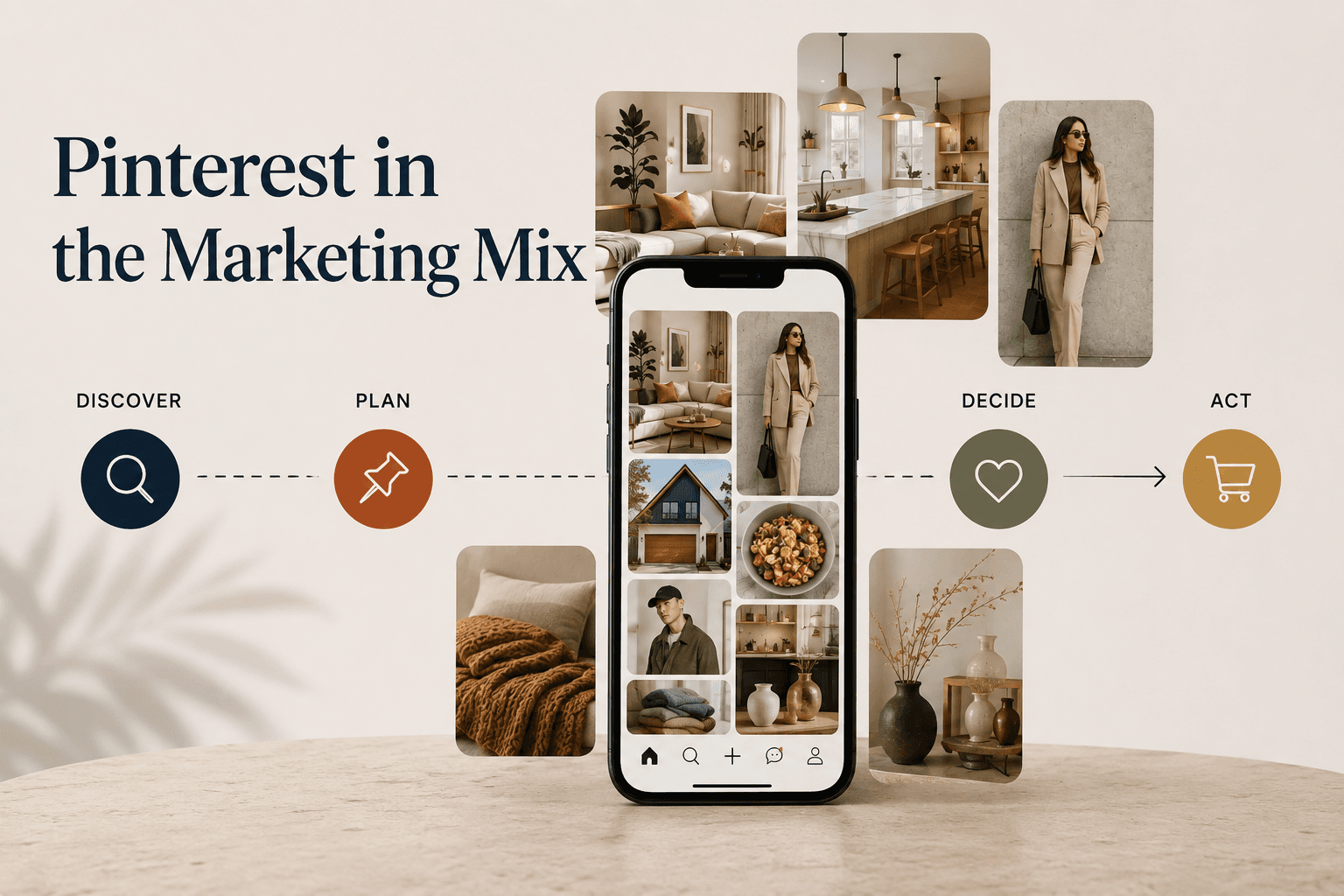
Pinterest can play a role across awareness, consideration and conversion, but its most distinctive strength is often between discovery and consideration. It allows brands to reach people while they are planning and forming preferences, before those people necessarily move into an explicit product, supplier or brand search.
That makes its role slightly different from channels designed primarily to capture existing demand.
A simple way to look at the marketing mix is:
Channel | Common user mindset | Typical role in the journey |
Google Search | "Help me find this" | Capturing active demand |
Facebook / Instagram | "Show me something relevant or interesting" | Awareness, demand generation and remarketing |
TikTok | "Entertain me, teach me or show me something new" | Discovery and awareness |
"Help me find ideas and decide what I want" | Discovery, planning and consideration | |
Email / CRM | "I already know this business" | Nurture, conversion and retention |
This isn't a hard division. Google can build awareness, Meta can convert and Pinterest can generate leads or sales. Customers don't experience marketing funnels as neatly as marketers draw them.
The table is useful because it highlights the different mindset that can exist when someone opens Pinterest.
Awareness: reaching people before they know your brand
At the awareness stage, Pinterest can introduce a business to people who weren't actively searching for it.
The important difference is that the awareness can still be connected to an identifiable interest or plan. Someone researching backyard renovation ideas has already provided a useful signal about what they are thinking about. A landscaper, outdoor furniture retailer, pool company, property developer or home improvement business could all be relevant to that person, even though none of those brands were explicitly searched.
That gives marketers a different question to ask about awareness campaigns. Instead of focusing only on how many people can be reached, consider when the business can become useful to them.
Getting a brand in front of someone at the beginning of a project can be far more valuable than generating another impression with someone who has no reason to care.
Consideration: helping customers work out what they want
Consideration is where Pinterest becomes particularly interesting.
People don't simply search for ideas on Pinterest and leave. They save Pins, create boards, compare options and return to projects over time. A broad idea can gradually become a clearer preference as someone works out what they like, what they need and what might be achievable.
For businesses, creative can therefore do some of the work that would normally happen later in the buying journey.
A home builder can show different floor plans, architectural styles and ways of using a space. A furniture business can show a complete room rather than an isolated product. A food company can demonstrate how its product fits into a recipe. An education provider can connect a course to the career or lifestyle someone is considering.
Pinterest offers formats including static Pins, video, carousels, collections and shopping ads, but the format is secondary to the principle: the content needs to help someone make a decision.
The strongest creative isn't always the piece that shouts the loudest about the product. Sometimes it is the one that helps the customer picture the outcome.
Conversion: moving inspiration into action
Pinterest doesn't stop being relevant once a person knows what they want. The platform also offers conversion-focused campaigns designed around website traffic, sales and lead generation, alongside retargeting and audience tools.
For an ecommerce retailer, the journey might move directly from an inspirational Pin into a product catalogue and purchase. For a service business, the next step could be an enquiry, consultation or lead form.
Pinterest's Performance+ suite is also increasing the amount of automation available across targeting, bidding, budgets and creative. This gives advertisers more ways to optimise campaigns towards business outcomes rather than treating Pinterest purely as an awareness channel.
The important point isn't that Pinterest magically handles every stage of the funnel. It is that the same customer can encounter a brand as their mindset develops from "I'm looking for ideas" to "I think I know what I want" and eventually "I'm ready to do something about it."
Pinterest can help shape demand, rather than waiting to capture it
This is where Pinterest becomes strategically different from a channel such as paid search.
Google Search is exceptionally good at capturing existing demand. If someone searches for office furniture Brisbane, home builder Gold Coast or family lawyer near me, the requirement is reasonably clear. The advertiser's job is to appear at the right time and give that person a compelling reason to choose them.
The limitation is that every competitor can see the same demand.
Pinterest can potentially enter the journey earlier, when the customer is still working out what their eventual search will be.
Imagine someone who has recently bought a house. They start saving living room ideas, then move onto dining rooms, outdoor areas, lighting and storage. Over time, those searches become increasingly specific as they decide what style they want and what they need to buy.
For a client we work with in the home improvement sector, that creates a very different marketing opportunity. Instead of waiting for someone to search Google for a specific furniture package or supplier, the business can potentially become part of the planning process while the customer is still deciding what the finished home should look like.
This isn't an argument for Pinterest instead of Google. The channels can perform different jobs.
Google can capture the requirement once it becomes explicit. Pinterest can help influence what that requirement eventually becomes.
For businesses looking for growth, that distinction matters. There is a limit to how much demand you can capture if you continue competing for the same pool of people who are already searching for your product. At some point, growth requires finding ways to influence future demand as well.

The marketing opportunity in the "moment before"
One of the most useful ideas that came out of our discussion with the Pinterest team was “moments marketing”.
Pinterest users frequently plan around something that hasn't happened yet. It could be a major calendar event such as Christmas or Father's Day, or a personal event such as moving house, having a baby, planning a wedding, renovating or changing careers.
Pinterest reports that eight in ten users come to the platform to search for at least one meaningful moment each year, and planning around seasonal events can begin well before the date itself.
This gives marketers an opportunity to think beyond conventional product targeting.
Consider how different industries could use the idea:
- Home and furniture: moving house, buying a first home, renovating, downsizing or preparing for Christmas entertaining.
- Property and construction: starting a family, needing more space, building a home office or planning a lifestyle change.
- Food and FMCG: children's birthdays, weeknight dinners, Christmas lunch, entertaining or seasonal recipes.
- Education: finishing school, preparing for university, changing careers or developing a new skill.
- Travel: honeymoons, school holidays, anniversaries, milestone birthdays or winter escapes.
- Professional services: starting a business, buying property, retirement or other life stages that create a need for advice.
This shifts the strategic question.
Instead of asking only "Who buys what we sell?", marketers can ask "What is happening in someone's life when what we sell becomes relevant?"
That question can uncover audiences, creative ideas and campaign opportunities that conventional product targeting misses.
It also encourages businesses to start earlier. If customers begin planning Christmas in October, advertising heavily in December may mean entering the journey after many decisions have already been made.
Why Pinterest creative needs a different approach
Pinterest is a highly visual environment. People open it specifically to find things they consider useful, interesting or aspirational, which means advertising has to earn its place in the feed.
During our meeting with Pinterest, we discussed the balance between creative that clearly looks like an advertisement and content that feels more native to the surrounding platform.
There isn't a universal rule that every Pinterest ad needs to look organic. Clear branding, product information and calls to action still matter. But marketers have more room to demonstrate the outcome rather than immediately pushing the offer.
Take a furniture company. A product cut-out with a large ‘Shop Now’ message communicates the commercial intent quickly. A well-designed room showing the same product in context can help someone understand how it might look in their own home.
Both can have a place in the campaign.
The difference is that the second creative gives the user something useful before asking for the click.
The same principle applies across other sectors. A builder can show how a floor plan works for a family rather than simply advertising the development. A food brand can show the finished recipe. A university can show what a course could lead to rather than only promoting enrolment.
Good Pinterest creative should make sense even before someone notices that it is an ad.
Static content still matters, but don't overlook video
Pinterest remains a heavily visual platform and static imagery continues to play an important role. However, one recommendation that came through strongly in our session with Pinterest was to test video as a way of creating movement within the feed.
Video can be particularly useful when the value of a product or service is easier to demonstrate than describe.
For example:
- A builder can show a short walkthrough of a completed home.
- A furniture business can show an empty room becoming a finished space.
- A food brand can turn a recipe into a simple sequence.
- A travel business can show the experience of a destination.
- A retailer can demonstrate how a product works or how it can be styled.
The lesson isn't that video will always beat static creative. It is that Pinterest gives marketers enough formats to test how different people respond at different points in the journey.
A strong campaign is unlikely to rely on one asset resized ten different ways.
Pinterest search data can tell you how customers think
Pinterest targeting includes many of the options marketers will recognise from other advertising platforms, including demographics, interests, customer lists and retargeting. Its search behaviour adds another useful layer.
Because people actively search the platform, marketers can see the language being used while customers are still researching a topic.
Pinterest Trends can help identify searches gaining traction within particular categories and moments. Those insights can inform campaign targeting, but they can also be useful beyond Pinterest.
Imagine a business that internally describes its offer as complete home furnishing packages. Customers might instead be searching for furnishing a first home, small apartment styling or new home furniture ideas.
Those phrases reveal different ways of thinking about the same commercial need.
That information can influence:
- Ad messaging
- Website copy
- Landing pages
- Content topics
- Search campaigns
- Email campaigns
- Creative briefs
This is another reason not to assess Pinterest purely as a media placement. For the right business, the platform can also provide insight into how customers research, plan and describe the problems the business solves.

AI is changing Pinterest advertising, but the inputs still matter
Like Google, Meta and most major advertising platforms, Pinterest is putting more campaign decisions into automated systems.
Its Performance+ tools use AI across areas such as targeting, bidding, budget allocation and creative. That can reduce some of the manual work involved in finding audiences and managing campaigns, but it doesn't remove the need for good marketing.
In fact, increased automation makes the quality of the inputs even more important.
If you're using automated campaign tools, you still need:
- Strong creative
- Clear product or service information
- Accurate conversion tracking
- Useful landing pages
- Reliable customer and product data
- A proposition people actually care about
Automation can help determine who sees an ad, how much to bid and which creative is most likely to perform. It can't make a weak offer compelling or fix a landing page that doesn't convert.
For marketing managers, that is an important distinction. The technology is becoming more sophisticated, but the fundamentals haven't disappeared.
Does organic Pinterest matter if you're running ads?
A large organic following isn't a prerequisite for testing Pinterest advertising. However, there is value in having a profile that gives people confidence when they investigate the business.
Someone who sees an ad may visit the brand's profile before going to the website. Relevant boards, useful Pins and consistent creative give that person another way to understand what the business does.
The Pinterest team also highlighted ways businesses can reduce the workload involved in building that presence, including repurposing suitable Instagram content and using organic Pins as paid creative.
For brands with strong visual content, boards can also be organised around the customer's interests rather than the company's internal product categories.
A home brand, for example, might build boards around small-space living, outdoor entertaining, kitchen inspiration, first-home ideas and coastal interiors. Those categories can reflect how customers research much more closely than the structure of the company's product catalogue.
Organic and paid don't need to operate as separate strategies. The strongest content can inform both.
Is Pinterest right for your marketing mix?
Pinterest isn't automatically a good investment because the platform has interesting targeting, new ad formats or a growing suite of AI tools. A channel earns its place in the marketing mix by helping solve a business problem.
Before adding Pinterest to a media plan, ask:
- Does our audience research products, projects or ideas visually?
- Is there a meaningful planning period before purchase?
- Do customers look for inspiration before they know which brand they want?
- Are there seasonal or life moments connected to the purchase?
- Can we demonstrate our value visually?
- Do we have enough quality creative to test the platform properly?
- Can we measure what happens after someone interacts with the campaign?
- Would reaching customers earlier give us an advantage over competitors?
If several of those answers are yes, Pinterest becomes worth testing.
The next question is how it will be measured.
A Pinterest campaign shouldn't automatically be judged only on last-click conversions, particularly if its job is to introduce the business earlier in the customer journey. Depending on the strategy, useful measures could include assisted conversions, new customer acquisition, branded search behaviour, lead quality, website engagement and the performance of the wider channel mix.
That doesn't mean giving Pinterest a free pass on commercial performance. It means measuring it against the job it was brought in to do.
Pinterest works best when you stop treating channels in isolation
A customer might discover an idea on Pinterest, encounter the business again through Instagram, search the brand on Google two weeks later, return through a paid search ad and eventually convert after receiving an email.
From the customer's perspective, that is one journey.
From the marketing team's perspective, it can appear in five different dashboards.
This is why BFJ Digital looks at new platforms in the context of the wider marketing operation. The question isn't simply "Does Pinterest work?" Almost any major advertising platform can work under the right circumstances.
The better questions are:
What role will it play? What gap does it fill? How will it interact with the channels we're already using? And can we measure its contribution to the business?
Pinterest becomes particularly interesting when the existing marketing mix is very good at capturing demand but has fewer ways to influence people before that demand becomes explicit.
For the right business, that earlier window can create another path to growth.

The opportunity may be before the search
Marketing teams spend a lot of time competing for customers who have already decided what they need. That investment remains important. Search, shopping, remarketing and conversion campaigns all play a clear commercial role.
But there is only so much existing demand to capture.
Pinterest gives marketers another place to look for growth because it can reach people while they're still working out what they want. Its combination of visual search, discovery, planning and performance advertising means a business can potentially become part of the decision before a customer has narrowed the market down to a handful of brands.
For a home business, that might mean appearing during the renovation plan rather than waiting for the supplier search. For a food brand, it might mean being part of the recipe idea rather than competing at the supermarket shelf. For an education provider, it could mean entering the conversation while someone is imagining a career change rather than waiting for a course comparison.
Pinterest doesn't need to replace another channel to justify its place in the marketing mix. It needs to add something the existing mix isn't already doing.
For marketing teams looking for the next source of sustainable growth, the period before someone knows exactly what they're looking for can be a very valuable place to start.
Frequently asked questions
What is Pinterest's role in the marketing funnel?
Pinterest can support awareness, consideration and conversion, but it is particularly useful during discovery and consideration. Users often arrive while researching ideas and planning future purchases, giving brands an opportunity to influence preferences before a specific product or supplier has been chosen.
Is Pinterest a social media platform or a search engine?
Pinterest has characteristics of both, but it is better understood as a visual discovery and search platform. Users can browse a feed like they would on social media, while also actively searching, saving and organising ideas around projects, products and future plans.
How is Pinterest different from Instagram and TikTok for marketers?
Instagram and TikTok are heavily driven by content consumption and algorithmic discovery. Pinterest also offers discovery, but users frequently arrive with a project, question or future decision already in mind. That planning behaviour can give advertisers access to consumers at a different point in the buying journey.
What types of businesses can benefit from Pinterest advertising?
Businesses with visually demonstrable products or services and a meaningful research or planning phase are particularly well suited to Pinterest. Home and interiors, property, hospitality, fashion, beauty, travel, retail and education are obvious examples, although service businesses can also use Pinterest when their offering connects with identifiable interests or life moments.
Can Pinterest generate leads and sales?
Yes. Pinterest supports conversion-focused advertising for website actions, ecommerce sales and lead generation. However, the role Pinterest plays will depend on the business and campaign. For some brands it will drive direct conversions, while for others its greater value may be introducing the brand earlier and supporting conversions through other channels.
Should Pinterest replace Google or Meta advertising?
Usually, no. Pinterest is better considered as another component of the marketing mix rather than a direct replacement for Google, Meta or other established channels. Its value comes from reaching customers in a different mindset and potentially influencing decisions earlier in the journey.
Hardeep Gill
Hardeep Gill is a Performance Media Specialist at BFJ Digital, bringing expertise in SEM, digital advertising, and strategic campaign management. As a versatile digital marketer, Hardeep excels at crafting and executing comprehensive digital strategies that deliver measurable business growth.
His expertise spans the technical intricacies of search engine marketing and programmatic advertising, enabling precise audience targeting at scale. Hardeep possesses a hands-on understanding of Meta advertising and the broader landscape of digital marketing, allowing them to leverage multiple channels effectively.
While skilled in strategic account management, Hardeep's core strength lies in his ability to harness diverse digital channels to drive tangible results. His approach combines technical proficiency with strategic thinking, ensuring that every campaign is optimised for maximum performance and return on investment.
With a Bachelor of Business majoring in Marketing, Hardeep brings both academic foundation and practical expertise to their role. His comprehensive understanding of the digital advertising ecosystem, from search to social to programmatic, makes them a valuable asset for clients seeking integrated performance media solutions that deliver real business impact.
Ready to See the Bigger Picture?
Want to understand how your digital and real-world marketing impact each other? Not sure if your CRM is supporting your paid media efforts? Just need some clarity and a clear plan to better ROI? Book your free strategy session today for an in-depth audit and action plan to double your digital marketing ROI.
- Meet with a strategy specialist to build a growth plan
- Increase your media performance by up to 200%
- Improve business efficiencies to increase ROI via automation and increase profit
- We cut to the chase. What digital marketing is actually working?