 Read More
15 Nov 2026
|5 min
SEO reporting: the same deals credit organic search with 3% or 15% of revenue

Ben Henzell
Owner at BFJ Digital
Keep ahead of the curve via our latest trends newsletter.
Contact us nowReporting on revenue per seo keyword is not possible using Googles stack. With labs, we’ve not only found a way to do that, but also apply multi touch attribution to see the value for the whole customer journey.
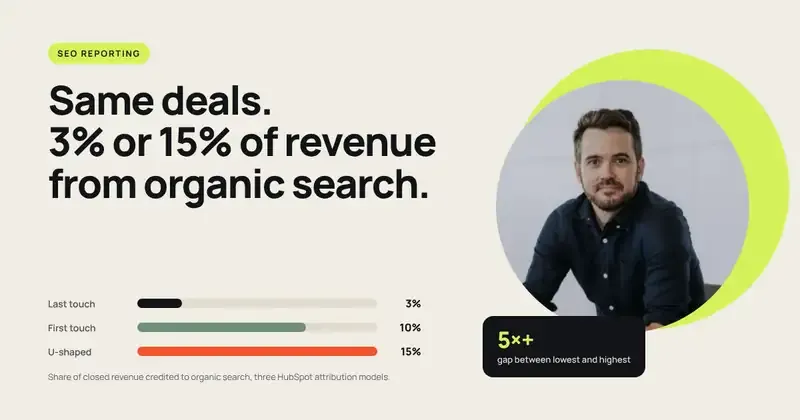
Exmaple, run the same closed deals through three attribution models and organic search is credited with about 3%, 10% or 15% of closed revenue. The deals do not change, only the model does, and the gap between the lowest and the highest is about five times. If your SEO reporting uses a single model, it is giving you one of those answers.
We wanted to know what was behind our own organic leads. Labs, our marketing intelligence platform, connects Search Console, GA4 and HubSpot, so we could trace about 120 organic form leads from the search that likely brought them through to revenue. This is what we found and how.
Why the same deals give different SEO numbers
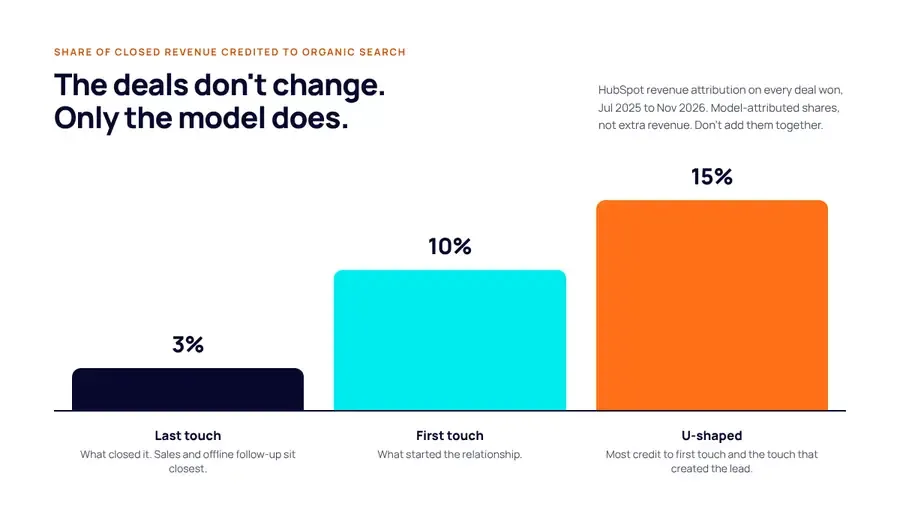
These figures come from HubSpot's revenue attribution on every deal marked won between July 2025 and November 2026, across all sources, not only the leads below. They are shares of model-attributed revenue, not extra revenue, and they should not be added together.
- First touch credits organic search with about 10% of closed revenue.
- A U-shaped model, which gives most of the credit to the first touch and the touch that created the lead, credits it with about 15%.
- Last touch credits it with about 3%, because sales and offline follow-up usually sit closest to the close.
None of these is wrong. They answer different questions: what started the relationship, and what closed it. A report that shows only one of them hides the other.
How we matched leads to keywords
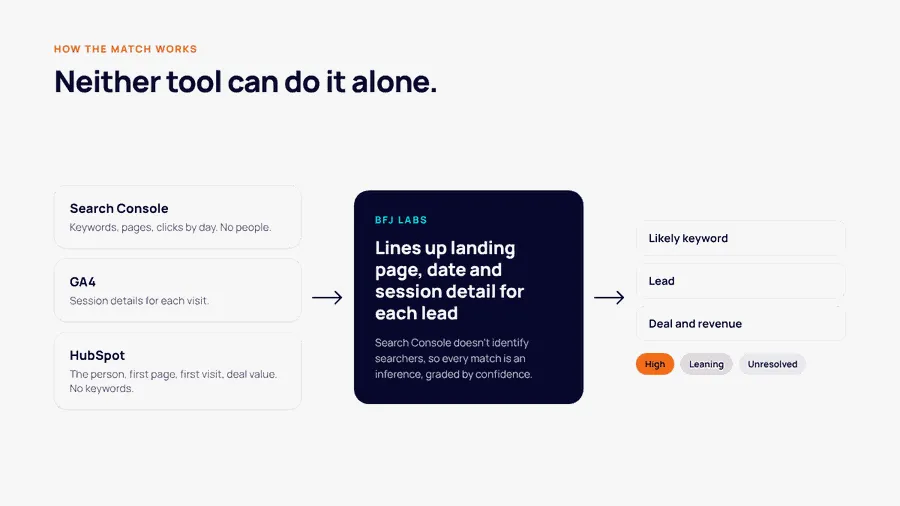
HubSpot knows the person. It records their first page, first visit time, traffic source and, where there is one, the deal and its value. HubSpot recorded all of these leads as Google organic.
Labs adds the keywords. For each lead it combined the landing page, the date and GA4 session details to work out the likely search behind the enquiry. Search Console does not identify individual searchers, so every match is an inference, and we graded each one by confidence.
Neither tool can do this alone. Search Console has no people in it, and HubSpot has no keywords.
What came back
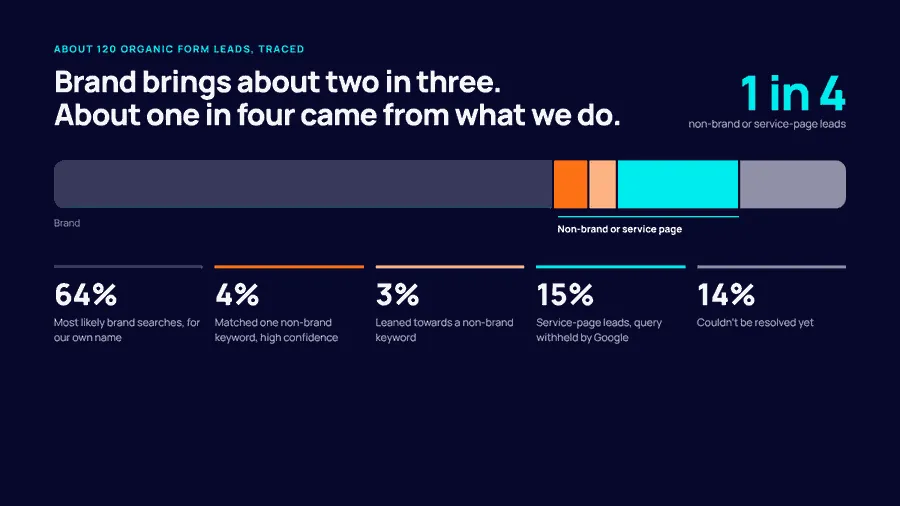
Of the roughly 120 leads:
- About two in three were most likely brand searches, meaning searches for our own name
- About 4% matched one non-brand keyword with high confidence
- About 3% leaned towards a non-brand keyword
- About 15% were service-page leads where Google withholds the query, so we know the page but not the words
- About 14% could not be resolved yet
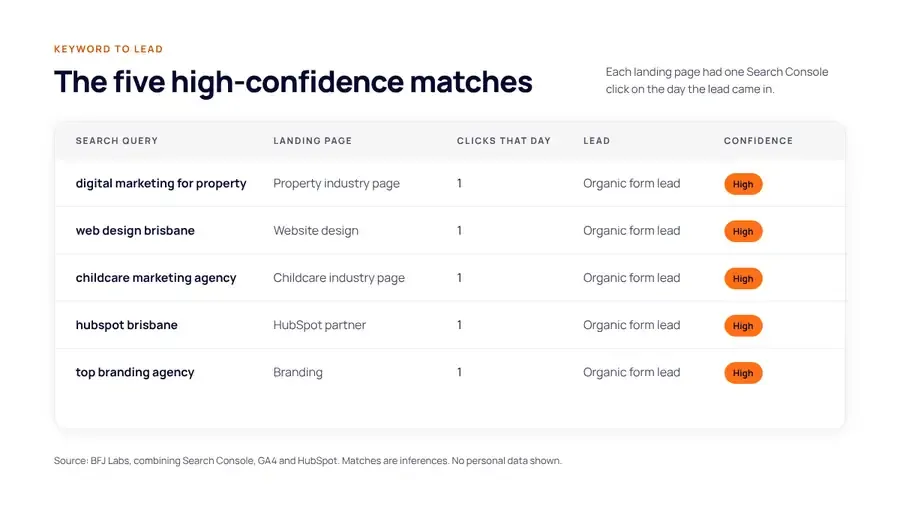
The five high-confidence matches. In each case the landing page had one Search Console click that day:
- digital marketing for property: Property industry page
- web design brisbane: Website design
- childcare marketing agency: Childcare industry page
- hubspot brisbane: HubSpot partner
- top branding agency: Branding
One of the five came from a keyword where we sit well down the results. A rank tracker would have written it off, and it produced an enquiry.
What this tells us about non-brand search
Brand search brings the most leads. Search for what we do, and a smaller stream of enquiries arrives on our SEO, industry and service pages: about one in four leads were identified, leaned non-brand or came through a service page with the query withheld.
The pool behind it is large. Search Console shows about 1.5 million Australian impressions over the 12 months to November 2026 on searches that are not our name, and much of that visibility is still below page one. We use lead and revenue evidence like this to decide which service and industry pages to improve first.
The revenue from the matched leads
Four organic-first leads have become customers, with their closed-won deal value recorded in HubSpot. Three came through service or case-study pages where Google hid the keyword, and one through the homepage. A hidden query still tells you which page earned the lead, so we track by page and day as well as by keyword.
Brand search is not the same as demand created by SEO
Branded leads raise an obvious question: where did those people first hear of us? Someone who searches your name already knows it, so these leads show where people arrived, not what created the interest. About half converted in their first visit, and about one in five came back through LinkedIn, so some of them probably started there. HubSpot only sees from the first tracked visit, so we cannot say how many.
Server-side tracking and its limits
Tracking gaps shape every number above. We run tags through Cloudflare Zaraz, which sends some events, such as Meta's, from the server rather than the browser. That reduces some browser-side loss. It does not get around consent choices or every ad blocker, and Safari still limits how long cookies set by scripts last, so we treat missing visits as a limit on the data and not something we can fully fix.
The SEO reporting stack you need to track revenue
- A HubSpot account that records first page and time, with hidden form fields for landing page, referrer and UTMs.
- GA4 passing its client ID, which a GA4 audit usually finds missing.
- Search Console data you can query by page and day.
- Server-side tagging where it fits, with consent respected.
What it means for SEO
Rankings tell you where a page sits. Reporting that connects keywords to leads and deals tells you whether it pays, and the attribution model you choose decides how much credit SEO gets for it.
If you want to know whether your own SEO reporting connects leads to actual deals, talk to us about SEO and revenue attribution, and see our data and analytics services for the tracking behind it.
About these numbers. This is one slice of our data: Google organic form leads on our own website, with revenue shares taken from HubSpot's attribution reports. It leaves out paid, referral, offline and client-led work, client names, and the finer detail of how Labs does the matching, which we keep to ourselves. Keyword matches are inferences, and attribution shares are model-attributed, not incremental revenue. Treat it as a worked example, not the full picture of what we see.
Ben Henzell founded BFJ Digital with a simple belief: great marketing should help businesses genuinely grow, not just look good on paper. With over 20 years in the industry, Ben has seen marketing evolve from billboards and print ads to the complex digital ecosystem we navigate today. That perspective is invaluable.
He's worked across traditional and digital channels, giving him a real understanding of what actually moves the needle for businesses. Ben's approach is refreshingly straightforward—he'd rather have an honest conversation about what will work than oversell a flashy strategy.
His Bachelor of Business in Advertising and Marketing gave him the foundation, but it's the two decades of real-world experience that make him someone clients trust when big decisions need to be made.
At BFJ Digital, Ben has built a team that shares his values: do great work, be honest with clients, and focus on results that matter. If you're looking for someone who genuinely cares about your business success and has the experience to back it up, that's Ben.
Ready to See the Bigger Picture?
Want to understand how your digital and real-world marketing impact each other?
Not sure if your CRM is supporting your paid media efforts? Just need some clarity and a clear plan to better ROI?
Book your free strategy session today for an in-depth audit and action plan to double your digital marketing ROI.