 Read More
10 Nov 2026
|6 min
We redesign the work first, then add AI. A person still signs off.

Ben Henzell
Owner at BFJ Digital

Keep ahead of the curve via our latest trends newsletter.
Contact us nowBen Henzell, BFJ Digital's founder, was a guest on the WP Remote Show, a WPDev podcast with over 100,000 subscribers, to talk about how BFJ builds with AI. This post covers what he said and what it means for our clients.
Watch the full episode: This Agency Built Its Own AI Marketing System.
Or jump to a topic:
- 4:39 – Why we moved away from page builders
- 8:14 – Deciding between a person, a tool, automation or AI
- 11:07 – Putting every meeting and call in one place
- 16:50 – Lobster: from a design component to a website
- 21:29 – How AI has changed digital marketing
- 22:17 – BFJ Labs
- 28:21 – Why a person still signs off
Our rule: never finish with AI
At BFJ, AI never has the final say. We call it “never finish with AI”. AI can find information, draft work and flag opportunities. A person makes the call and signs off. Ben says that even with BFJ Labs as powerful as it is, it doesn't produce the level of content we want, so nothing goes out without a human reading it first.
That check can be quick. A writer might read a piece and say it's perfect, publish it. What matters is that a person has read it and made sure the client gets what they need.
Redesign the work first, then add AI
The most common way to use AI is to bolt it onto what you already do. Ben's view is that this just squeezes the old process instead of improving it. He points to a Google leader he heard speak at an industry event, who said good AI integration means redesigning the business from lead to receipt.
So three years ago, before the current AI boom, we went through every service line, every staff member and every client. For each one we asked what the risk was, what the opportunity was, whether a tool could do the job, and whether it would benefit us or a client.
Then we followed a simple order. Find the problem. If an AI tool can improve the process, use it. If there isn't one, build it. If it doesn't deserve to be built, do it the traditional way. Everything below came out of that order, not the other way round.
Each example follows the same pattern: the old way, the redesigned workflow, and where a person signs off.
Websites: fewer plugins, and a build that doesn't need AI
The old way. Websites built with layers of page builders and plugins, with a developer turning each design component into code and loading it into the CMS. WordPress has hundreds of thousands of plugins, and an update to one can affect another, which adds security risk and update work across the sites we manage. Ben is clear that page builders have a place, especially for small businesses that can't afford an agency.
The redesigned workflow. We build on our own WordPress foundation, without page builders and messy code, and with firm rules on which plugins our developers can use. Then Lobster, one of our internal tools, moves design components from a Figma file into WordPress at the click of a button. To a designer, an image looks like a picture. To a browser, it's a set of numbers: its size, its file type, whether it has rounded corners. The same numbers carry from the design to the code to the website's content system, so Lobster moves them across with automation.
AI inspired the idea, but there is no AI in the build. AI could do it, but there's a very good chance it would hallucinate and make mistakes. Moving numbers from one place to another is a job for automation, and the result is predictable.
Where a person signs off. Our developers set Lobster up, run it and check the result. Their time then goes to building the parts of the site that don't exist yet for that client. Ben says it makes sites quicker to build, and it doesn't put developers at risk.
What you get. A faster site that's more likely to be found and to convert, with fewer security risks and fewer plugin updates.
Marketing: BFJ Labs, one view of everything
The old way. Marketing data lives in many separate platforms: ads, analytics, search, the CRM, phone tracking. Putting it together takes people's time, and changes are easy to miss.
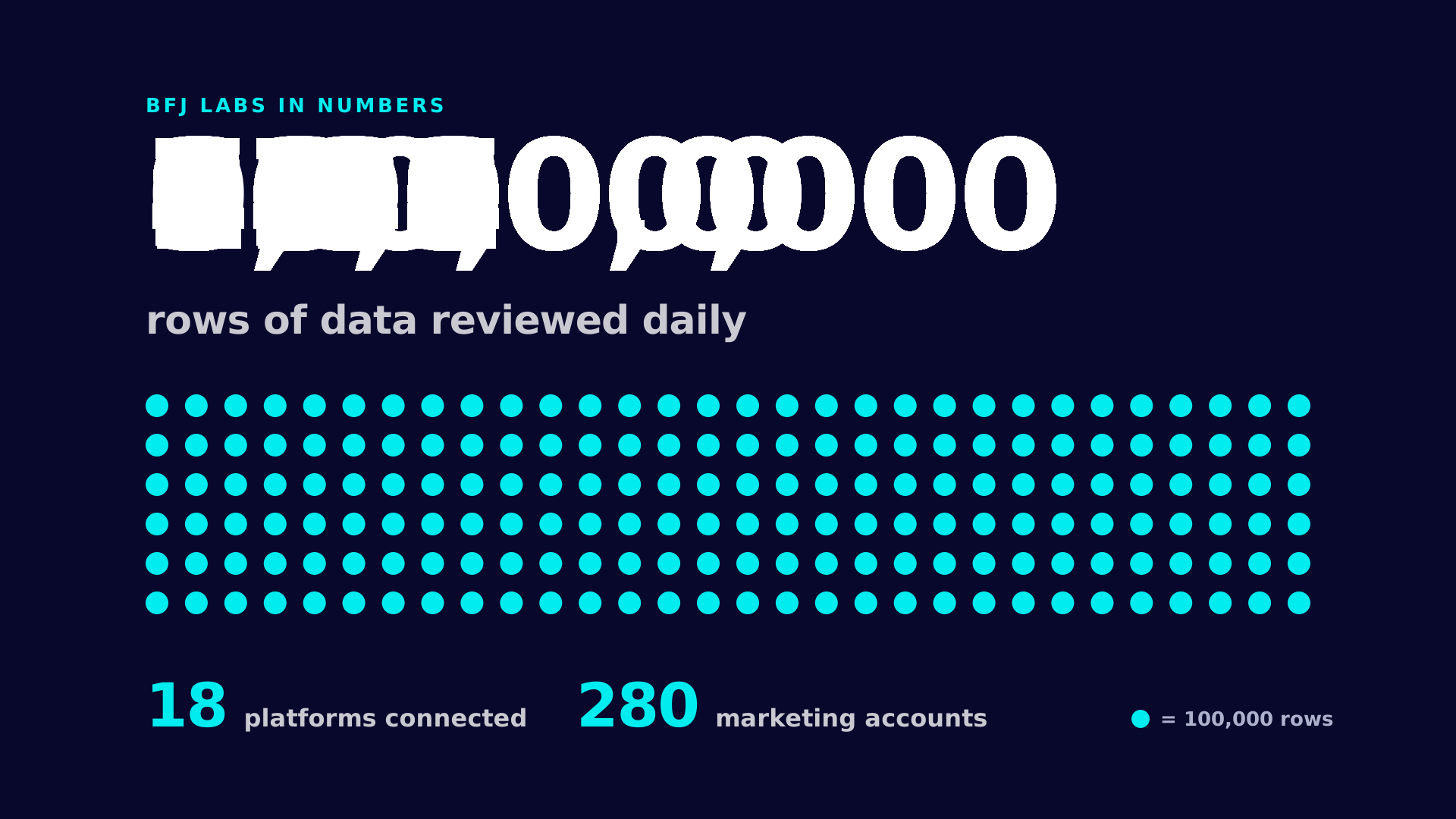
The redesigned workflow. BFJ Labs is our own marketing intelligence platform. It took three years to design and a year to build, and we're still developing it. It now holds more than 18,000,000 rows of data across 290+ accounts. It pulls from Google Ads, Meta, programmatic, Google Analytics, Search Console, AI search results, the website, the CRM, phone tracking, Google Business Profile and LinkedIn. It's all connected through APIs rather than an AI going out to find information, security came first, and the data refreshes through the day. The result is a single source of truth for each client.
On top of that data, Labs tells us when something needs attention:
- If a competitor launches a new campaign, Labs flags it, explains the strategy and suggests whether we should respond.
- If a keyword ranking or a result in AI search tools like ChatGPT moves up or down, Labs shows which content is performing and what to write next.
- It writes a brief for the content writer, using our tone of voice and taking competitors and existing site content into account. Ben calls it the best brief a writer will ever be given.
Where a person signs off. The account manager or media manager decides whether to act on what Labs found, and the writer rewrites the content. We deliberately didn't connect Labs to platforms like Google Ads. It informs us, and it doesn't put ads live. Hear Ben explain Labs at 24:08 of the episode.
What you get. Decisions based on one set of data across every channel, and content briefed with data, then written and checked by a person.
Knowing your business: one place for every conversation
The old way. Information arrives from everywhere: phone calls, emails, text messages, Slack, web forms, the CRM. Project tools house a lot of it, but not all of it, and finding anything means digging through folders.
The redesigned workflow. Every meeting we attend is recorded and transcribed, along with our sales calls and inbound phone calls. Selected emails, under secure protocols, are included too. All of it goes into a central repository for each client, with an AI assistant on top so our team can ask questions in plain English.
Where a person signs off. The AI does what it's good at: finding and recalling information. The thinking is still done by people. If you tell us your key audience is women aged 50 to 60 in Brisbane, our media planner can find that without trawling through notes, then decide what to do with it. A designer briefing a new site can pull up the page you said mattered most, and see that a competitor targets a different age group.
What you get. A team that already has the context from your meetings and calls, so you don't have to explain things twice.
Why a person still signs off
Ben is blunt about where the internet is heading. Content produced by AI or bots without anyone checking it is already filling the web, and without regulation he expects it to get messier. In his view, the internet should be a place where people get questions answered quickly, and low-quality content makes it worse.
He's also open that this could change. He thinks there will come a time when a human layer isn't needed. For now, BFJ's standard is that nothing goes out without a person checking it. As Ben puts it: “We just want to build a better internet.”
What this means for you
- A faster, more secure website, built on a lean foundation, with automation doing the repetitive work and a developer checking the result.
- Marketing decisions based on one set of data from every channel, with alerts when something changes.
- Content briefed with data, then written and checked by a person.
- A team that already has the context from your meetings and calls, so you don't have to explain things twice.
Want to know how this could work for your website or marketing? Get in touch with the BFJ team.
Frequently asked questions
Why doesn't BFJ just add AI to what it already does?
Ben's view is that bolting AI onto an existing process only squeezes it. BFJ looks at the problem first, redesigns the workflow, and then uses AI where it helps. Where it doesn't, we use automation or the traditional way.
Does BFJ use AI to build websites?
Not in the core build. Our tool Lobster moves approved designs into WordPress using automation, not AI, because automation is more predictable. Our developers set it up, run it and check the result.
Does AI write my content?
BFJ Labs can draft a brief for the writer, and the content it produces is not human-verified on its own. A writer uses it as a brief and rewrites it, and a person reads everything before it goes live.
Can AI change my ads or website without approval?
No. BFJ Labs reads data from your platforms and tells us what it finds. It is not connected to platforms like Google Ads and is not set up to publish content, so a person always makes those changes.
What are Lobster and BFJ Labs?
They are BFJ's internal tools. Lobster moves approved designs into WordPress. BFJ Labs is our marketing intelligence platform. It holds more than 18,000,000 rows of data across 290+ accounts, such as google ads, meta, prog, etc, it brings your channel data into one place and flags what needs attention.
Ben Henzell founded BFJ Digital with a simple belief: great marketing should help businesses genuinely grow, not just look good on paper. With over 20 years in the industry, Ben has seen marketing evolve from billboards and print ads to the complex digital ecosystem we navigate today. That perspective is invaluable.
He's worked across traditional and digital channels, giving him a real understanding of what actually moves the needle for businesses. Ben's approach is refreshingly straightforward—he'd rather have an honest conversation about what will work than oversell a flashy strategy.
His Bachelor of Business in Advertising and Marketing gave him the foundation, but it's the two decades of real-world experience that make him someone clients trust when big decisions need to be made.
At BFJ Digital, Ben has built a team that shares his values: do great work, be honest with clients, and focus on results that matter. If you're looking for someone who genuinely cares about your business success and has the experience to back it up, that's Ben.
Ready to See the Bigger Picture?
Want to understand how your digital and real-world marketing impact each other?
Not sure if your CRM is supporting your paid media efforts? Just need some clarity and a clear plan to better ROI?
Book your free strategy session today for an in-depth audit and action plan to double your digital marketing ROI.