Figma Just Changed How Websites Get Built. We Backed the Technology Years Ago.

Ben Henzell
Owner at BFJ Digital
Keep ahead of the curve via our latest trends newsletter.
Contact us nowFigma Just Changed How Websites Get Built. We Backed the Technology Years Ago.
How Figma Make and Payload could reshape website development, agency pricing and the future of digital marketing.
On 15 October 2026, Figma put Payload, an open source CMS, inside Figma Make. Design or prompt a website in Make, and it now comes with a working database, file storage, user logins and a content admin.
That sounds like a feature update. It is bigger than that. Design, development and content management have been separate jobs, separate tools and separate invoices for twenty years. They are starting to merge into one.
We started building on Payload two to three years ago, long before Figma bought it. Our own site runs on it, and so do client builds like. Fitzpatricks, as will Ainslie Bullion to name a few. So this isn't a hot take from the sidelines. Here is what we think it means for businesses, marketing teams and agencies, and what we're still testing.
What Figma Make and Payload actually change
Until now, a Figma Make prototype stopped at the page. To become a real website, it had to be rebuilt by developers and connected to a CMS. Payload closes that gap.
Before 15 October | With Payload in Make (rolling out) | |
|---|---|---|
What Make produces | A front-end prototype | A site with a database and content admin |
Content changes | Prompt again, or raise a dev ticket | Edit in the Payload admin, with role-based access |
Forms and submissions | Wire up a third-party tool | Stored and reviewable in the admin |
Who can ship a site | Designers + developers | Designers and small teams, faster |
Two caveats. These are Figma's stated capabilities, and they are rolling out over the coming weeks, so most teams can't use them yet. We haven't verified them in production. And a faster first build is not the same as a finished, production-grade website. More on that below.
If you want the background on the architecture, see our page on headless websites.
Why this could disrupt website development globally
The traditional website process looks like this: strategy, wireframes, design, front-end build, CMS build, content entry, QA, launch. Each handover costs time and money.
Make + Payload compresses the middle of that process. Here is what we expect to follow:
- Fewer manual front-end hours. Turning a design into code, the bulk of many builds, gets much faster.
- New competition. Small agencies, freelancers and in-house marketing teams can ship sites that previously needed a full agency team.
- Pricing pressure. Anyone selling websites by the development hour will feel it first.
- Faster everything. Landing pages, microsites and campaign sites move from weeks to days.
None of this means fully automated production websites are a solved problem. They aren't. But the direction is clear, and businesses should plan for it.
What happens to traditional digital agencies?
Some agency work is going to lose commercial value. Pretending otherwise would be dishonest.
If an agency's main value is turning designs into pages, tools like Make will squeeze it hard. Clients will reasonably ask why a build costs what it does when a tool can produce a first draft in an afternoon.
AI won't just speed up page building. It will automate a growing share of integration, SEO and QA work too. The displaced hours won't simply reappear somewhere else.
Work | Manual effort | Commercial importance |
|---|---|---|
Front-end coding | Falling sharply | Falling |
CMS configuration | Falling | Falling |
CRM and system integration | Increasingly automated | High: it's where revenue connects |
Technical SEO implementation | Increasingly automated | High: errors now ship at scale |
Architecture and strategy | Still human-led | Rising |
QA and governance | More automated | Rising: more people can publish |
The real consequence is for pricing. The traditional agency model has often tied project fees to production effort. When technology compresses that effort, agencies face a choice: defend the old pricing model, or rethink what clients are paying for.
We think the opportunity is to deliver more commercial value, faster, not simply to produce the same website for less. Agencies that sell outcomes, such as leads, revenue and connected systems, will do well. Agencies that sell hours will struggle.
Why we backed Payload years ago
We didn't predict the acquisition. We chose Payload for reasons that matter even more now.
- It's open source (MIT licence). No vendor can reprice the software or lock you in. Combined with the right contract, clients can own the code, content and data outright.
- It's built for Next.js. Payload runs inside the website's own codebase rather than beside it. That means fewer moving parts, and a strong foundation for fast sites when built well.
- It's built for integration. Because it's code-first, we can connect it properly to CRMs, commerce platforms, pricing feeds and analytics.
- Your data stays in your database. Postgres or MongoDB, hosted where you choose. That matters for privacy, for regulated industries and for joining website data to CRM data.
Payload's maintainers have confirmed it stays MIT-licensed and self-hostable after the Figma deal. Figma's backing makes the ecosystem stronger; it doesn't make your site less yours.
We first wrote about this when Figma acquired Payload. Today it's a core part of our Payload CMS agency work.
What we've already built using Payload
Fitzpatricks, Ainslie Bullion: modern content on top of live commerce in production now.
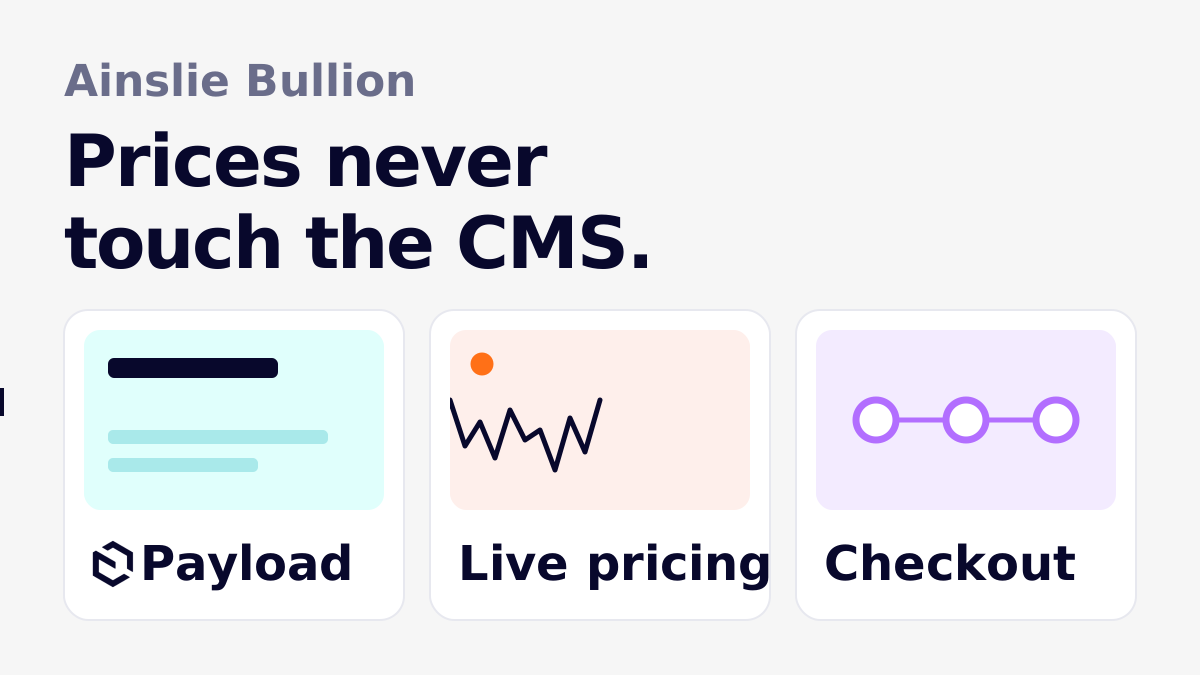
Ainslie sells precious metals, with prices that move constantly. They needed a fast, editable website that never interferes with live pricing or checkout.
Layer | What runs it | Why |
|---|---|---|
Content, products, SEO | Payload + Next.js | Fast, cacheable, editable by Ainslie's team |
Live pricing | Ainslie's own pricing system | Prices never pass through the CMS |
Checkout | Ainslie's existing platform | Transactions stay with the system of record |
The lesson: Payload is an excellent content platform, not a replacement for every business system. Used that way, it modernised the website without rebuilding what already worked.
bfj.digital: our own site plus others
We run our own website on Payload, so every pattern we recommend has been tested on us first.
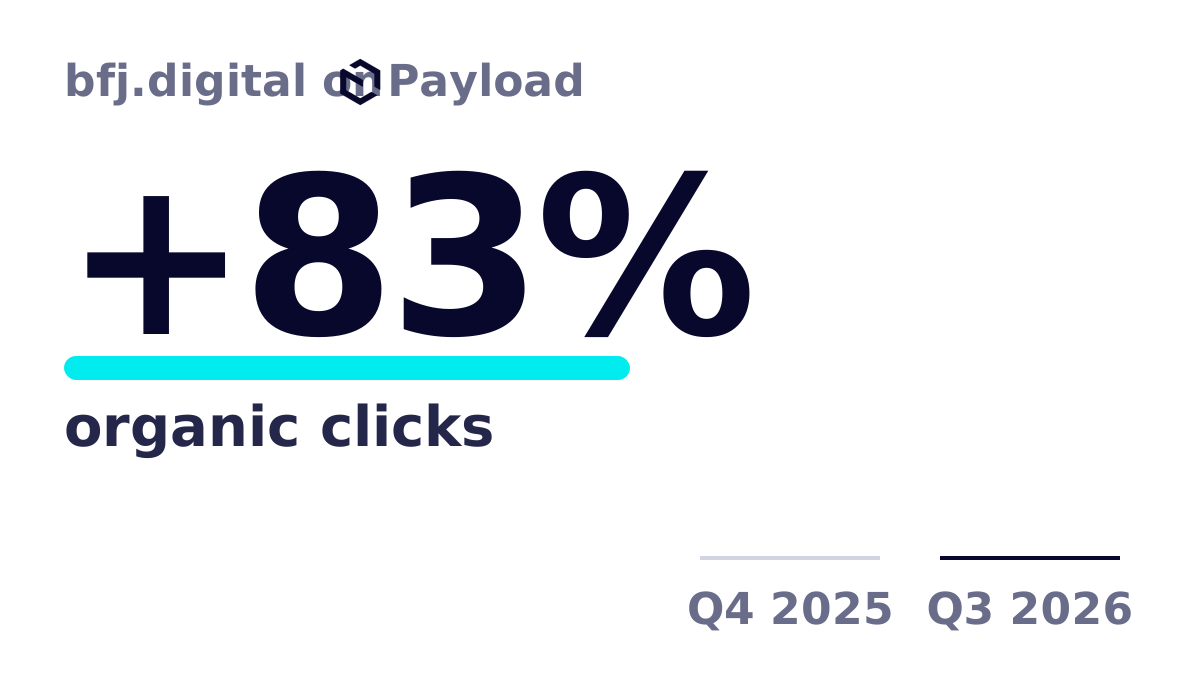
bfj.digital, Australia (Google Search Console) | Oct–Dec 2025 | Jul–Sep 2026 | Change |
|---|---|---|---|
Organic clicks | 607 | 1,109 | +83% |
Impressions | 366,634 | 355,907 | −3% |
Click-through rate | 0.17% | 0.31% | +88% |
Average position | 30.6 | 16.8 | 13.8 places higher |
Average position in Search Console is impression-weighted, so it shifts with the mix of searches you appear for. And Payload alone didn't cause this. The result comes from the combination: a fast Payload and Next.js build, technical SEO, better content and ongoing optimisation. The platform makes that work easier to do well.
We also now rank on page one for Payload development searches across Australia, including first for "payload website development brisbane".
The commercial opportunity for businesses
For businesses, faster builds create real options:
- Get to market sooner. Campaign and product pages launch in days, not weeks.
- Spend the effort where it counts. Less time on front-end production means more on strategy, CRM integration, tracking and performance: the parts that drive revenue.
- Test more. Cheaper pages mean more landing page tests and more learning.
- Own the asset. On an open source platform, the website is a business asset you control, not a subscription you rent.
The businesses that benefit most will treat the website as the start of a system, connected to their CRM, measured properly and improved every month, not as a one-off build.
What AI still doesn't solve
A website that looks finished isn't necessarily working. Make speeds up the build. It doesn't do this:
- Integration: forms that actually reach your CRM, and data that flows to sales. See our HubSpot CRM integration work.
- Measurement: tracking, attribution and reporting set up before launch, not after.
- Search: technical SEO, site migrations, redirects and visibility in AI search.
- Quality: accessibility, performance and security hardening.
- Judgement: which pages to build, for whom, and why.
That is where most websites succeed or fail, and where most of a project's commercial value sits.
Payload vs traditional CMS platforms
There is no single best CMS. Here is how we think about it:
Payload | WordPress | Webflow / Framer | SaaS headless CMS | |
|---|---|---|---|---|
Software model | Open source (MIT) | Open source (GPL) | Proprietary platform | Proprietary platform |
Hosting choice | Anywhere | Anywhere | Mostly the platform; export options vary | Front end anywhere; content with the vendor |
Flexibility | Very high | High | Medium | High |
Integrations | Code-level | Plugins or custom code | More limited | Code-level via APIs |
Best for | Custom sites tied to business systems | Content sites with a familiar editor | Simple marketing sites | Large multi-channel content teams |
We still build and host WordPress websites, and for many businesses it remains the right choice. We recommend Payload when a site is core to how a business sells, needs deep integration, or should be fully owned.
What we're testing next
We haven't finished our own Figma Make trial, and we won't claim time savings until we have. We are testing Make + Payload against our existing AI-assisted workflow on a real page, and assessing:
- End-to-end delivery hours
- Code quality and maintainability
- Payload content structure
- Export to GitHub and freedom to host anywhere
- Responsive design and accessibility
- Technical SEO and performance
- Security
- CRM and analytics integration
We will publish the results, including where it falls short.
FAQ
What is Figma Make with Payload? Figma Make now generates a working back end alongside the design: a database, file storage, user logins and a Payload content admin, so prototypes can become editable websites.
Is Payload CMS still open source after the Figma acquisition? Yes. Payload's maintainers have confirmed it remains MIT-licensed and self-hostable.
Do I still need an agency if I use Figma Make? For a simple page, perhaps not. For a website that connects to your CRM, tracks revenue, ranks in search and stays secure, yes. That is where most of the work and value sits.
Should I move my WordPress site to Payload? Not automatically. If your site works and mainly needs content updates, WordPress may still be right. Payload makes sense when integration, performance or ownership are holding you back.
The bottom line
The tools used to build websites are changing rapidly. The commercial purpose of a website isn't. Businesses still need to attract customers, generate revenue and connect their digital systems.
Figma and Payload could dramatically reduce the effort required to build the technology. The opportunity is to invest more of that effort in making the technology perform.
That's where we see the future of website development.
Considering a new website or reviewing your CMS? We'll help you work out the right technology and architecture, then connect it to the systems that drive revenue: your CRM, tracking and reporting.
Talk to our Payload CMS team · See how we connect websites to HubSpot
Sources: Figma announcement, 15 October 2026 (Techzine coverage); bfj.digital Google Search Console data via BFJ Labs, Australia, Oct–Dec 2025 vs Jul–Sep 2026; Payload rankings 1 Jul–14 Oct 2026.
Ben Henzell
Ben Henzell founded BFJ Digital with a simple belief: great marketing should help businesses genuinely grow, not just look good on paper. With over 20 years in the industry, Ben has seen marketing evolve from billboards and print ads to the complex digital ecosystem we navigate today. That perspective is invaluable.
He's worked across traditional and digital channels, giving him a real understanding of what actually moves the needle for businesses. Ben's approach is refreshingly straightforward—he'd rather have an honest conversation about what will work than oversell a flashy strategy.
His Bachelor of Business in Advertising and Marketing gave him the foundation, but it's the two decades of real-world experience that make him someone clients trust when big decisions need to be made.
At BFJ Digital, Ben has built a team that shares his values: do great work, be honest with clients, and focus on results that matter. If you're looking for someone who genuinely cares about your business success and has the experience to back it up, that's Ben.
Ready to See the Bigger Picture?
Want to understand how your digital and real-world marketing impact each other? Not sure if your CRM is supporting your paid media efforts? Just need some clarity and a clear plan to better ROI? Book your free strategy session today for an in-depth audit and action plan to double your digital marketing ROI.
- Meet with a strategy specialist to build a growth plan
- Increase your media performance by up to 200%
- Improve business efficiencies to increase ROI via automation and increase profit
- We cut to the chase. What digital marketing is actually working?