Programmatic Advertising in a Fragmented Media Market

Nivi Pillai
Keep ahead of the curve via our latest trends newsletter.
Contact us nowMost marketers think media fragmentation is a reach problem. In reality, it's becoming a commercial control problem. The reach maths is the easy part now. The hard part is proving what your budget actually bought once it's spread across a dozen platforms that each grade their own performance.
The money has followed the audience. Australian advertisers spent $5.4 billion on video in 2025, with video taking a 29 per cent share of all online advertising. That spend now spreads across broadcaster catch-up, YouTube, social video, connected TV and a growing list of ad-supported streaming services.
Each of those environments sets its own targeting, its own reporting standard and its own view of what worked. Add enough of them to a plan and you start paying twice for the same viewer, losing control of frequency, and relying on platform reports that can't show you the full picture.
None of that is a reason to pull back, because the audience is still there and advertisers are still growing their video budgets. The real question is how you buy across these environments while keeping control of the money. This is the case for buying programmatically and measuring independently, so a growing media footprint still shows up as growth on your P&L.
What is media fragmentation?
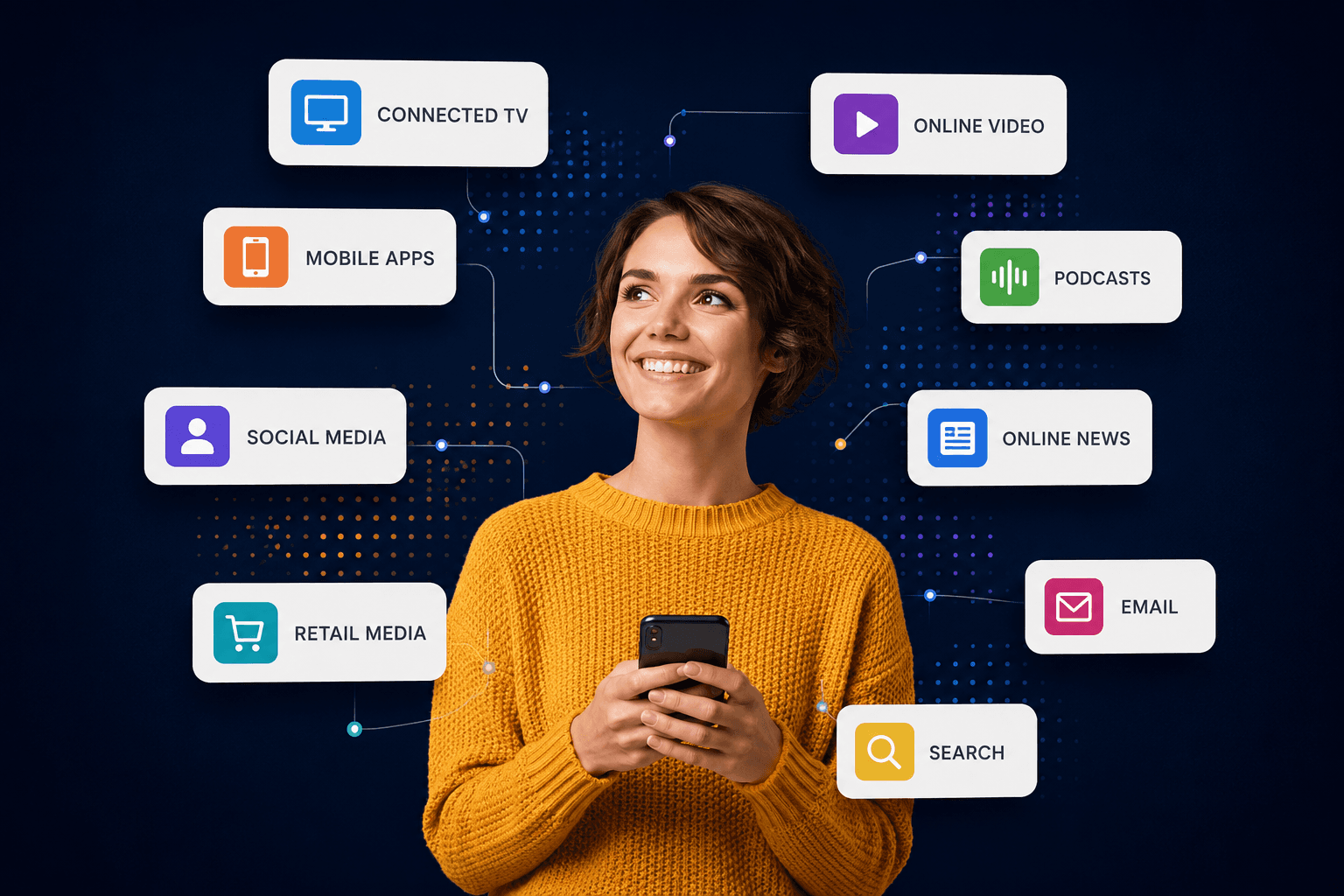
A generation ago, a handful of channels delivered most of the video audience in one place. That audience has since broken apart across broadcaster video on demand from Seven, Nine, and Ten, ad-supported platforms like YouTube and Tubi, social video on Meta and TikTok, and paid streaming services that have opened up to advertising.
The numbers show how uneven the split has become. Social video grew 35 per cent in 2025 to reach $2.2 billion, while broadcaster video on demand grew 7 per cent to around $500 million. Connected TV keeps taking a larger share of publisher video inventory. Every one of these environments wants a line in your media plan.
Most of them operate as walled gardens. A walled garden is a platform that controls its own inventory, its own audience data, and its own reporting. You can buy space and read results, but only on the platform's terms and only inside its walls. Google, Meta, Amazon, and now the major streaming services all work this way.
Disney+ is the most recent to build one. In April 2026, Disney+ launched its Standard with Ads plan in Australia and New Zealand at $9.99 a month, opening its inventory to local advertisers for the first time. It is selling that inventory through Disney’s own advertising team and its own ad technology.
The move followed slowing subscriber growth, with Disney+ sitting at around 3.3 million Australian subscribers behind Netflix and Prime Video. It also puts Disney+ alongside Netflix, Prime Video and Binge, which already run ad-supported tiers. Disney is the latest confirmation of a pattern that adds a new walled garden to the market every few months, making the buying and the measuring a little harder.
Media buying has become a commercial decision
When there were a handful of places to buy video, placement was the job. Book the inventory and confirm that it delivered. That work is now automated, and it is the least valuable part of the process.
The real job is allocation. You decide where the marginal dollar goes across a dozen environments, and at what frequency, to hit a commercial target. That is a finance decision more than a media decision, and it has pulled the media manager's role much closer to the P&L. The industry has already noticed. When agencies buy connected TV programmatically, the single most common demand is frequency control, named by half of all buyers. They know that uncapped frequency across platforms is one of the fastest ways to waste a video budget.
- Allocation is the hard part. Buying into Disney+ takes a few clicks. Working out if the incremental reach justifies the CPM premium against your cost per acquisition target is the real work.
- Working media ratio decides the real cost. Working media is the share of your budget that reaches an audience, rather than the share consumed by platform fees and management time. Every new platform you add directly can lower that ratio, and the true cost of a fragmented plan stays hidden until you track it.
- Frequency is a portfolio decision. The same viewer is reachable on Disney+, Netflix, YouTube, and broadcaster catch-up in the same week. Controlling how often you hit that person across platforms, rather than inside each one, has a measurable dollar value.
You cannot use a platform's own report as your source of truth
The platform selling you the inventory also grades the results. Walled gardens mark their own homework, and they mark it generously.
This is not a claim that platforms lie. It is a structural point. Self-reported numbers are built to flatter the platform, and they cannot see anything that happens outside the garden. The industry data backs this up.
Buyers report that the quality of measurement signals varies widely across video environments, and ad-supported streaming platforms sit at the bottom of that list for consistent, reliable signals. Nine in ten agencies plan their video across screens as one exercise, yet one in four rarely or never bring the results back together the same way. The plan is unified and the scorekeeping is not.
- Every platform claims the conversions it touched. Add up the self-reported conversions from Disney+, Meta, Google, and your broadcaster partners and the total will comfortably exceed your actual sales. Each one counts the same conversion as its own.
- The metrics do not reconcile. An impression on one platform and a completed view on another are not the same unit. Stack them side by side and you imply a comparison that does not exist.
- You only see the wins. Dashboards report the outcomes a platform wants credit for. They hide the sales you would have made anyway, which is the one figure that tells you if the spend was incremental.
What the dashboard shows | What it leaves out | What it costs you |
|---|---|---|
Self-attributed conversions | The overlap with every other channel claiming the same sale | Budget drifts to whichever platform reports best, regardless of real performance |
Platform-defined views and completions | A common standard to compare against other media | Plans built on numbers that never reconcile |
In-garden reach | Duplicated audience you have already reached elsewhere | Paying again to reach the same viewer |
Reported return on ad spend | Incremental lift against sales you would have won anyway | Spend justified by activity rather than outcome |
How to buy a fragmented market without losing control
Follow the audience into these environments, then consolidate the buying and the measurement so fragmentation does not work against your budget. This is where programmatic earns its place.
- Consolidate buying through a demand-side platform. A demand-side platform, or DSP, is a single system that buys advertising across many environments at once, including open web inventory and a growing amount of connected TV. It gives you one place to set targeting, one place to control spend, and one reporting view across platforms that would otherwise each sit behind their own login. Australian buyers are already moving this way, with almost half planning to increase programmatic connected TV investment this year
- Plan reach and frequency at the audience level. Deduplicated planning means you buy a total audience and control total frequency across every platform, instead of funding overlap you cannot see. This is the direct fix for paying twice for the same viewer.
- Run one measurement layer above the platforms. Server-side tracking, GA4, and media mix modelling give you a neutral source of truth, so the call on what worked does not come from the platform that was paid to run the ads.
- Judge channels on incremental lift. Incrementality is the extra sales you would not have made without the spend. Geo holdout tests and lift studies measure it directly, and that number, rather than a platform dashboard, should decide where the next dollar goes.
- Keep an independent partner in the buying. An agency that sells you no inventory has no reason to favour one platform over another. That independence is what keeps the measurement honest and the budget working.
Some environments still sell direct and keep their own measurement, so no single system captures everything. Where you have to buy direct, an independent measurement layer still holds every platform to the same standard. You can read more on how the buying itself works in our guide to programmatic advertising and how the largest retail platform runs it in our explainer on Amazon DSP.
What we check before we trust a platform’s number
Before we accept a platform’s number, we ask four questions.
Did another channel also claim this conversion? Is the metric comparable to the rest of the plan? Are we reaching a new audience, or paying again for people already reached elsewhere? Did the spend create incremental demand, or only claim demand that already existed?
Until those questions are answered, a platform report is only the starting point for analysis, not the final word on performance.
What this means for your next media plan
Fragmentation is the market you are buying in, and it rewards a clear method. Follow the audience into new environments, because that is where attention has gone. Buy as much of it as you can through one programmatic system, so your targeting and reporting sit in one place instead of behind a dozen separate logins. Hold every platform to a single measurement standard that you own and control. Judge each channel on the sales it genuinely added, then move the budget accordingly.
Done this way, a fragmented market stops being a threat to your budget and becomes an advantage for advertisers organised enough to buy it well.
Talk to us about your media plan
If you want a neutral read on where your video and programmatic budget is actually working, our team can review your current plan and measurement setup and show you where fragmentation is quietly adding cost. See how we run programmatic advertising or get in touch.
Frequently asked questions
What is media fragmentation in advertising?
Media fragmentation is the splitting of audiences across a growing number of platforms and ad tiers. As viewers move between streaming, broadcaster catch-up, social video and ad-supported subscription services, no single channel delivers the reach it once did. It also makes planning, frequency control and measurement harder.
Should we expand our advertising into new streaming platforms?
Yes, if that is where your audience is watching. The point is not to avoid new channels. It is to expand in a controlled way, using programmatic buying where possible, planning frequency across platforms, and measuring every channel against one standard.
Why can’t I trust the reporting inside platforms like Disney+ or Netflix?
Platform reports are useful, but they are not neutral. Each platform uses its own definitions and attribution windows, and each one can only see what happens inside its own environment. Use the report as an input, then validate it against independent measurement.
How does programmatic advertising help with fragmentation?
Programmatic buying gives you a single point of control across open inventory and a growing share of connected TV. It helps reduce duplicated reach, manage frequency and keep reporting more consistent. It does not remove every walled garden, so independent measurement is still essential.
What does an agency do that a platform cannot?
An independent agency is not selling its own inventory, so it can hold a neutral view of performance. That means comparing platforms on common standards, testing incremental lift, managing frequency across environments, and showing the true cost and return of each channel.
Nivi Pillai
Nivi Pillai brings 15+ years of digital marketing experience across four continents, and honestly, it shows in everything she does. Her career has spanned EMEA, India, Singapore, and Australia, where she has been based for over six years.
Beginning her journey at Yahoo, Nivi partnered with global brands on performance and content-led campaigns before progressing to deliver integrated strategies across technology, finance, property, and professional services sectors.
Throughout her career, Nivi has specialised in translating complex business challenges into clear, measurable digital outcomes by bringing together data, creativity, and commercial insight.
Her approach blends strategic vision with hands-on execution, ensuring campaigns not only engage audiences but deliver tangible business impact. Nivi's leadership has been recognised with multiple awards, including leading one of the first complete site takeovers on Yahoo India for Star Network's television show Satyamev Jayate, which became a global case study. She has also been honoured as Most Valuable Player multiple times across Yahoo and Dentsu for consistent performance and campaign success.
As Head of Digital Solutions at BFJ Digital, Nivi works closely with clients to design results-driven digital strategies covering lead generation, SEO, programmatic advertising, and CRM enablement, helping businesses harness digital power for sustainable growth.
Ready to See the Bigger Picture?
Want to understand how your digital and real-world marketing impact each other? Not sure if your CRM is supporting your paid media efforts? Just need some clarity and a clear plan to better ROI? Book your free strategy session today for an in-depth audit and action plan to double your digital marketing ROI.
- Meet with a strategy specialist to build a growth plan
- Increase your media performance by up to 200%
- Improve business efficiencies to increase ROI via automation and increase profit
- We cut to the chase. What digital marketing is actually working?