How much does SEO cost in Australia? (2026)

Sarah Halliday
Digital Account Manager at BFJ Digital
Keep ahead of the curve via our latest trends newsletter.
Contact us nowMost Australian agencies charge between $1,500 and $5,000 a month for an SEO retainer, with hourly rates of about $80 to $250. Our own retainers start at $3,000 a month. Below, we explain what each level buys, how to tell whether it's paying off, and what to ask before you sign.
SEO (search engine optimisation) is the work that helps your website show up when people search on Google, and increasingly when they ask AI tools like ChatGPT.
What SEO costs in Australia
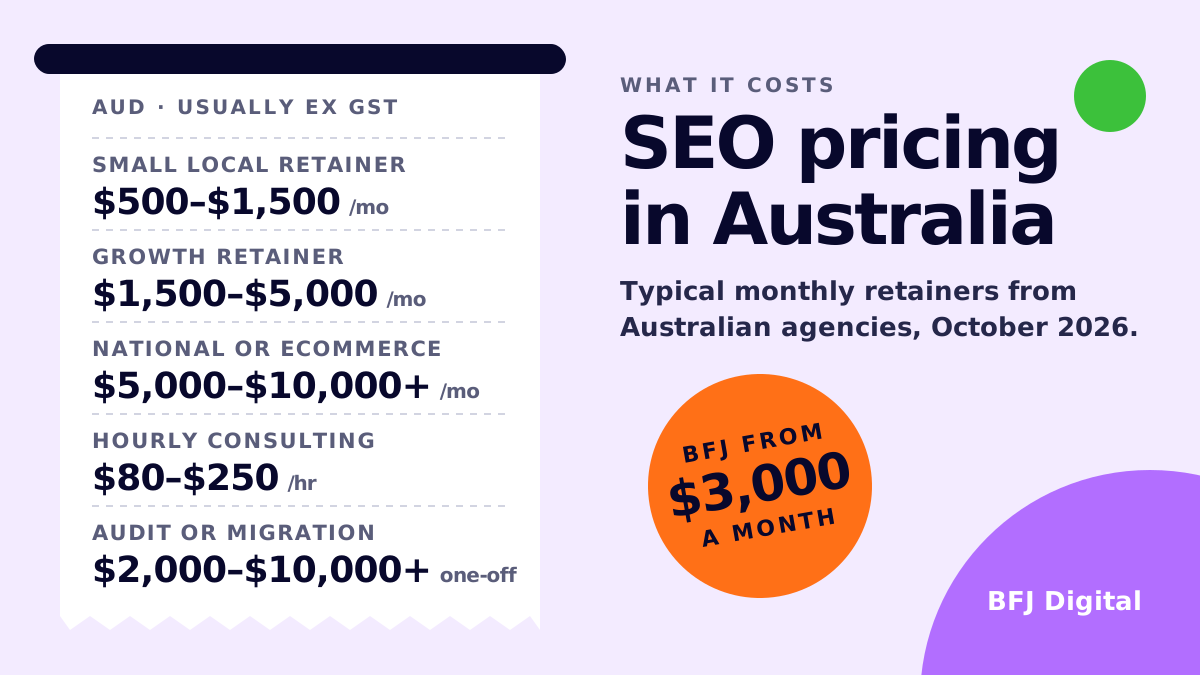
These ranges come from a review of pricing published by Australian agencies in October 2026. Figures are in Australian dollars and usually exclude GST.
Option | Typical range (AUD) | What it usually covers | When it fits |
|---|---|---|---|
Small local retainer | $500 to $1,500 a month | A light audit, a handful of keywords, basic on-page fixes and Google Business Profile updates. | A small local business with a few services in a low-competition area. |
Growth retainer | $1,500 to $5,000 a month | Ongoing content, technical fixes, link building and reporting. | Most small to mid-sized businesses that want search to bring in enquiries. |
National or eCommerce retainer | $5,000 to $10,000+ a month | Full strategy, content at scale, digital PR and technical work across large sites. | National, multi-location or eCommerce businesses in competitive markets. |
Hourly consulting | $80 to $250 an hour | Advice, reviews and urgent fixes. | You have an in-house team and want a second set of eyes. |
One-off audit or migration | About $2,000 to $10,000+ | A technical audit, a site migration or a content plan. Price depends on site size. | You have a specific problem to fix first. |
Where BFJ Digital sits
Our SEO retainers start at $3,000 + GST a month. That covers technical fixes, new and improved pages, link building, and monthly reporting connected to your CRM. What's included depends on your site, your market and what you want to achieve, so we scope it on a call.
Two things to be wary of at any price. First, tactics designed to manipulate rankings rather than help people, such as buying links or publishing pages at scale that add nothing for the reader. Both are against Google's spam policies, and fixing a manual action against your site costs time, money and visibility. Second, promises of page-one rankings. No one controls Google's results, so no one can honestly guarantee them.
What drives the cost
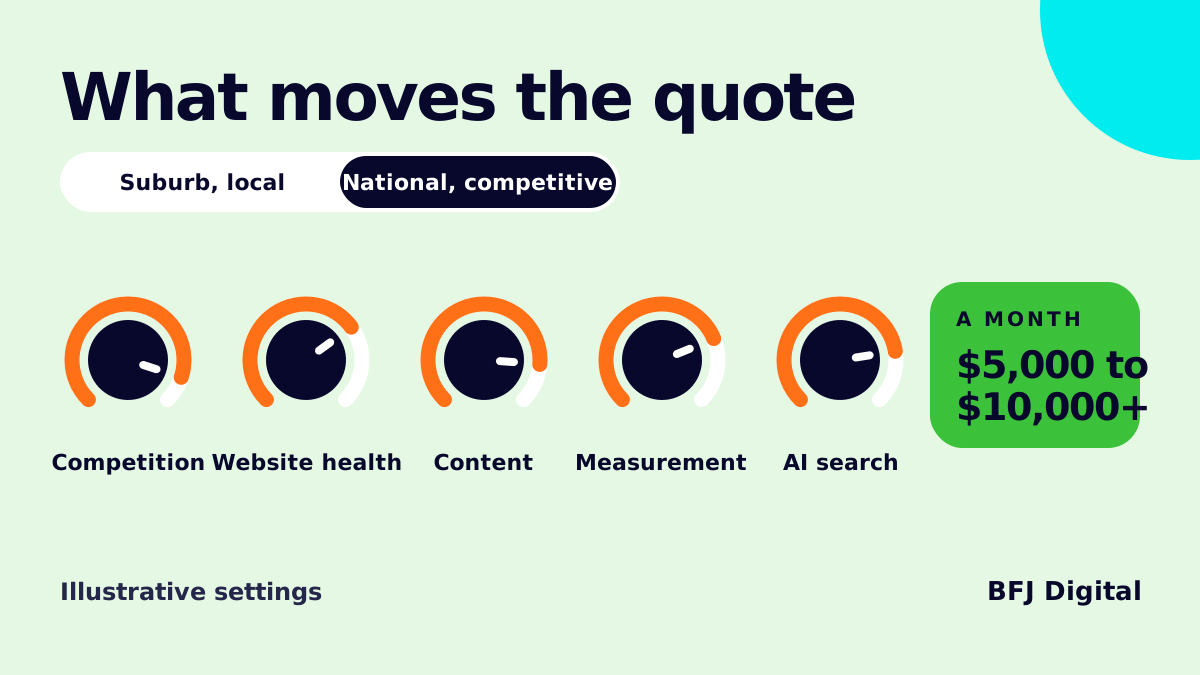
Two businesses can get very different quotes for "SEO" and both can be fair. It usually comes down to five things.
Cost driver | What pushes the cost up | What to ask |
|---|---|---|
Competition | Chasing national or capital-city searches against well-funded competitors, rather than suburb or niche searches. | Which searches are you targeting, and how many people make them each month? |
Website health | A slow site, broken redirects after a migration, or pages Google can't read properly. These need fixing before anything else works. | What needs fixing first, and how long will it take? |
Content | New service, location or industry pages each month, written properly rather than padded out. | How many pages, who writes them, and who checks them? |
Measurement | Connecting your website and CRM (customer relationship management system) so enquiries and sales carry their source. | How will I see which pages and channels bring in enquiries and revenue? |
AI search | Tracking and improving how often tools like ChatGPT, Gemini and Perplexity mention your business. | Do you measure AI visibility, and how? |
How we measure whether SEO is paying off
Rankings and traffic are early signs. Revenue is the result. We connect enquiries and sales to their recorded sources, and flag the gaps.
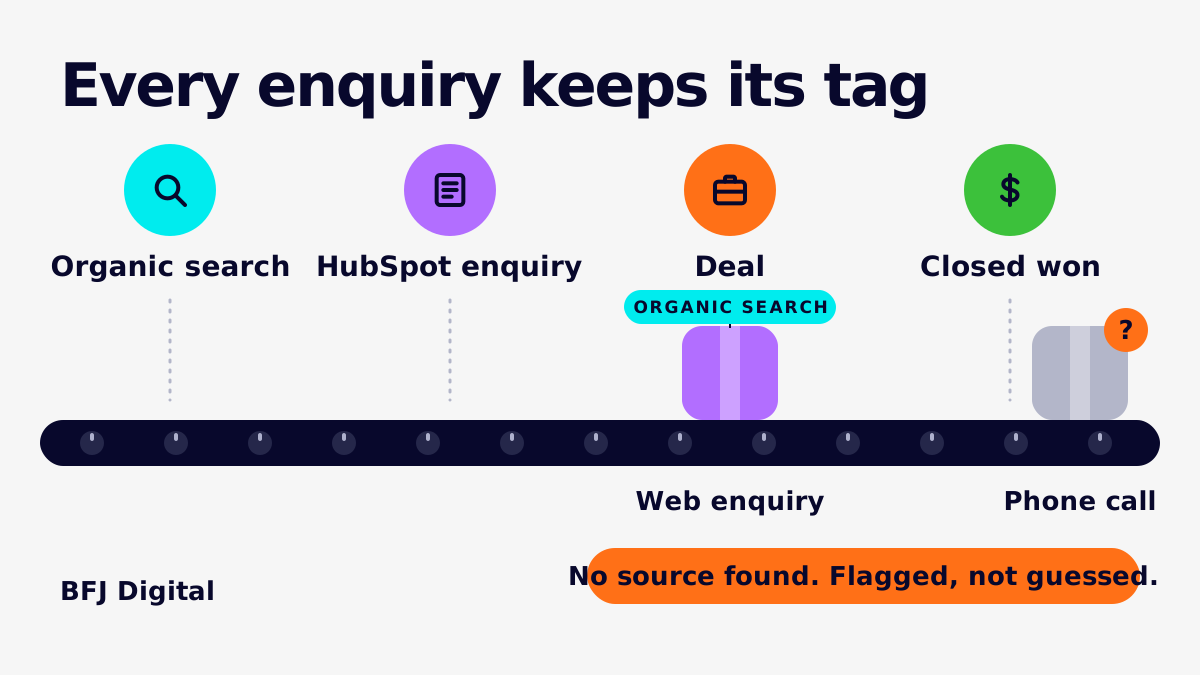
- Enquiries land in your CRM with their recorded source. When someone fills in a form, HubSpot records the first known source, such as organic search, and the page they landed on. Tracking has limits, such as cookie consent and people switching devices, so some enquiries arrive without a clear source.
- That source stays with the deal through to the sale. When the enquiry becomes a deal and closes, the revenue sits against the channel recorded for it.
- Online sales are tracked by channel. For eCommerce, GA4 (Google Analytics 4) records the channel for each sale it can attribute.
- Gaps are flagged, not filled in. Phone calls are the common one. Where a call can't be linked to a source, we say so in the report rather than guess.
One limit applies to organic search in particular. Google Search Console reports organic keywords in aggregate, so no tool can tell you which exact organic keyword produced a specific lead. We report organic performance at the page and channel level instead, which is enough to decide where the next dollar goes.
As a HubSpot Diamond Partner, we set up the CRM side of this ourselves. Labs, our reporting platform, then brings Search Console, GA4, call tracking and HubSpot into one monthly report, so you see search, enquiries and revenue side by side. The work doesn't stop at launch. Each month we use what the data shows to decide what changes next.
What this looked like for Ainslie Bullion
Ainslie Bullion is a precious metals dealer we've worked with across SEO, paid media, CRM and analytics. Between FY2023/24 and FY2025/26:
- Organic search revenue grew 10.1 times.
- Sales referred by AI assistants, such as ChatGPT, now show up as their own channel in GA4.
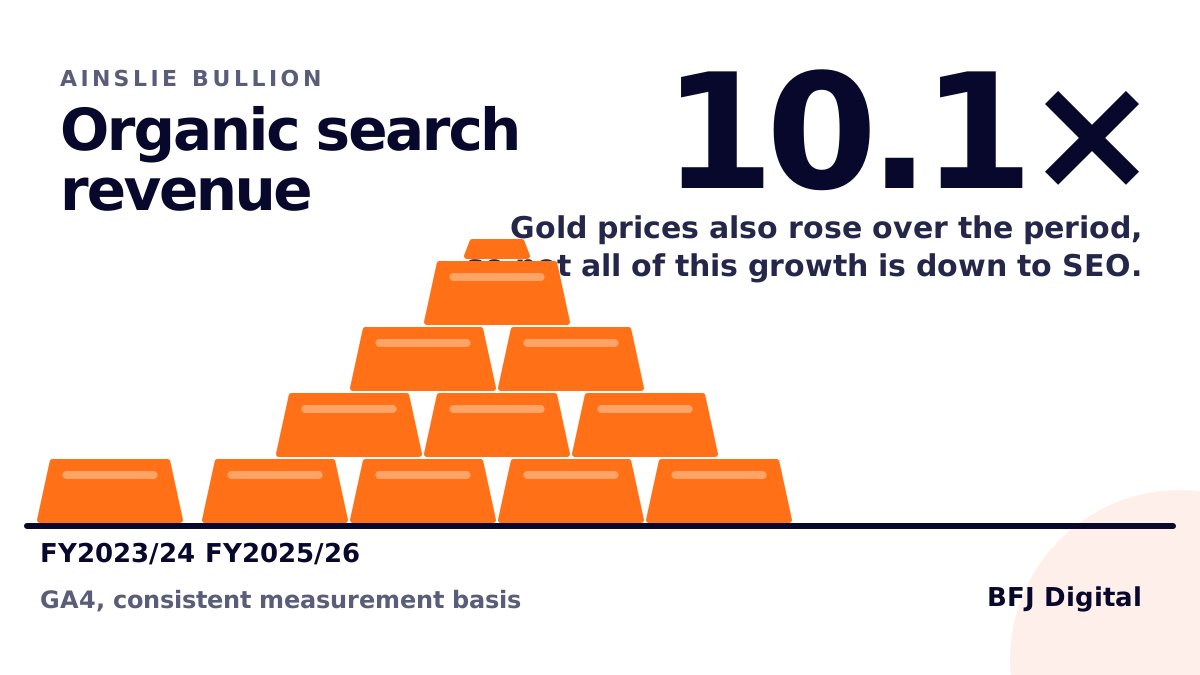
That's what the data shows. Here's how we read it. Gold prices rose over the same period, which lifted revenue across Ainslie's business, so not all of that growth is down to SEO. What we can say is that organic search grew strongly over two years, and AI assistants have appeared as a new source of sales worth watching.
Is it worth it? A worked example
This example is illustrative. Swap in your own numbers. Count only the additional enquiries the SEO work brings in, not business that would have found you anyway.
Step | Example figure |
|---|---|
Annual SEO investment | $48,000 ($4,000 a month, ex GST) |
Additional qualified enquiries from organic search | 8 a month, 96 a year |
Close rate | 20%, so about 19 new clients |
Average gross profit per client, first year | $4,000 |
Gross profit generated | About $76,000 |
Gross profit after the SEO investment | About $28,000, before other overheads |
Gross profit generated per dollar invested | About $1.60 |
Break-even point | 12 new clients a year, or about 5 additional qualified enquiries a month |
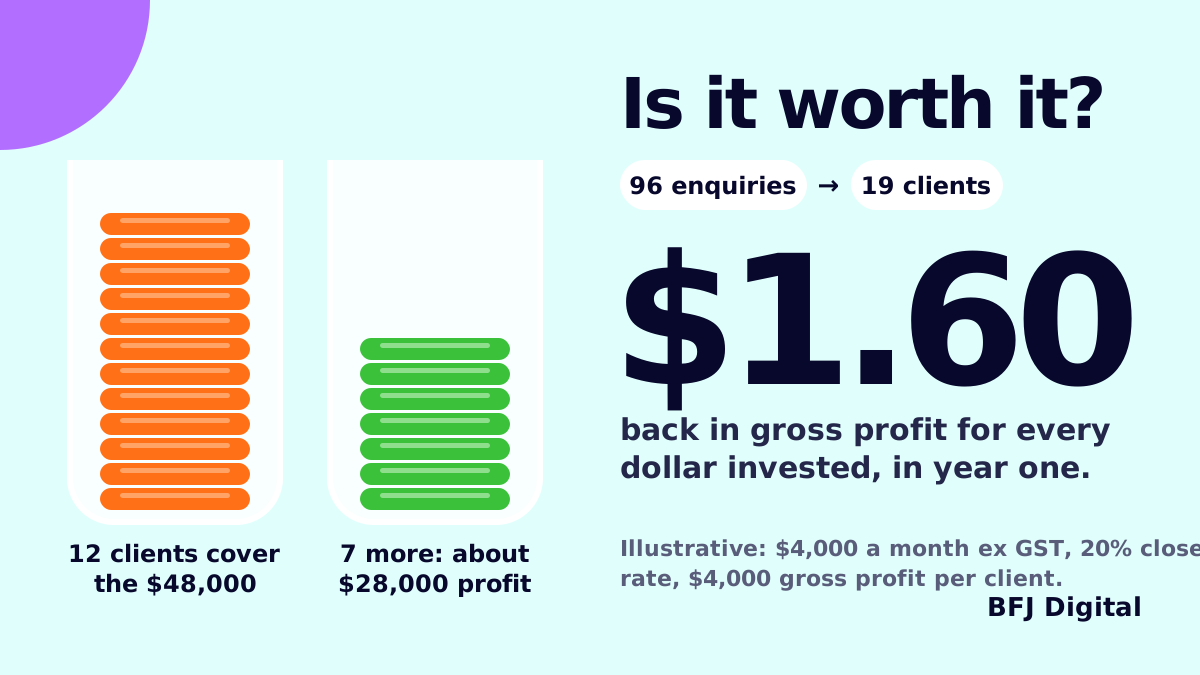
Year one is usually lower, because results build over months. If clients keep buying from you for years, the return grows over time, but judge payback over the same period you're paying for the work.
SEO now includes AI answers
More buyers now ask ChatGPT, Gemini or Perplexity before they search Google. These tools name a few businesses in their answers. If yours isn't one of them, you've missed that buyer early.
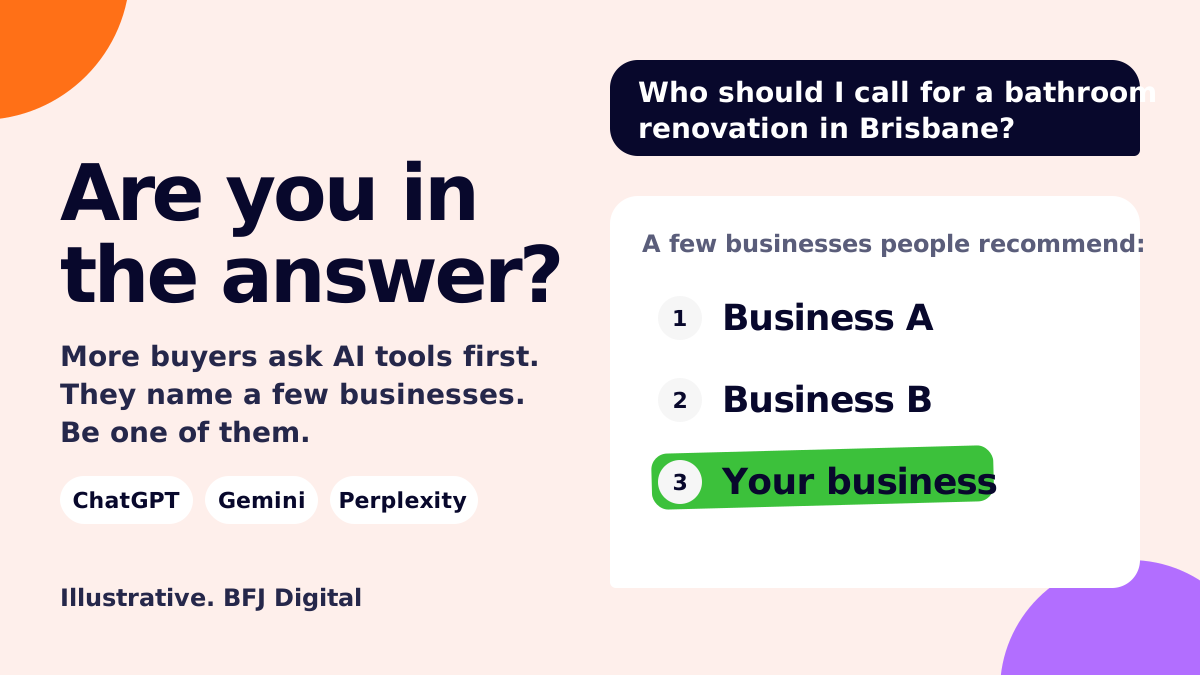
We track how often AI tools mention our clients in Labs. We focus on questions that don't already include the business name, because being recommended to a new buyer matters more than being found by someone who already knows you. Ask any SEO partner how they measure this.
Six questions to ask before you sign
- What will you change in the first 90 days, and why those things first?
- How will I see which pages and channels bring in enquiries and revenue, not just visits?
- What happens after the work goes live? Who checks it's still working in month six?
- How do you track whether AI tools mention my business?
- Who actually does the work, and who do I talk to?
- Can I see a real report you've sent a client, with the names removed?
If the answers are vague, the reporting probably will be too.
Common questions
How long does SEO take to work? Usually months rather than weeks. Technical fixes can show early movement. Content and authority take longer to build. A good partner shows you the early signs, like impressions and positions moving, well before enquiries pick up.
Is SEO worth it for a small business? It can be, if the searches you target are ones your customers actually make. A local service business often gets more from a handful of strong suburb and service pages than from chasing broad, competitive terms.
Do I need SEO and Google Ads? Not always, but they work well together. Ads bring in enquiries now. SEO builds a source of enquiries you don't pay for per click. Ad data also shows which searches convert, which helps decide where SEO effort goes.
Can I do SEO myself? Some of it, yes. Keeping your Google Business Profile current and writing clear service pages makes a real difference. Technical fixes and measurement are where most businesses need help.
Your next step
If your current SEO report shows rankings but can't show which enquiries and sales came from search, that's worth asking about.
There are two ways to start:
- Run our free 4-minute website check. It's an automated scan that shows technical and on-page issues straight away. It's a quick health check, not a full strategy audit. Ask us to run it.
- Request a scoped SEO proposal. We'll review your site, your CRM data and your market, then quote against what you want to achieve. Request a proposal.
Sarah Halliday
Sarah Halliday is a Digital Account Manager at BFJ Digital, bringing ten years of experience across digital marketing, SEO, client management, and project delivery. Based in Brisbane, Sarah specialises in helping clients connect marketing performance to tangible business outcomes through strategic planning and execution.
Her career progression demonstrates her versatility and expertise, having previously served as an SEO Specialist and Account Manager, where she developed strategies that improved visibility, traffic, and conversions for diverse client portfolios. Earlier roles included Digital Marketing Manager, Client Marketing Manager, and Digital Projects Manager, where she coordinated websites, SEO initiatives, and creative deliverables across multiple concurrent projects.
Sarah's dual degree in Business and Creative Industries, with concentrations in Marketing and Art History and Design, provides her with a unique perspective that combines analytical rigour with creative thinking.
Known for her strong work ethic and people-first approach, Sarah excels at bridging technical execution with meaningful client relationships. Her professional interests span SEO, digital strategy, client engagement, and sustainable business growth, making her an invaluable partner for clients seeking both strategic insight and reliable project delivery.
Ready to See the Bigger Picture?
Want to understand how your digital and real-world marketing impact each other?
Not sure if your CRM is supporting your paid media efforts? Just need some clarity and a clear plan to better ROI?
Book your free strategy session today for an in-depth audit and action plan to double your digital marketing ROI.