Allied Health Marketing: How to Turn Enquiries Into Booked Appointments

Scott Macfarlane
Operations Manager at BFJ Digital

Keep ahead of the curve via our latest trends newsletter.
Contact us nowKey takeaways
- Plan each service separately, because physiotherapy, psychology and speech pathology patients find and book clinics in different ways.
- Fix missed calls, slow follow-up and ads for booked-out practitioners before you increase your budget.
- Don't rely on a single source of patients. GP referrals and online marketing work best together.
- Choose marketing channels by the bookings they produce, not the traffic they bring.
- Follow AHPRA's advertising rules from the start, and keep patient health information out of ad platforms.
- Judge success by your cost per attended new patient and not by clicks or enquiries.
How many new patients did your marketing bring in last month? Not enquiries or clicks, but patients who booked and turned up?
For most allied health practices, that's surprisingly hard to answer. Your advertising reports show clicks and enquiries, but they rarely show who actually booked. Without that link, it's easy to spend money in the wrong places, such as advertising a practitioner who's already booked out, or judging a campaign on clicks rather than appointments.
It gets harder when your clinic offers more than one service. A physiotherapist may fill their diary from local Google searches, a psychologist may rely mostly on GP referrals, and a speech pathologist may have a long waitlist while a colleague has gaps. Each service needs its own approach.
What does allied health practice marketing involve?
Allied health practice marketing covers everything that helps your clinic attract the right new patients, turn them into booked appointments, and understand what those patients are worth to the business.
In practice, that usually means a mix of local search, paid advertising, referral relationships and a website that makes booking easy. It also means measuring results, so you can see which spending actually leads to appointments.
It's important to remember that allied health isn't one market. Physiotherapy, psychology, podiatry, occupational therapy, speech pathology, dietetics and exercise physiology each attract patients in their own way. What fills a physiotherapist's diary is often very different from what fills a psychologist's, so a single campaign for every service tends to underperform.
That's why your marketing plan works best when it's built service by service. Before deciding on channels or budget, map out three things for each discipline: where its patients come from, how they pay for care, and which practitioners have room in their diary. The rest of this guide follows that approach.
Where allied health practices lose marketing budget
Most wasted marketing budget disappears in the gap between an enquiry and a booked appointment. Your reports can look healthy while your appointment book stays half-empty. These six problems come up again and again.
1. Paying for clicks that don't lead to bookings. Broad keywords can attract people researching a condition rather than looking for treatment. You're paying for traffic that's unlikely to become an appointment.
2. Ranking for keywords that don't bring in patients. A blog about lower back stretches might attract plenty of visitors, but that traffic means little if people aren't moving through to your service pages or booking appointments.
3. Sending visitors to poorly optimised service pages. If patients can't easily find practitioner details, treatment information or a clear way to book, they're likely to leave. Even the best ads can't make up for a confusing website.
4. Losing enquiries before they become bookings. Missed calls, unanswered forms and slow follow-ups can cost your clinic potential patients. Getting the enquiry is only half the job.
5. Promoting services that are already fully booked. Advertising a practitioner with a six-week waitlist can waste your budget, especially when another practitioner has appointments available.
6. Measuring enquiries instead of actual appointments. Calls, form submissions and booking clicks are useful metrics, but they don't tell you how many patients actually booked and attended. That's the number that matters when assessing marketing performance.
The list below shows how each problem tends to appear in your reports, and what you can do about it.
- Low booking rate from paid search. Dashboard shows: high clicks, high cost per conversion. What may really be happening: keywords attract researchers, not bookers, and the landing page lacks availability. Recommended improvement: shift budget to high-intent service and suburb terms, add negative keywords, show real booking options.
- Lots of traffic, few appointments. Dashboard shows: strong sessions, weak conversions. What may really be happening: content ranks for informational terms outside your catchment. Recommended improvement: build bookable service pages by location, keep blogs for trust and link them to booking paths.
- Enquiries that never book. Dashboard shows: healthy lead count. What may really be happening: calls missed, forms unmonitored, slow follow-up. Recommended improvement: call tracking, defined response times, a single owner for enquiry follow-up.
- One service overperforms, others idle. Dashboard shows: good overall lead volume. What may really be happening: demand is pooling on a booked-out practitioner or service. Recommended improvement: reallocate spend to practitioners and services with capacity, pause ads for full books.
- Good "conversions", flat revenue. Dashboard shows: conversion target met. What may really be happening: conversions are clicks and calls, not attended first visits. Recommended improvement: track to confirmed and attended appointments, import that back into reporting.
- Rising cost per lead. Dashboard shows: cost per lead creeping up. What may really be happening: competing on broad terms against aggregators and other clinics. Recommended improvement: tighten targeting, improve page relevance, use first-party data for better audiences.
If your clinic is missing calls while some practitioners still have gaps, more enquiries won't fix the problem. Start by turning the enquiries you already have into bookings with the right practitioners. Otherwise, extra spending simply pays for patients you could already be seeing.
How to balance referrals and direct bookings
Patients reach allied health clinics in several ways. Some are referred by a GP or specialist, some hear about you through word of mouth, and others find you through Google, paid ads or an online booking platform.
Relying too heavily on any one of these is risky. If a key referring GP retires, or your Google rankings drop, bookings can fall quickly. The right mix also depends on the service, as the list below shows.
- Physiotherapy: patients mainly come from GP referrals, Google searches, WorkCover and CTP. Marketing priorities: local SEO, Google Ads and easy online bookings.
- Psychology: patients mainly come from GP referrals, mental health referral pathways. Marketing priorities: strong referral relationships and clear appointment availability.
- Podiatry: patients mainly come from GP and specialist referrals, local Google searches. Marketing priorities: Google Business Profile, local SEO and service pages.
Funding also plays a big role in how patients access allied health services. Since 1 July 2025, eligible patients with a GP chronic condition management plan can access up to five Medicare-subsidised allied health services each calendar year. Aboriginal and Torres Strait Islander patients can access up to ten.
This cap matters when you plan your marketing. If a patient only has five subsidised sessions, the value of each new patient is limited, so it pays to keep expectations realistic. Other funding sources, such as NDIS, private health insurance and WorkCover, each come with their own eligibility, referral and payment rules.
Referrals and digital marketing work best together. One patient might find your clinic on Google, then book only after their GP recommends you. Another might be referred by their GP, then check your website and reviews before making an appointment.
In both cases, each channel supports the other. Strong referral relationships and a solid online presence work together to help patients recognise your name and feel confident booking.
Which digital channels work for allied health practices
There's no shortage of marketing channels. The real question is which ones lead to booked appointments for your services, in your area.
Local SEO and Google Business Profile
Most patients look for allied health services close to home or work. A well-optimised Google Business Profile and strong local SEO help your clinic appear when people search for services in their area.
Keep your clinic details, service categories and practitioner information up to date. If you offer several services, give each one its own page, such as physiotherapy, psychology or podiatry. That way, each service can rank for its own searches, and patients can quickly find what they need.
Google Ads
Google Ads can help attract patients who are actively searching for treatment, particularly when you have appointments available.
Run a separate campaign for each service, target the suburbs you serve, and send people to the matching service page. Negative keywords, such as 'jobs' or 'university courses', stop you paying for irrelevant searches.
It's worth knowing the limits, too. Some allied health services have low search volumes, competition can push up costs, and healthcare advertising rules restrict what you can claim. That's why it pays to track actual bookings, so you can see which campaigns bring in patients.
Website and conversion
Your website should make it easy for patients to understand your services, choose a practitioner and book an appointment.
A well-designed website needs clear service information, practitioner profiles, visible booking options and contact details that are easy to find, especially on mobile.
If your booking button sends patients to a third-party platform, check that your tracking follows them there. Otherwise, you won't know which marketing channels are producing bookings.
Content marketing
Good content marketing answers the questions patients are already asking and helps them understand their treatment options.
Focus on articles that answer common patient concerns and link through to the relevant booking page. A handful of well-researched articles will usually do more for you than dozens of generic health blogs that attract traffic but few appointments.
Other marketing channels
Email can help you stay in touch with referrers and, where appropriate, existing patients. Social media is useful for building trust, introducing your practitioners and showing what your clinic is like.
Finally, don't overlook your referral network. Simply letting local GPs know a practitioner has availability can sometimes fill appointments faster than a new ad campaign.
AHPRA advertising rules and what they mean for allied health
Healthcare advertising in Australia is tightly regulated, but not every allied health profession follows the same rules. Professions regulated by AHPRA, including physiotherapy, psychology, podiatry, occupational therapy, osteopathy and chiropractic, must follow Section 133 of the Health Practitioner Regulation National Law.
Other professions, such as speech pathology, dietetics, exercise physiology, audiology and counselling, are generally self-regulated through their professional associations. They still need to follow Australian Consumer Law, which prohibits misleading advertising.
If your clinic advertises several services together, the simplest approach is to apply the stricter AHPRA standards to all of them.
What does Section 133 prohibit?
Under Section 133, advertising for regulated health services must not:
- Make false, misleading or deceptive claims.
- Offer discounts, gifts or incentives without clearly stating the terms.
- Use testimonials about clinical care, treatments or outcomes.
- Create unrealistic expectations about treatment results.
- Encourage unnecessary or excessive use of healthcare services.
These rules apply to your website, Google Ads, social media advertising and other promotional content.
For a more detailed breakdown, read our guide to what AHPRA Section 133 means for your Google and Meta Ads.
Can allied health clinics use patient reviews?
Patient reviews are a common source of confusion. AHPRA doesn't allow testimonials about the clinical side of care in advertising your clinic controls. That includes comments about treatment, a practitioner's skill or health outcomes.
Comments about the non-clinical experience are generally fine. Praise for friendly reception staff, easy parking or a simple booking process, for example, can usually be used.
Independent reviews, such as those on Google, are treated differently from testimonials you publish yourself. You generally don't need to remove genuine, unsolicited reviews from these platforms. However, you should avoid reposting or promoting any that make clinical claims.
Don't overlook patient privacy and website tracking
Your marketing also needs to comply with privacy law, and website tracking is a common blind spot.
The Office of the Australian Information Commissioner (OAIC) has taken action against healthcare businesses, including Monash IVF and Medmate, over the use of website tracking pixels that disclosed sensitive information to third-party platforms.
If your clinic uses Google Analytics, Meta Pixel or similar tools, review what information they collect and where it goes. Sensitive health information should never be sent to advertising platforms.
How to measure allied health marketing performance
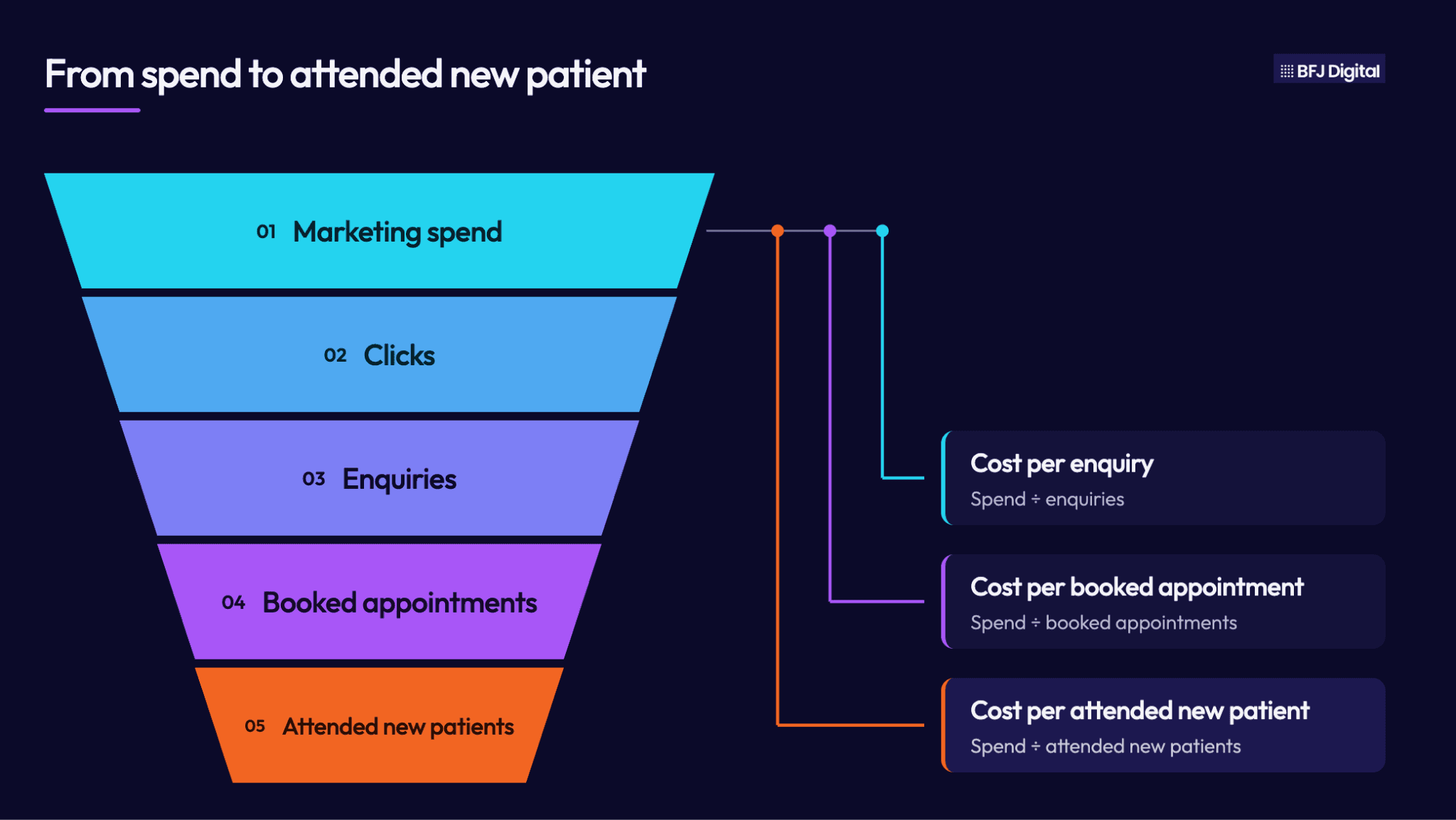
Impressions, clicks and website sessions show activity, but they don't tell you whether your spending produced patients. To find that out, follow each patient's path from first click to first appointment, and work out what each step costs.
That path usually runs from an ad or search result, to an enquiry, to a confirmed booking, and finally to an attended first appointment. Each step has its own cost, and each cost tells you something different.
Here's an example. A practice spends $3,000 on advertising in a month and receives 60 enquiries. Of those, 30 people book, and 24 turn up to their first appointment.
- Cost per enquiry is $3,000 divided by 60, which is $50.
- Cost per confirmed booking is $3,000 divided by 30, which is $100.
- Cost per attended new patient is $3,000 divided by 24, which is $125.
Each number tells a different story. Judged on cost per enquiry, the campaign looks cheap at $50. Judged on cost per attended patient, it costs more than twice as much. The gap between bookings and attendance is also telling. Six people booked but didn't show, which points to a problem with reminders and confirmations inside the practice, not with the ads.
For a complete picture, include costs beyond advertising. If agency fees and tracking add another $1,000, the true cost per attended new patient rises to about $167 ($4,000 divided by 24).
Be careful with lifetime value, too. A course of allied health care may run over several visits, but it usually ends, and Medicare-funded sessions are capped. Counting repeat visits as guaranteed revenue will overstate your return, so it's safer to estimate value conservatively, as a range.
It's also worth being upfront about what tracking can't do. A phone call counted as a conversion might come from an existing patient, a supplier or a wrong number. A booking platform can break your tracking if it isn't set up to follow the patient. And someone might find you on Google, then book weeks later after talking to their GP. No tracking setup captures all of this perfectly, so good reporting acknowledges the gaps.
Privacy matters here too. As the OAIC cases above show, identifiable or sensitive patient information should stay out of advertising platforms. Instead, practical tracking relies on online booking data, call tracking, monitored website forms and a CRM that records whether an enquiry became an attended appointment. You can then use offline conversion data to connect marketing data to revenue without sending health details to ad platforms. That keeps your measurement both useful and compliant.
Building a practical allied health marketing strategy
For an established clinic, the order you do things in matters more than any single tactic. These steps start with understanding where you are now, then move to fixing gaps, and finish with ongoing improvement.
- Audit patient acquisition sources and practitioner capacity together, so you know where patients come from and where you have room to see them.
- Review current SEO, paid media and website performance against booked appointments, not against traffic alone.
- Identify the services and locations with both genuine demand and available capacity.
- Fix enquiry handling and booking conversion before increasing spend.
- Connect marketing data to booking outcomes through call tracking, forms and your CRM.
- Allocate budget to the services and practitioners that can absorb more patients.
- Review monthly and move money towards what produces attended new patients.
A 90-day roadmap helps you separate quick operational wins from slower SEO and technical work. Don't expect full results within 90 days, since local SEO and content take months to build. You can, however, lay the groundwork and see some early wins in that time.
- Days 1 to 30 (fix the leaks): Call tracking and response-time standards, enquiry owner assigned, capacity mapped by practitioner, quick service-page fixes.
- Days 31 to 60 (connect and target): Conversion tracking to confirmed bookings, Google Business Profile and local pages improved, paid search restructured by service and capacity.
- Days 61 to 90 (measure and reallocate): Reporting tied to attended new patients, budget shifted to services with room, content plan started for longer-term organic growth.
When to bring in a marketing agency
Not every practice needs a full-service agency. The right choice depends on where the pressure is. These signs suggest outside help might be worthwhile:
- Marketing spend is rising without clear reporting on new patients acquired.
- The practice is opening another location or hiring practitioners who need patient demand to match.
- Several service lines each need their own approach and nobody internally has time to run them.
- Booking performance is inconsistent and the cause is not obvious.
- Marketing is spread across several disconnected suppliers, so the website, ads, tracking and CRM do not talk to each other.
An agency isn't always the right call, though. A single-service clinic with one reliable source of patients may do better with an in-house coordinator or a specialist freelancer. If your main problem is missed calls and slow follow-up, fix that first, because no agency can convert enquiries that nobody answers. And if you only need occasional help with campaigns, you probably don't need a full retainer.
An integrated partner is most useful when the problem spans several areas at once. Results often leak where your healthcare marketing strategy, paid media, website, CRM and measurement meet. A coordinated team can manage those connections better than four separate suppliers. That's the work BFJ does for allied health clinics, and it's worth bringing us in when that's the problem you need to solve.
Get More Bookings From Your Marketing
The clinics that grow aren't necessarily the ones with the most enquiries. They're the ones that send patients to practitioners with room in their diary, turn enquiries into bookings, and measure results by the attended appointments. Marketing creates demand, but the step from enquiry to booked appointment is where most practices have the most to gain.
If you can't tie your marketing activity to new patients, start with a review. Look at where demand is coming from, where it's being lost, and which services have room to grow. We're happy to help you work through it. Explore our healthcare marketing work, or run your current advertising past our healthcare ad compliance checker as a starting point.
Frequently asked questions
Is SEO or Google Ads better for an allied health clinic?
They do different jobs. Google Ads can bring in enquiries quickly from people searching for a specific service, which is useful when you have appointments to fill. Local SEO and your Google Business Profile take months to build, but they provide lasting visibility at a lower ongoing cost. Most established clinics benefit from both, with the focus on services that have demand and available appointments.
What advertising rules apply to allied health practices in Australia?
If your practitioners are registered with AHPRA, as physiotherapists, psychologists, podiatrists and occupational therapists are, your advertising must comply with Section 133 of the National Law. It restricts misleading claims, testimonials about clinical care, unrealistic promises about outcomes, and offers without clear terms. Self-regulated professions, such as speech pathology and dietetics, must still follow Australian Consumer Law. Privacy law also limits what patient information you can send to ad platforms.
Does my clinic need more marketing if practitioners are already busy?
Often not. If some practitioners are fully booked while others have gaps, focus on steering patients to available appointments and turning more enquiries into bookings. Spending more across the board while reception is already stretched usually just lengthens waitlists and wastes budget.
How long does allied health marketing take to work?
Quick operational wins, like call tracking and better enquiry handling, can show results within weeks. Paid search can generate enquiries fairly quickly where there is demand. Local SEO and content usually take several months to compound, so a realistic plan expects early wins from operations and paid media and longer-term gains from organic visibility.
Scott Macfarlane has been with BFJ Digital for almost 10 years, and in that time, he's become the glue that holds complex projects together. As Operations Manager, Scott is the person who makes sure everything actually happens—from the big strategic moves down to the technical details that can make or break a campaign.
With more than a decade of experience in digital marketing, Scott brings a unique blend of creative thinking and technical expertise to every project.
His dual degree in Creative Industries and Information Technology provides him with comprehensive skills that bridge the gap between strategic vision and technical execution. Scott's expertise encompasses project and account management, strategic oversight of both paid and organic media channels, and technical implementation.
He is dedicated to building strong client partnerships and takes a hands-on approach to driving optimal performance across all campaigns.
Scott's ability to manage complex digital ecosystems while maintaining focus on client goals has made him an invaluable asset to the BFJ Digital team. His commitment to staying current with emerging technologies and marketing platforms ensures that clients benefit from cutting-edge solutions tailored to their specific business needs.
Ready to See the Bigger Picture?
Want to understand how your digital and real-world marketing impact each other?
Not sure if your CRM is supporting your paid media efforts? Just need some clarity and a clear plan to better ROI?
Book your free strategy session today for an in-depth audit and action plan to double your digital marketing ROI.