What AHPRA Section 133 Means for Your Google and Meta Ads

Hardeep Gill
Performance Media Specialist at BFJ Digital

Keep ahead of the curve via our latest trends newsletter.
Contact us nowKey Takeaways
- Section 133 bans five things in healthcare ads: false or misleading claims, offers without stated terms, testimonials, unreasonable expectations of benefit, and copy that pushes unnecessary treatment.
- Compliance covers the full campaign. The ad, landing page, sitelinks, retargeting and follow-up emails all count, so a compliant headline over a non-compliant landing page is still a breach.
- Google or Meta approval is not Section 133 approval. Both filters need to pass independently.
- Testimonials about clinical care are off limits in anything you control, including video, review extensions and landing page quotes. Unsolicited third-party reviews are treated separately.
- Discounts and free consults are allowed if the terms are clear and the offer is not being used to push unnecessary treatment. Cosmetic surgery and higher-risk non-surgical procedures carry extra rules.
- The advertiser carries the risk, not the agency. Bake in clinician sign-off before launch.
Healthcare advertising has always had a harder job to do. You need to convince someone to take action without overstating what a treatment can achieve, leaning too heavily on patient experiences or turning an offer into an inducement.
Add Google and Meta into the mix, and there’s another layer to manage. An ad needs to satisfy the platform, comply with Australian healthcare advertising law and still be persuasive enough to generate a lead.
That’s where Section 133 of the Health Practitioner Regulation National Law matters. It sets clear boundaries around how regulated health services can be advertised, but those boundaries don’t make effective paid media impossible.
They simply change what good advertising looks like.
For healthcare marketers, the challenge is knowing where those boundaries sit and how to build Google and Meta campaigns that perform within them.
What is AHPRA Section 133?
AHPRA is the Australian Health Practitioner Regulation Agency. It works with 15 National Boards (the Medical Board, Dental Board, Psychology Board, Physiotherapy Board and others) to administer the Health Practitioner Regulation National Law, referred to as the National Law.
Section 133 sits inside that National Law and governs how a "regulated health service" can be advertised. AHPRA describes advertising as any verbal, printed or electronic public communication that promotes a regulated health service provider to attract patients. That definition is broad on purpose. It captures paid search ads, social ads, YouTube pre-rolls, landing pages, retargeting creative, email campaigns, organic social posts and website copy. If it promotes the service, it counts.
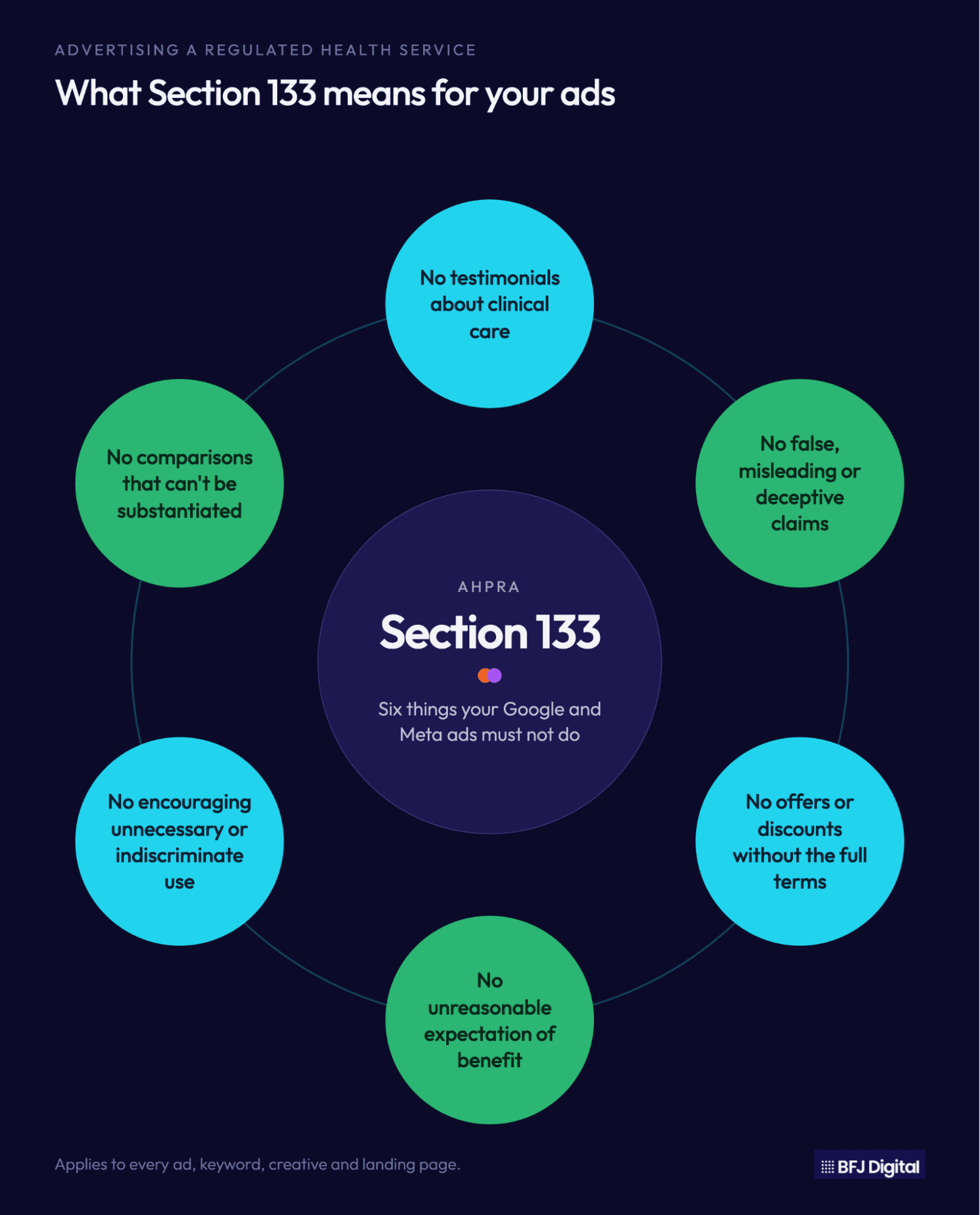
Section 133 does not list every possible restriction on healthcare marketing. It sets out five categories of advertising that are not permitted. Other rules also apply, and we cover those in a later section. The five categories are:
Section 133 requirement | What it means | Where it shows up in a paid campaign |
|---|---|---|
Advertising must not be false, misleading or deceptive, or likely to be misleading or deceptive | Claims need to be accurate and supportable. Overstating a benefit, hiding a material fact or implying an outcome the service cannot reliably produce is a breach. | Headlines that promise cures, guarantees or "best" claims. Landing pages that show results without context. Ad extensions that add claims the ad body cannot support. |
Advertising must not offer a gift, discount or other inducement unless the advertisement also states the terms and conditions of that offer | A discount, freebie or bonus needs the conditions attached to it. Not buried on the site. Attached to the offer. | A responsive search ad promoting "$99 first consult" with no conditions in the ad or on the landing page. |
Advertising must not use testimonials or purported testimonials about the service or business | Content the advertiser controls cannot include patient statements about the clinical aspects of the service, including outcomes, symptoms, diagnoses or the practitioner's skill. | Star ratings and quotes about treatment outcomes shown in an image ad. Reviews republished on a landing page. Video ads featuring a former patient describing results. |
Advertising must not create an unreasonable expectation of beneficial treatment | The way the service is described cannot lead a reasonable reader to expect a better outcome than the evidence supports. | Words like "guaranteed", "permanent fix" and "no more pain". Before-and-after content that implies typical results when it does not. |
Advertising must not directly or indirectly encourage the indiscriminate or unnecessary use of regulated health services | The campaign cannot push people toward treatment they do not need, or toward more of a service than is clinically warranted. | Urgency creative ("book now, before it is too late") on discretionary procedures. Broad-match campaigns that pull in people with no clinical need for the service being advertised. |
AHPRA's current Guidelines for advertising a regulated health service (revised December 2020) apply across the 15 regulated professions and expand on each category. Some professions carry additional rules on top. Cosmetic surgery, for example, has been governed by its own advertising guideline since 1 July 2023, and higher-risk non-surgical cosmetic procedures fall under a separate guideline that came into effect on 2 September 2025.
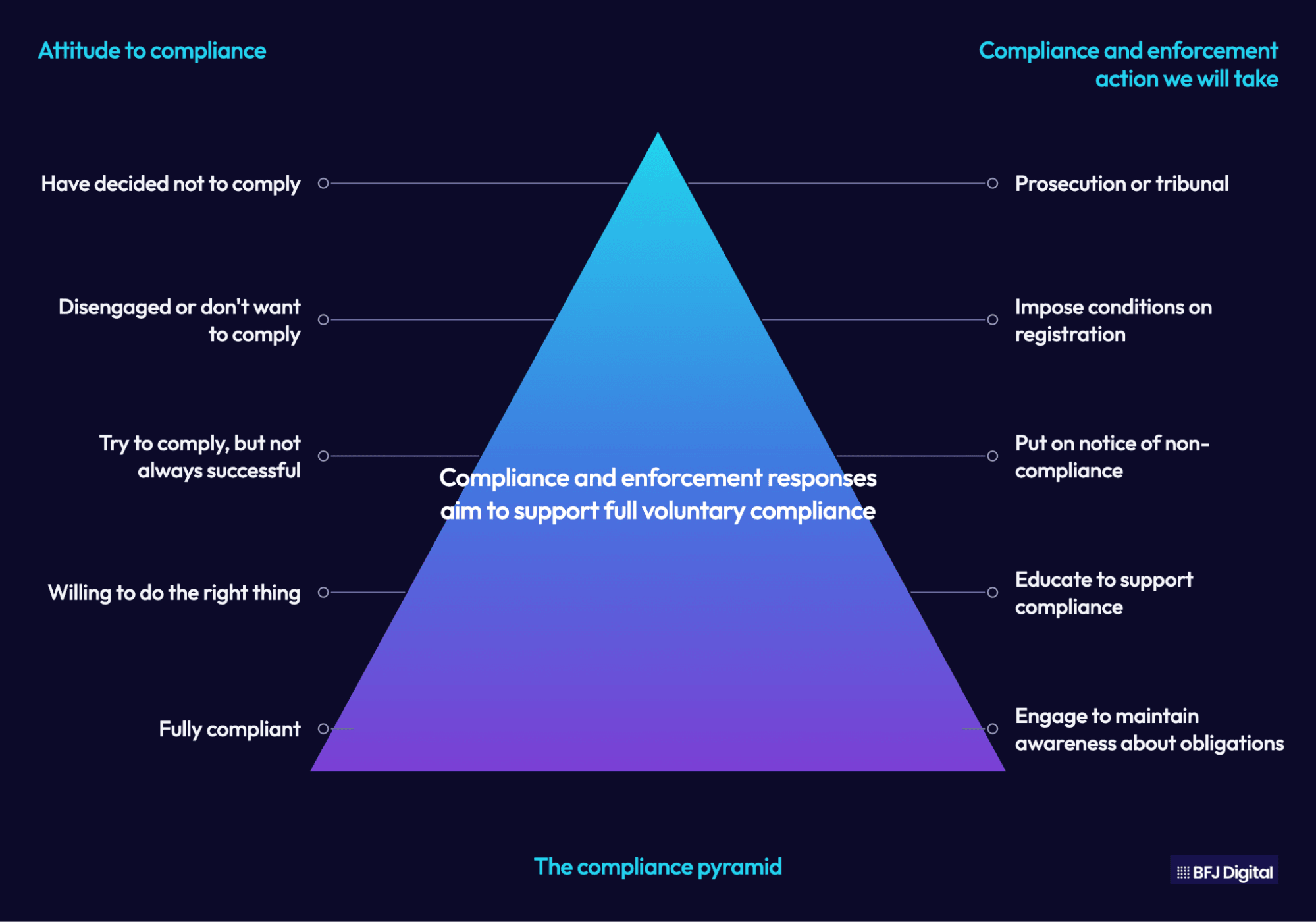
Since 2022, most jurisdictions have adopted an amendment to the National Law that lifted the maximum penalty for advertising breaches to $60,000 for an individual and $120,000 for a body corporate per offence. AHPRA’s public position, set out in its current advertising compliance and enforcement strategy, is to educate first and prosecute where practitioners ignore compliance notices or breaches are serious.
Does Section 133 apply to Google and Meta advertising?
Yes. Section 133 is concerned with the advertising of a regulated health service. It is medium-neutral. Search ads on Google, Performance Max, Display, YouTube, Facebook feed placements, Instagram Reels and Stories all sit within its scope where they promote a regulated health service.
A common misreading is that Section 133 applies to a headline or a piece of ad copy in isolation. It does not. AHPRA's guideline treats the advertising as the whole communication a patient sees. That includes the ad itself, the landing page it points to, sitelinks and asset extensions in Google, form flows, retargeting creative that follows the user and email content triggered by a submission.
The practical version for a media buyer is that compliance sits across the full campaign. A carefully worded RSA that fires a non-compliant claim on the landing page it links to is not a compliant ad. A Meta lead ad that stays within policy but pushes leads into a nurture sequence quoting patient outcomes is not a compliant campaign. Every surface a patient reaches from the ad counts.
The difference between AHPRA compliance and platform policy
Healthcare advertisers sit under more than one rulebook. It is worth being explicit about what each layer does, because passing one does not automatically satisfy the others.
The layers are:
- Section 133 and the National Law. The Australian legislation that governs advertising of regulated health services. Enforced by AHPRA and the National Boards.
- AHPRA and National Board guidelines. Guidance documents that interpret and apply the National Law, including the general advertising guidelines and profession-specific guidelines (cosmetic surgery, non-surgical cosmetic procedures, Chinese medicine and others).
- Google Ads and Meta advertising policies. Platform rules governing what can be uploaded and served on their networks, including certification and restricted content categories.
- Other applicable Australian laws. The Australian Consumer Law (misleading and deceptive conduct, prohibited practices), the Therapeutic Goods Act where medicines or devices are involved, spam and privacy law, and state-level rules where relevant.
Passing Google's automated review does not establish compliance with Section 133. Google reviews an ad against its own policies. Australian healthcare law is not what its review is designed to catch. In the other direction, an ad may be lawful under Section 133 and still be rejected by Meta because it breaches Meta's community standards, health and wellness policy or personal attributes policy. Rejection is not a compliance verdict either way.
The safe workflow is to treat platform approval as necessary but not sufficient, and to run your own compliance review against the National Law and the relevant Board guidelines before an ad ever goes into ad review.
What Section 133 means for your Google Ads
Google is where most healthcare campaigns get built first, because the intent signal from search is stronger than anywhere else. It is also where a lot of the higher-risk advertising decisions get made, because Google's asset formats keep asking for more headlines, more descriptions and more variations that all need to hold up.
If you want context on how we structure paid search programs generally, our Google Ads services page sets out the framework we apply before overlaying the healthcare-specific rules below.
The areas to work through are:
Headlines. Responsive Search Ads want fifteen headlines. Under time pressure, it is tempting to fill the slots with superlatives and absolute claims. Words like "best", "leading", "number one" and "expert" are hard to substantiate and read as either misleading or as an unreasonable expectation of benefit. Descriptive, factual headlines pass the test more comfortably. "Bulk-billed GP, Spring Hill" holds up. "Brisbane's best bulk-billing GP" does not.
Descriptions. The 90-character description is where treatment claims tend to creep in. A description that says a service "eliminates" a condition or "guarantees" an outcome is likely to fail one of the Section 133 tests. Rewrite outcome claims as service descriptions: what is offered, who it is for, what the appointment involves.
Extensions and assets. Sitelinks, callouts and structured snippets are advertising too. A callout that says "Money back guarantee" or a sitelink that reads "Get results in one visit" carries the same risk as a headline. Review them the same way.
Landing pages. The landing page is part of the ad. If your ad is compliant but the page introduces testimonials, before-and-after visuals or unqualified outcome claims, the ad becomes non-compliant by association. Landing pages also need to carry the terms and conditions of any offer promoted in the ad. Building healthcare landing pages inside a proper website design and development workflow makes it easier to keep claims, disclaimers and offer terms consistent across campaigns.
Evidence supporting claims. AHPRA requires acceptable evidence for effectiveness claims. Peer-reviewed clinical research is the benchmark. If a claim cannot be traced to an evidence base, it is at risk. Keep a file of the evidence supporting each claim in each ad and each landing page.
Reviews and testimonials. Review extensions and star ratings that describe clinical outcomes are testimonials for the purposes of Section 133. The distinction AHPRA draws is between content the advertiser controls and independent third-party content. A star rating on the ad, a quote block on the landing page and a rich-result snippet from your own site all sit inside your control. An unsolicited Google Business review that mentions treatment outcomes is a different matter, and AHPRA's testimonial guidance recognises the difference.
Keyword to ad to landing page consistency. Section 133's fifth prohibition covers indiscriminate or unnecessary use. Broad-match keyword strategies that pull in generic symptom searches and route them into a discretionary treatment page raise this issue. Match types, negative lists and audience layering are the compliance controls, not just the performance controls.
The table below is illustrative, not a template of pre-approved compliant wording. It shows the direction of travel from riskier to more defensible copy.
Riskier approach | Better approach | Why |
|---|---|---|
"Permanent solution for back pain" | "Physiotherapy for lower back pain: individual assessment and treatment plans" | Removes the absolute outcome. Describes the service. |
"Brisbane's leading dental clinic" | "General and cosmetic dentistry in Brisbane. Registered dentists." | Removes an unsupportable superlative. Substitutes verifiable facts. |
"$99 skin consult! Book now" | "First skin consultation $99. Offer conditions on the landing page." | Signals that terms exist and are accessible. |
"Guaranteed weight loss program" | "Medically supervised weight management program. Individual results vary." | Removes the guarantee. Sets expectations honestly. |
Any wording still needs to be reviewed in context. Compliant phrasing on one clinic's page can be risky on another where the service or the evidence base is different.
What Section 133 means for your Meta Ads
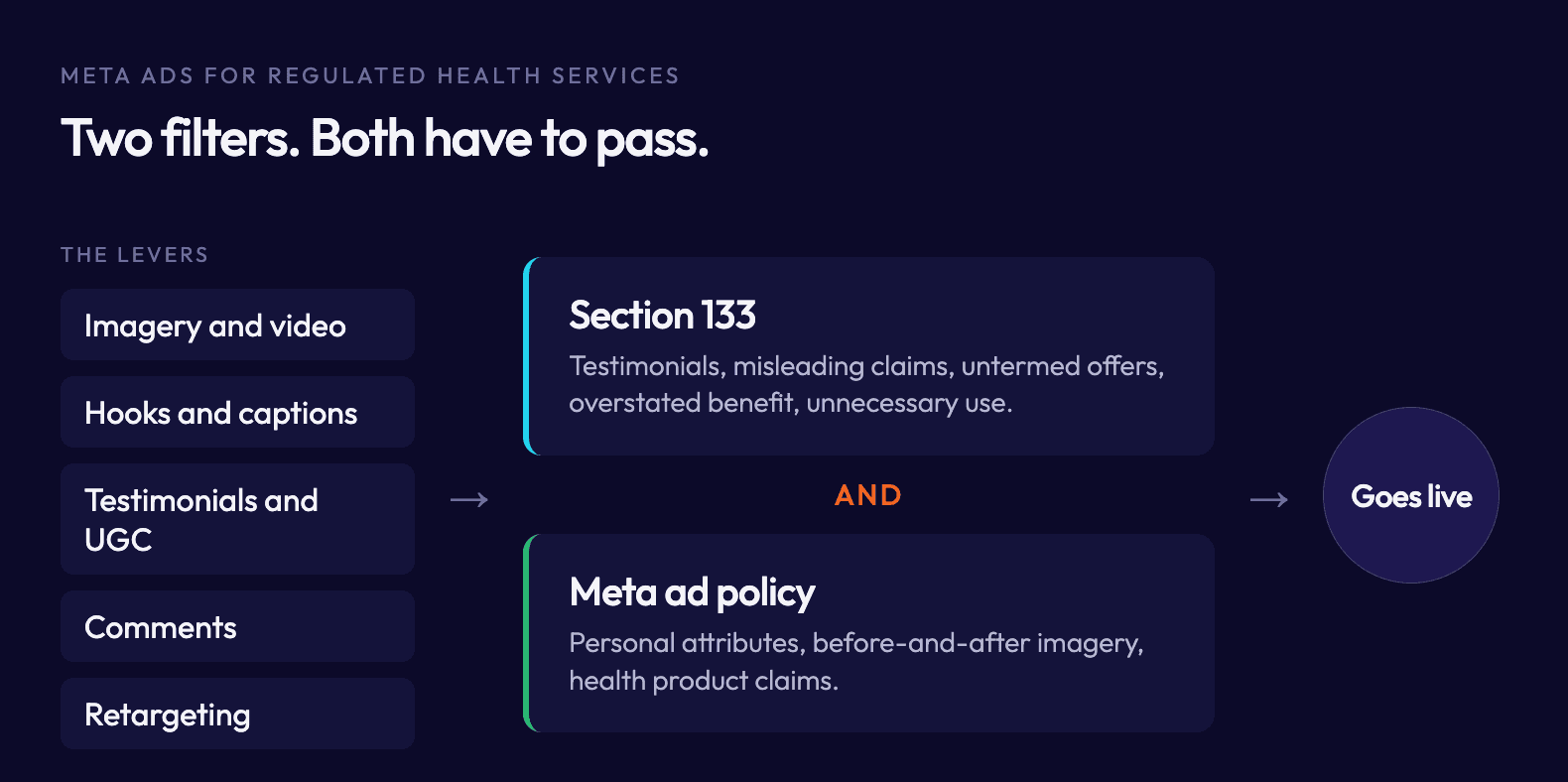
Meta is a harder environment for regulated health advertising than Google. So much of what makes Meta work is the exact material Section 133 restricts. Campaigns lean on hooks, testimonial-style creative, before-and-after imagery, influencer collaborations and comment-driven engagement. Every one of those levers needs a compliance filter attached to it.
The areas that need most attention are:
Imagery and video. Section 133 does not name imagery in its five prohibitions, but images and video that suggest outcomes function as claims. A video showing a "patient" saying how the treatment changed their life is a testimonial. Visual construction that implies an outcome the service cannot reliably deliver is an unreasonable expectation of benefit. Stock photography unrelated to the actual clinic can also be misleading.
Hooks and captions. Scroll-stopping hooks tend to reach for absolutes. "The one thing your dentist won't tell you" or "This treatment will change your life" are the class of claim that Section 133 catches. Educational hooks perform on Meta too. They just take more thought.
Testimonials and social proof. Content the advertiser controls that references clinical aspects of a service is a testimonial. That includes user-generated content the clinic republishes, influencer partnerships and video reviews. AHPRA's guidance also flags that a testimonial the advertiser has posted but which reads as if it came from a third party is a "purported testimonial" and is captured by the prohibition.
Comments and community management. Unsolicited comments on an ad or business page are not created by the advertiser. AHPRA's testimonial guidance says advertisers are not required to remove content on platforms they do not control. Your own boosted post is arguably different from a review on an independent forum, and this is one area where a healthcare business should get its own advice. Turning off comments on paid ads and moderating testimonial-style comments is a defensible starting point.
Retargeting and nurture. The ad is not the endpoint of the compliance question. A retargeting sequence that takes a warm audience to landing pages carrying patient-outcome video picks up the compliance issue as a whole.
Meta's own rules. Meta's advertising policies include restrictions on personal attributes (implying knowledge about the viewer's health or physical features), before-and-after imagery in some categories and health-related product claims. Meta may reject creative Section 133 would permit, and may allow creative Section 133 does not. Both filters need to pass.
Can you use patient testimonials in healthcare ads?
The short answer is that Section 133 currently prohibits testimonials in advertising the advertiser controls. That has been the position for many years. Amendments passed in the 2022 amending Act to lift the ban have not, at the time of writing, taken effect in a way that changes day-to-day compliance. AHPRA's public advertising guidance still treats testimonials as prohibited.
AHPRA defines a testimonial as a recommendation or positive statement about the clinical aspects of a regulated health service used in advertising. Clinical aspects include a symptom or reason for seeking treatment, a specific diagnosis, a specific treatment, an outcome or the practitioner's skills and experience. Comments about non-clinical aspects like reception staff, waiting times or ease of booking are not testimonials.
For Google Ads, that translates to a few operational rules. Do not use structured snippets or callouts that quote patient outcomes. Do not run review extensions that surface clinical statements. Landing pages should not carry testimonial blocks referencing treatment results. Star-rating rich results based on aggregated clinical reviews carry the same risk.
For Meta, the same principles apply, with extra care around video creative that is functionally a testimonial even if it is not labelled as one. A "day in the life" video that ends with a patient describing how much better they feel is a testimonial. An educational video from a clinician explaining what the treatment involves is not.
AHPRA draws a line between content on platforms the advertiser controls and independent patient discussion on platforms they do not. An unsolicited Google Business review is a good example of the second category. Do not remove genuine independent reviews. Do not amplify them in your own advertising.
Can you advertise discounts, offers or free consultations?
Section 133 does not prohibit healthcare businesses from offering discounts or free consultations. It requires that a gift, discount or other inducement offered in an advertisement is accompanied by the terms and conditions of the offer. That is a compliance question about how the offer is presented, not whether it can exist.
The practical problem in paid digital is that headlines and ad copy have very little room. A Google RSA headline of 30 characters cannot fit meaningful terms and conditions. That is fine, provided the terms are stated in the ad's description or callout, and the landing page carries them clearly and accessibly. "Terms apply" on its own is not enough. The conditions themselves need to be visible.
There is also a Section 133 exposure specific to offer-driven campaigns. If a discount is used to push people toward a service they do not clinically need, the campaign risks the "indiscriminate or unnecessary use" prohibition. That is more of an issue for elective and cosmetic services than for primary care. It is worth thinking through for any discretionary treatment being promoted with a discount.
Free consultations are permitted as an offer format, provided the same rules are followed. The word "free" needs to be accurate. The terms need to be stated. The offer cannot function as an inducement into unnecessary treatment. For cosmetic surgery specifically, additional rules apply under the 2023 cosmetic surgery advertising guideline.
Treatment claims are where advertisers need to be careful
Two of the five Section 133 prohibitions are about claims: misleading or deceptive advertising, and unreasonable expectations of benefit. In digital marketing, treatment claims are the single most common source of trouble.
The pattern to look for is absolute or unsupported language. Words like "cure", "eliminate", "permanent", "guaranteed", "pain-free" and "risk-free" carry the highest risk because they promise more than evidence usually supports. Comparative superlatives like "best" and "leading" carry the same risk because they are hard to substantiate against every competitor.
A claim like "Fix your back pain permanently" fails on multiple grounds. "Permanently" is a promise the service almost certainly cannot deliver. "Fix" implies certainty. The claim as a whole creates an expectation of benefit that a reasonable patient would understand as guaranteed. A more measured version would describe the service factually: what the assessment involves, what treatments are used, and who the service suits. That does not guarantee compliance either. It is directionally safer.
The evidence question sits under all of this. AHPRA requires acceptable evidence for advertising claims, and its guidance treats peer-reviewed research as the benchmark. If a claim cannot be tied to that kind of evidence, it should not sit in an ad. That is a workflow issue as much as a copywriting issue. The evidence file needs to exist and be checkable before the campaign goes live.
Language that encourages unnecessary treatment overlaps with claims. Copy that manufactures urgency around a discretionary service ("your smile can't wait", "don't delay") pushes into the fifth Section 133 prohibition. Educational framing works better and is easier to defend.
What about before-and-after images?
Section 133 does not carry a blanket ban on before-and-after images. It captures them under the same prohibitions on misleading content, unreasonable expectations of benefit and testimonials.
The Medical Board's cosmetic surgery advertising guideline, in effect since 1 July 2023, adds specific rules. Images must be responsibly used, represent realistic outcomes and show actual patients. The Board discourages using an "after" image as the most prominent visual element, because doing so tends to create an unrealistic expectation of the typical result. Higher-risk non-surgical cosmetic procedures have their own guideline, effective 2 September 2025, which adds restrictions including on testimonials from social media influencers and on advertising directed at people under 18.
For other regulated professions the general Section 133 principles still apply. A physio clinic showing a "before" of a stooped patient and an "after" of the same patient jogging creates an unreasonable expectation of outcome, and functions as a testimonial. A dental practice showing veneers work risks the same tests.
The practical position for paid media is that before-and-after content should not be used as ad creative in most healthcare verticals. Where it is used in cosmetic surgery or non-surgical cosmetic procedures, it needs to be tested against the profession-specific guideline as well as Section 133.
Who is responsible for AHPRA compliance, the clinic or the agency?
AHPRA's position is that responsibility for compliance sits with the advertiser: whoever controls the advertising. That will usually be the practice or the business advertising the service. Where a registered health practitioner is involved, they can also carry professional obligations separately, and can face disciplinary action even where an agency wrote the ad.
The practical reading for a healthcare business working with a marketing agency is that the business cannot outsource the compliance risk. A contract with the agency can allocate work and process, but it does not shift the underlying obligation to AHPRA or to the National Board. That is a reason to have an ad approval process that lives on the client side, not only on the agency side. A clinician sign-off on every new ad and landing page is a proportionate step for most healthcare campaigns.
At BFJ Digital, we take the view that compliance is part of the service, not a client problem to be managed around. Every ad we run for a healthcare client is drafted against the National Law and the relevant Board guidelines before it reaches the platform. We also work with clients to build an internal review and approval workflow that gives them a defensible record of how each ad was signed off.
A practical AHPRA advertising checklist for Google and Meta
Use this before launching a new campaign or a new set of creatives. It is not a replacement for legal advice, and it is not a guarantee of compliance. It is a working checklist for the person hitting publish.
- Is every treatment or benefit claim supportable with evidence on file?
- Could any wording be read as implying a guaranteed or absolute result?
- Does the ad or landing page create an expectation of benefit the service cannot reliably deliver?
- Are testimonials being used anywhere in the ad, the landing page, the sitelinks, the retargeting creative or the follow-up sequence?
- Is any offer or inducement in the ad accompanied by terms and conditions that a reader can find easily?
- Could the campaign encourage the use of a service for people who do not clinically need it?
- Does the landing page introduce claims that are not present in the ad?
- Have the relevant National Board guidelines been checked, including any profession-specific cosmetic or non-surgical cosmetic procedure rules?
- Does the campaign also meet Google Ads or Meta advertising policies?
- Has a nominated person, ideally a registered practitioner or someone with delegated authority, formally reviewed and signed off the campaign?
Save the answers. If AHPRA ever asks how you approved a specific ad, a documented sign-off is a stronger position than a memory.
Compliance doesn't mean your ads have to be boring
There’s a persistent idea in healthcare marketing that Section 133 makes strong performance advertising almost impossible. It doesn’t. It simply takes some of the usual shortcuts off the table.
Without exaggerated claims or heavy reliance on social proof, the fundamentals of the campaign have to work harder. That puts more weight on the quality of the entire marketing system. In practice, the healthcare advertisers that perform well tend to get a few key things right:
- Relevance. Tightly themed campaigns that match keyword intent to ad copy to landing page.
- Clarity. Plain-language service descriptions that answer the questions patients actually have.
- Factual practitioner information. Qualifications and registration stated accurately carry weight.
- Location and convenience. Locality, hours, bulk-billing status and appointment availability are strong performance levers and easy to state compliantly.
- Educational content marketing. Guides and videos that answer real patient questions build trust and pull organic and paid performance together.
- Landing page experience. Fast, clear pages that match what the ad promised.
- Audience structure. Match types, audiences and negatives that keep the campaign in front of the right people.
- Measurement and revenue attribution. Server-side conversion tracking, offline conversion imports and margin-informed bidding.
- First-party data. Compliant use of your CRM to build lookalikes and to feed conversion signals back into the platforms.
None of this is particularly glamorous, but it’s the work that actually brings down cost per acquisition. Get these fundamentals right, and Section 133 becomes a constraint to work within rather than something that holds the campaign back.
Need help running healthcare campaigns within the rules?
Running compliant healthcare advertising does not mean accepting weak performance. It means knowing where the boundaries are and building the campaign properly inside them.
BFJ Digital works with healthcare and allied health clients across Australia to connect paid media, data, landing pages and measurement to real commercial outcomes. If you want a second view on your current healthcare campaigns, or you are planning a new one, we can help you think it through.
Learn more about our healthcare marketing work, our Google Ads services, or run your existing copy through our healthcare ad compliance checker as a starting point.
This article is educational marketing content, not legal advice. Section 133 and the associated AHPRA and National Board guidelines are the source of truth. Where you are unsure, take advice from a lawyer or your medical indemnity insurer.
Hardeep Gill
Hardeep Gill is a Performance Media Specialist at BFJ Digital, bringing expertise in SEM, digital advertising, and strategic campaign management. As a versatile digital marketer, Hardeep excels at crafting and executing comprehensive digital strategies that deliver measurable business growth.
His expertise spans the technical intricacies of search engine marketing and programmatic advertising, enabling precise audience targeting at scale. Hardeep possesses a hands-on understanding of Meta advertising and the broader landscape of digital marketing, allowing them to leverage multiple channels effectively.
While skilled in strategic account management, Hardeep's core strength lies in his ability to harness diverse digital channels to drive tangible results. His approach combines technical proficiency with strategic thinking, ensuring that every campaign is optimised for maximum performance and return on investment.
With a Bachelor of Business majoring in Marketing, Hardeep brings both academic foundation and practical expertise to their role. His comprehensive understanding of the digital advertising ecosystem, from search to social to programmatic, makes them a valuable asset for clients seeking integrated performance media solutions that deliver real business impact.
Ready to See the Bigger Picture?
Want to understand how your digital and real-world marketing impact each other? Not sure if your CRM is supporting your paid media efforts? Just need some clarity and a clear plan to better ROI? Book your free strategy session today for an in-depth audit and action plan to double your digital marketing ROI.
- Meet with a strategy specialist to build a growth plan
- Increase your media performance by up to 200%
- Improve business efficiencies to increase ROI via automation and increase profit
- We cut to the chase. What digital marketing is actually working?