 Read More
21 Nov 2026
|11 min
AI Search Is Changing Content Strategy. Here’s What You Should Publish Now

Aysha Muhammed
Digital Content & SEO Producer at BFJ

Keep ahead of the curve via our latest trends newsletter.
Contact us nowKey takeaways
- Give people a reason to click. If an AI-generated answer can capture the full value of your content in a few sentences, the page needs more substance, such as first-hand experience, original data, real examples or practical decision-making detail.
- Prioritise content that helps people make decisions. Commercial pages, comparisons, cost explainers, case studies and detailed “which option is right for me?” content become more valuable as generic informational queries are increasingly answered within search.
- Look beyond keyword research for content ideas. Sales calls, client questions, objections and problems your team repeatedly solves can reveal topics that keyword exports miss
- Bring practitioners and subject matter experts into the content process. Interview the people actually doing the work to uncover mistakes, trade-offs, costs, lessons and examples that make the content harder to replicate.
- Measure what happens after the click. Rankings and visibility still matter, but engaged visits, qualified enquiries, movement to commercial pages and sales usefulness provide a better picture of content performance.
There’s a question I keep coming back to when planning content: if Google can give someone a decent answer before they reach our page, why would they click?
I find that a much more useful question than “How do we rank in AI?” because it shifts the focus from visibility to value. If a page offers the same definition or surface-level explanation a reader can already get from an AI-generated response, there’s little incentive to visit. But give them something the AI response can’t fully deliver, like real costs, a useful decision framework, first-hand experience or the reasoning behind an actual result, and you give them a reason to keep digging.
AI Overviews and AI Mode are also changing how people explore a subject. Someone researching a CRM migration might start with a broad question, read an AI-generated response, then move into questions about data quality, costs, timelines and implementation risks. Google says its AI features can run related searches across subtopics and data sources to build a response. That means one broad query can lead someone through several smaller decisions before they ever reach a supplier’s website. Google Search Central explains how AI features work.
That changes the job of content. A broad guide that neatly repackages information already available across the web is easier to summarise and gives the reader less reason to seek out the source. The opportunity is to publish what can’t be so easily compressed: first-hand experience, original data, real examples, informed opinions and the practical detail that comes from actually doing the work.
For businesses, that means getting closer to the people doing that work. Talk to the team running the campaigns, implementing the CRM or speaking to customers. Find out what actually happened, what went wrong, what it cost, what surprised them and what they would do differently next time.
Good content increasingly depends on having something worth saying before you worry about how to say it.
The data says something is changing. It doesn’t give us one neat headline.
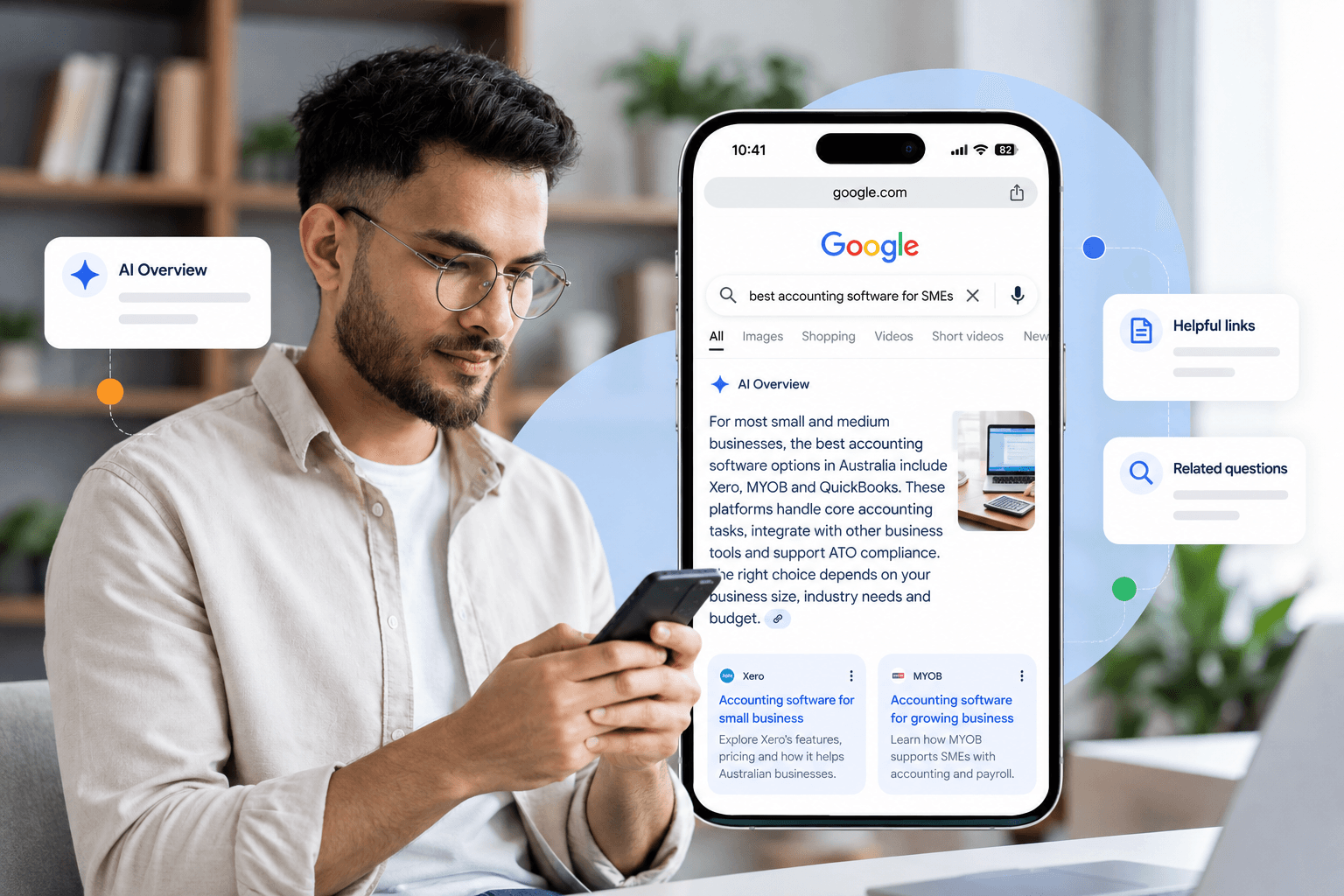
Google said AI Overviews reached more than 1.5 billion monthly users across 200 countries and territories in May 2025. That tells us the feature has scale. It does not tell us that 1.5 billion people stopped clicking websites. Google’s I/O announcement is a reach figure, not a traffic study.
Pew Research Centre offers a closer look at behaviour. In its analysis of 68,879 Google searches from a panel of US adults in March 2025, people clicked a traditional search result in 8% of visits when an AI summary appeared, compared with 15% when it did not. Links within the AI summary received clicks in 1% of visits to pages with a summary. The study is observational, US-based and drawn from one period. It shows a meaningful association, but it cannot prove that AI caused every lost click or predict the effect on an Australian B2B site.
An Ahrefs study updated in February 2026 compared 150,000 informational keywords showing AI Overviews with 150,000 informational keywords without them. Using aggregated Search Console data, Ahrefs estimated that an AI Overview was associated with a 58% lower click-through rate for the top-ranking page in December 2025 than its model predicted without one. That is an estimate for the studied keyword set and position, not a blanket 58% traffic loss for every website. It also reflects broader changes in search results over the comparison period.
Google offers a different lens. In August 2025, its Head of Search said total organic click volume to websites was relatively stable year on year, while “quality clicks”, measured partly by people not quickly returning to Search, had risen slightly.
These findings can coexist. A particular informational result can lose clicks while total search activity grows. A smaller number of visitors may arrive with more context. None of those broad studies replaces your own Search Console, analytics and lead data. If an impressions chart rises while clicks flatten, the right response is to investigate the queries, pages and conversions, not announce that SEO is dead.
What I see when content plans meet real businesses
In content work, the strongest topics rarely arrive as a clean keyword export. They show up in a sales call, a confused client email, or a question that keeps delaying a decision.
Take CRM migration. There are hundreds of articles comparing platforms or listing migration steps, and much of that information is easy for AI to summarise. The more useful questions emerge when a migration becomes real: Which data should we leave behind? What needs cleaning first? What happens to historical reporting? Who owns field mapping? What tends to go wrong?
Those are questions worth taking to the implementation team. Their answers can turn another generic “CRM migration guide” into something built around mistakes they’ve seen, decisions clients underestimate and lessons learned from doing the work.
The same applies to paid media. “What is a good cost per lead?” is easy enough to answer with benchmarks. But a dental practice can have a great-looking cost per lead while very few enquiries become booked treatments. The more useful content explains how lead quality, follow-up, bookings and actual patient value fit together, ideally using real or anonymised campaign data.
Keyword research still matters. But it’s only one source of ideas. We should also be listening for the questions clients keep asking, the problems teams repeatedly solve and the decisions customers struggle to make.
I’ve also seen informational pages attract the language a business wants its commercial page to own. In a wealth management audit, for example, blog articles surfaced for valuable service and location searches while the main commercial page was less dominant. That was a page-role problem to investigate, not proof that the business needed another general blog. It called for clearer distinctions between educational articles, the service page and local pages, plus links that help readers move between them.
Those examples are editorial observations from our work, not a claim that AI features caused a particular client’s results. The practical lesson is that keyword demand is only one input. We also need to understand the question behind the query and the next decision the reader must make.
So, what should you publish now?
1. Strengthen the pages where a buyer can actually choose you
Start with your service, product, industry and location pages. If they say little beyond “tailored solutions” and “get in touch”, a visitor has no basis for comparison.
Explain who the service suits, what it includes, how the work happens, what affects cost or timing, and what a buyer needs to prepare. Show the people, qualifications and process behind the offer. A good commercial page answers the awkward questions before they become a sales objection.
For ecommerce businesses, the equivalent is the product detail page. Someone following an AI recommendation may land directly on a product, bypassing your homepage and category pages. That page needs to help them decide and buy: clear specifications, suitable uses, compatibility, delivery costs, returns and genuine customer reviews. Ask yourself: if this were the first page someone saw, would they have enough information to purchase confidently?
2. Publish decision content, including the trade-offs
Comparisons, cost explainers and “which option fits?” articles have a reason to exist because the answer depends on context. A useful piece might compare onboarding with a full HubSpot implementation, or explain the cost of using separate agencies for paid media, SEO and CRM work.
Give the reader criteria they can use: scope, dependencies, internal capacity, time to value and likely failure points. For ecommerce, that means explaining product features and benefits, dimensions, weight, materials, compatibility and sizing, alongside shipping costs and returns.
Explain the trade-offs, too. When does the cheaper option make sense? Who would benefit from a different product or service? A business willing to explain where its offer is a poor fit often sounds more credible than one that declares itself the best choice for everyone.
3. Turn work you’ve done into evidence a summary cannot recreate
Case studies deserve more attention than a logo, a percentage and three paragraphs of celebration. Show the starting problem, constraints, choices made, work completed, measurement window and what happened. If a result was also influenced by seasonality, increased spend or a website change, say so.
The same principle applies to smaller pieces of first-hand evidence. A screenshot of an anonymised reporting framework, an annotated workflow, an interview with a specialist, or a before-and-after explanation of a landing page can add more than a page of familiar tips. Use client data with permission, protect confidential details and distinguish measured outcomes from your interpretation.
Google’s 2026 guidance on generative AI features specifically encourages a unique point of view and first-hand experience. It describes generic, easily reproduced content as “commodity” content. That is close to what an experienced editor feels when reading five pages that say the same thing in different headings.
4. Answer the narrow questions your team hears every week
Ask sales, account managers and delivery teams what prospects misunderstand. Which question takes ten minutes to answer well? Which objection appears just before approval? Which issue creates rework after a project starts?
Then choose the right home for each answer. A short section on a service page may be enough. A detailed, high-stakes comparison may warrant its own article. A cluster of related questions might become one coherent guide. Google warns against creating separate pages for every query variation simply to influence AI results. Its systems can understand related language without an exact-match page for each phrase.
5. Make a clear argument when the market is confused
An opinion piece needs an opinion earned through evidence. If clients repeatedly treat lead volume as success while their sales team struggles with fit, say why the metric falls short. If a CRM implementation fails because the team never agreed on lifecycle stages, explain the organisational decision behind the technical problem.
The point is to contribute something an AI answer can cite, challenge or send a reader to explore. An article that merely rounds up what everyone else has said adds little to the discussion. An argument with examples, boundaries and practical consequences gives the reader something to think about.
How to write for AI search without sounding like a robot
First, answer the reader’s question early. Then earn the extra scroll. A direct opening helps a busy person, and a clear section heading helps them find the next part. Neither requires a stiff formula.
Consider this opening:
“HubSpot implementation is the strategic process of configuring a comprehensive CRM ecosystem to maximise operational efficiencies.”
I’d rather read:
“A HubSpot implementation costs more when your team needs to clean and migrate years of data, rebuild reporting and agree on how leads move through sales. The licence is only one part of the budget.”
The second version makes a claim a reader can test. It names the work, explains a cost driver and opens the door to evidence. It is also easier to understand without reading it twice.
Next, add the detail that only your team can supply. Interview the practitioner before drafting. Ask: What happened the last time you did this? What went wrong? What did you change? What would make you advise against it? If the answer is a neat list of universal tips, keep asking.
Use sources with care. A study needs a population, date and measure.. State the limits alongside the number. Data loses its value when a headline asks it to prove more than it can.
Then edit for movement. Let each heading make a promise; let each section deliver on it. Use an example when a concept feels slippery. Cut the sentence that repeats your heading. Keep the words a customer uses, even if a more technical term sounds impressive internally.
Google says there is no special AI markup or extra technical requirement for appearing in AI Overviews or AI Mode beyond eligibility in Search. You don’t need to rewrite copy for AI systems or create an llms.txt file for Google Search. The technical foundations of SEO still matter.
Make sure search engines can crawl and index your pages, follow your internal links and access your important content. Use relevant structured data, such as Article schema for blogs and Product schema for ecommerce pages, and ensure it matches the information visitors can see. FAQ schema can describe genuine questions and answers, but it is optional: Google no longer displays FAQ rich results, and the markup does not guarantee inclusion in AI answers.
Where possible, deliver your main content and links in the initial HTML through server-side rendering or pre-rendering. Google can render JavaScript, but some other bots cannot. Providing the content upfront makes it accessible to a wider range of crawlers. Check what search engines actually receive, rather than assuming that everything visible in your browser is accessible to them.
Good writing needs a website that makes it easy to find, read and understand.
Measure the business result, not only the search appearance
Begin with the baseline: for each priority page, record search queries, impressions, clicks, click-through rate, engaged visits and qualified enquiries. Segment by page and intent. Review changes alongside ranking, seasonality, paid activity and website changes. Search Console includes AI-feature appearances within its Search performance reporting, so a blended chart should not be treated as a clean AI referral report. Check the reporting options available in your property before promising a separate AI figure.
Then ask what the page did for a visitor who arrived. Did a comparison lead to a relevant service page? Did a cost explainer produce a better qualified enquiry? Did the sales team start using it to answer the same recurring question? Those signals tell us more about content quality than a screenshot showing a brand mention in one AI response.
For many businesses, the first sensible move is an audit, not a publishing sprint. Pull your most visible informational pages. Mark the ones that answer a question fully on the results page, the ones that contain genuine experience, and the ones that should lead to a commercial decision. Identify thin service pages and duplicated topics. Then spend the next production cycle improving the pages with a clear buyer role.
AI search is giving people faster summaries. By the time someone reaches your website, they may already understand the basics and be further along in their buying decision. They could be arriving to check your experience, compare options, confirm costs or resolve one final concern.
That changes what your content needs to deliver. The work I’d back now is honest comparisons, useful commercial pages, documented experience and clear next steps. Give visitors the evidence and detail they need to move from an initial answer to a confident decision.
If a reader can get the whole value of your article from a two-sentence summary, give them a better reason to visit. Show your working. Help them make the next decision. Good luck!
Aysha’s journey into marketing started the way a lot of great careers do—accidentally. She began with her own blog, just writing because she genuinely loved it. Then she tripped into marketing and never left.
Her career took off in SaaS as a Product and Growth Marketer, where she learned how to drive real business outcomes through content, building marketing channels that consistently brought in hundreds of thousands of visitors and qualified leads every month. After proving she could scale content operations in the fast-paced SaaS world, she moved to agency life, and that's where her versatility really shines.
Now, as a Content Specialist at BFJ Digital, Aysha brings something pretty special: she's both a creative writer and a data nerd, which is a rare combination. What makes Aysha brilliant at what she does is her ability to chameleon her writing style for any audience and style. She gets excited about both the perfect turn of phrase and the analytics that show it's working.
Her Bachelor's in English Literature and Journalism gave her the writing chops, but it's her genuine fascination with technology and her constant upskilling that keep her ahead of the curve.
Ready to See the Bigger Picture?
Want to understand how your digital and real-world marketing impact each other?
Not sure if your CRM is supporting your paid media efforts? Just need some clarity and a clear plan to better ROI?
Book your free strategy session today for an in-depth audit and action plan to double your digital marketing ROI.