 Read More
28 Nov 2026
|6 min
MCP Servers for Marketing: The Stack We Run, and What We Cut

Ben Henzell
Owner at BFJ Digital

Keep ahead of the curve via our latest trends newsletter.
Contact us nowConnecting Claude to Ahrefs doesn't make you an SEO. Connecting it to Google Ads doesn't make you a media buyer.
That's the bit most "AI for marketing" posts skip. Every week there's a new directory listing 50 more MCP servers you can plug into your AI tools. Some of them are genuinely useful. We run a handful every day across our 25-person Brisbane agency.
But access isn't the hard part. Knowing which number to trust, which question to ask, and when the answer is wrong is the hard part. That still takes people who've done the work.
Here's the stack we actually run, what we cut, and why we ended up building our own platform to sit underneath it.
New to MCP? Start here
An MCP server is a connector between an AI assistant and a tool you already use. It's a pipe, not a strategist.
If that's new, read our explainer first: What is MCP? Model Context Protocol for marketers. This post assumes the basics and answers the next question: which ones are worth connecting?
The stack we run
We pick connectors by job, not by logo. Each one has to answer a question we ask every week, or it goes.
- Performance data across clients: BFJ Labs (our own platform). One consistent source for ads, search, analytics and calls. More below.
- Pipeline and CRM: HubSpot. We're a HubSpot Diamond partner. It's where leads, deals and email live.
- Rank tracking and search data: DataForSEO, via Labs. Raw search data we control and benchmark ourselves.
- Prospecting and enrichment: Apollo. Who a lead is, and whether they're worth a call.
- Website and CMS: our own site connector, plus WordPress for client sites. Draft pages and audits without logging into 100 dashboards.
- Design: Figma. Pull specs and assets straight from the source file.
- Team comms and project work: Slack and Teamwork. Where briefs, approvals and time live.
- Site audits: Screaming Frog. The crawler our SEO team already trusts.
- Behaviour and UX: Microsoft Clarity. GA4 tells you what happened. Recordings show you why.
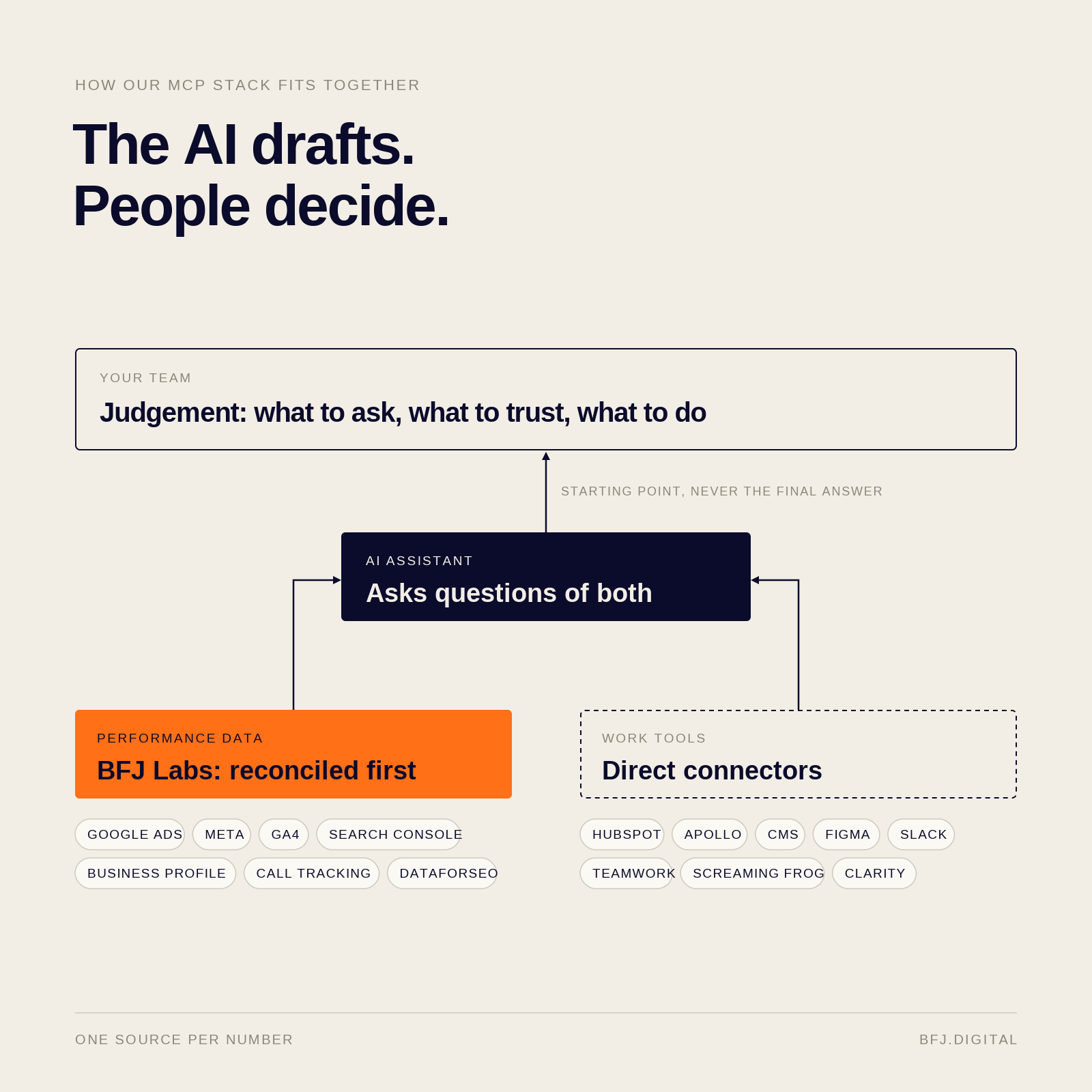
Notice what's missing: there's no separate Google Analytics or Search Console connector. Labs already serves both. Two paths to the same number means two numbers, and then nobody trusts either.
What we cut, and why
The list of things we don't connect is as deliberate as the list we do.
- Duplicate data sources. Every SEO suite now has an MCP. Connect three and you'll get three keyword volumes and three rankings. We picked one engine and benchmark it ourselves.
- AI-visibility trackers. There are at least seven tools selling "how often does ChatGPT mention you". We track citations in Labs instead, against the same clients and keywords we already report on.
- Content scoring tools. Useful in isolation. But a score without the client's commercial context is just another number to argue about.
- Anything with write access we can't undo. DNS, ad budgets, live pages. Read access first. Write access only where there's a draft or an approval step in between.
- Fun stuff in the work account. More connected tools makes the AI worse at picking the right one. We keep the work setup lean on purpose.
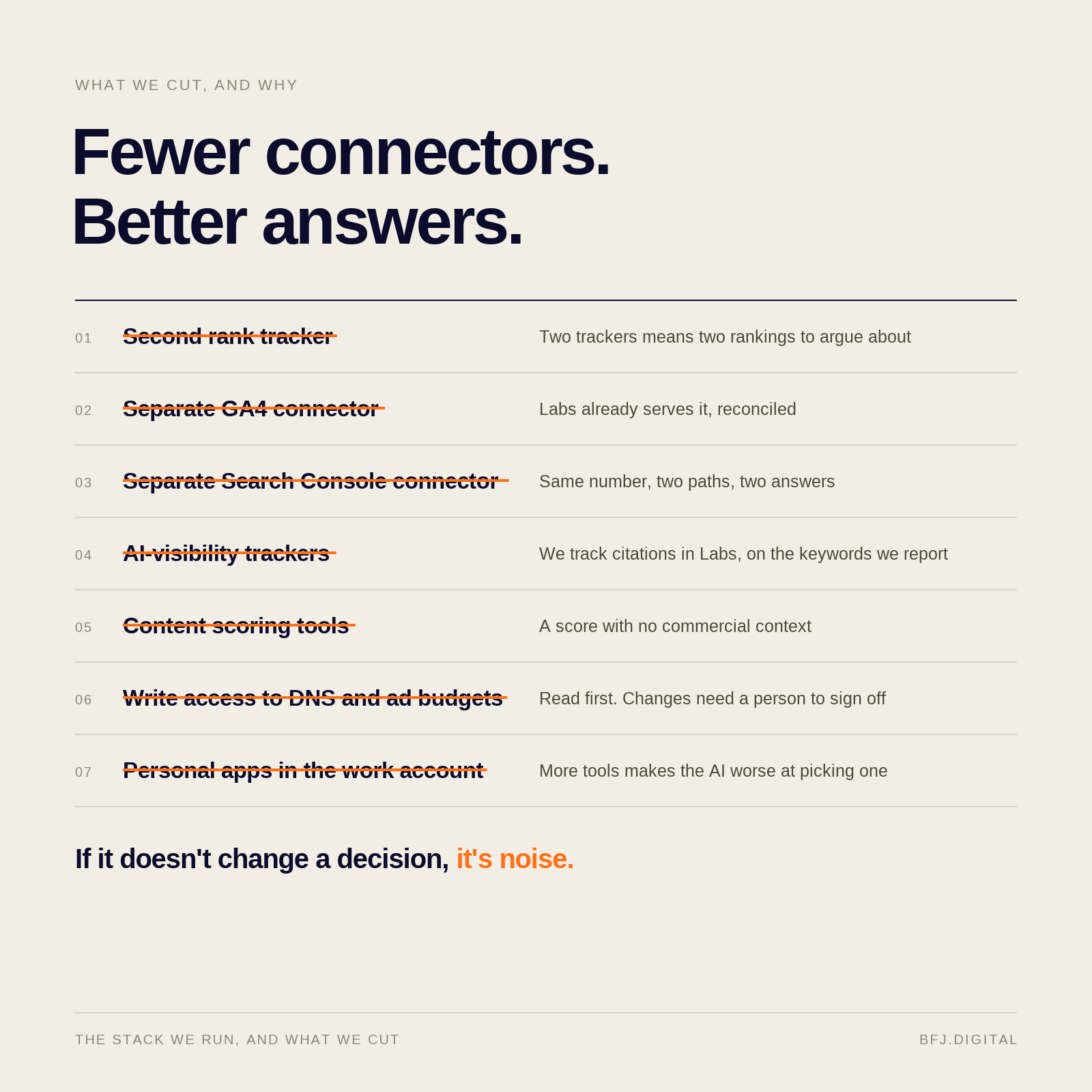
The rule we use: if a connector doesn't change a decision we make, it's noise.
Why the whole stack sits on Labs
Connect every platform's own MCP and you get every platform's own version of the truth. Google Ads, Meta and GA4 will all claim the same sale.
So our AI tools don't talk to twenty raw APIs. They talk to BFJ Labs, our in-house data platform, which reconciles the numbers first. That took three years of unglamorous plumbing, and we've written up what it took.
The plumbing is the product. The connectors are the easy bit.
How we set up the team workspace
Connectors are half of it. The other half is telling the AI how to think, and what's off limits.
Our marketing team shares one Claude Project. It holds:
- Our brand rules. Tone of voice and design system, so every draft starts on-brand.
- Our strategy and budget. It links to the live budget sheet. It doesn't rebuild it, so there's one version of the truth.
- Operating rules. Report what's defensible. Flag attribution noise. Filter the pipeline by stage and source before quoting a number. Use AI for synthesis, not arithmetic.
And it's just as clear on what stays out. Company finances, HR and anything client-confidential don't belong in a shared marketing workspace.
Two things that caught us out, so they don't catch you:
- Connectors belong to the person, not the project. If your account is connected to your accounting software, the AI can reach it from any project you're in. Instructions aren't a lock. Disconnect what shouldn't be there.
- Sharing a project doesn't share access. Each teammate connects their own tools, with their own permissions. That's a feature.
Why MCPs don't make marketers from scratch
There's a pitch doing the rounds: connect AI to your tools and you won't need an agency, or a marketing team. We understand the appeal. We just don't think it holds up.
AI makes a good marketer faster. It makes an inexperienced one confidently wrong, faster.
The difference shows up in the questions, not the answers:
- The AI says "cost per lead dropped 30%". A marketer asks: did lead quality drop with it? What does sales say?
- The AI says "brand search is your best campaign". A marketer asks: would those people have found us anyway?
- The AI says "rankings fell for 40 keywords". A marketer asks: did we change tracking, location or device settings?
- The AI says "Meta drove 200 conversions". A marketer asks: counted by whom, and over what window?
- The AI says "increase budget on the top campaign". A marketer asks: is it limited by budget, or by demand?
None of those follow-ups need a new connector. They need someone who's been burned by each of them before.
That's why we've invested in both: a platform that gives our team clean data, and people with the judgement to question it. Remove either one and the AI is just a faster way to make the wrong call.
FAQ
What is the best MCP server for marketing data in Australia?
There isn't one. Google Ads, Meta, GA4, HubSpot and DataForSEO all run official servers, but each reports its own version of events. The best setup is one reconciled data source underneath, so every answer starts from the same numbers. For us, that's BFJ Labs.
How many MCP servers should a marketing team connect?
As few as answer the questions you ask every week. We run about 10. Every extra connector adds another version of the truth and makes the AI worse at picking the right tool.
Should I connect Google Analytics and Search Console directly?
Only if they're your single source for those numbers. If another platform already reports them, a second connection gives you two answers to the same question.
Can an MCP server change my live campaigns?
Some can, if you grant write access. We start every connection read-only and only allow changes where a person approves them first.
The short version
- Pick connectors by the decisions they change, not by how many exist.
- One source per number. Duplicates create arguments, not insight.
- Read access first. Write access only with a draft or approval step.
- Put your rules in writing so the AI works the way your team does.
- Clean data plus experienced people is the edge. The connectors are table stakes.
Want to know what your marketing data is actually telling you, before an AI tells you something confidently wrong? Book 30 minutes with Fabian. We'll show you how we use Labs to find the leak between spend, leads and revenue.
Ben Henzell founded BFJ Digital with a simple belief: great marketing should help businesses genuinely grow, not just look good on paper. With over 20 years in the industry, Ben has seen marketing evolve from billboards and print ads to the complex digital ecosystem we navigate today. That perspective is invaluable.
He's worked across traditional and digital channels, giving him a real understanding of what actually moves the needle for businesses. Ben's approach is refreshingly straightforward—he'd rather have an honest conversation about what will work than oversell a flashy strategy.
His Bachelor of Business in Advertising and Marketing gave him the foundation, but it's the two decades of real-world experience that make him someone clients trust when big decisions need to be made.
At BFJ Digital, Ben has built a team that shares his values: do great work, be honest with clients, and focus on results that matter. If you're looking for someone who genuinely cares about your business success and has the experience to back it up, that's Ben.
Ready to See the Bigger Picture?
Want to understand how your digital and real-world marketing impact each other?
Not sure if your CRM is supporting your paid media efforts? Just need some clarity and a clear plan to better ROI?
Book your free strategy session today for an in-depth audit and action plan to double your digital marketing ROI.