HubSpot AEO Brisbane: What the New Marketing Hub Feature Means for SEO and AI Visibility
Sarah Halliday
Digital Account Manager at BFJ Digital
Keep ahead of the curve via our latest trends newsletter.
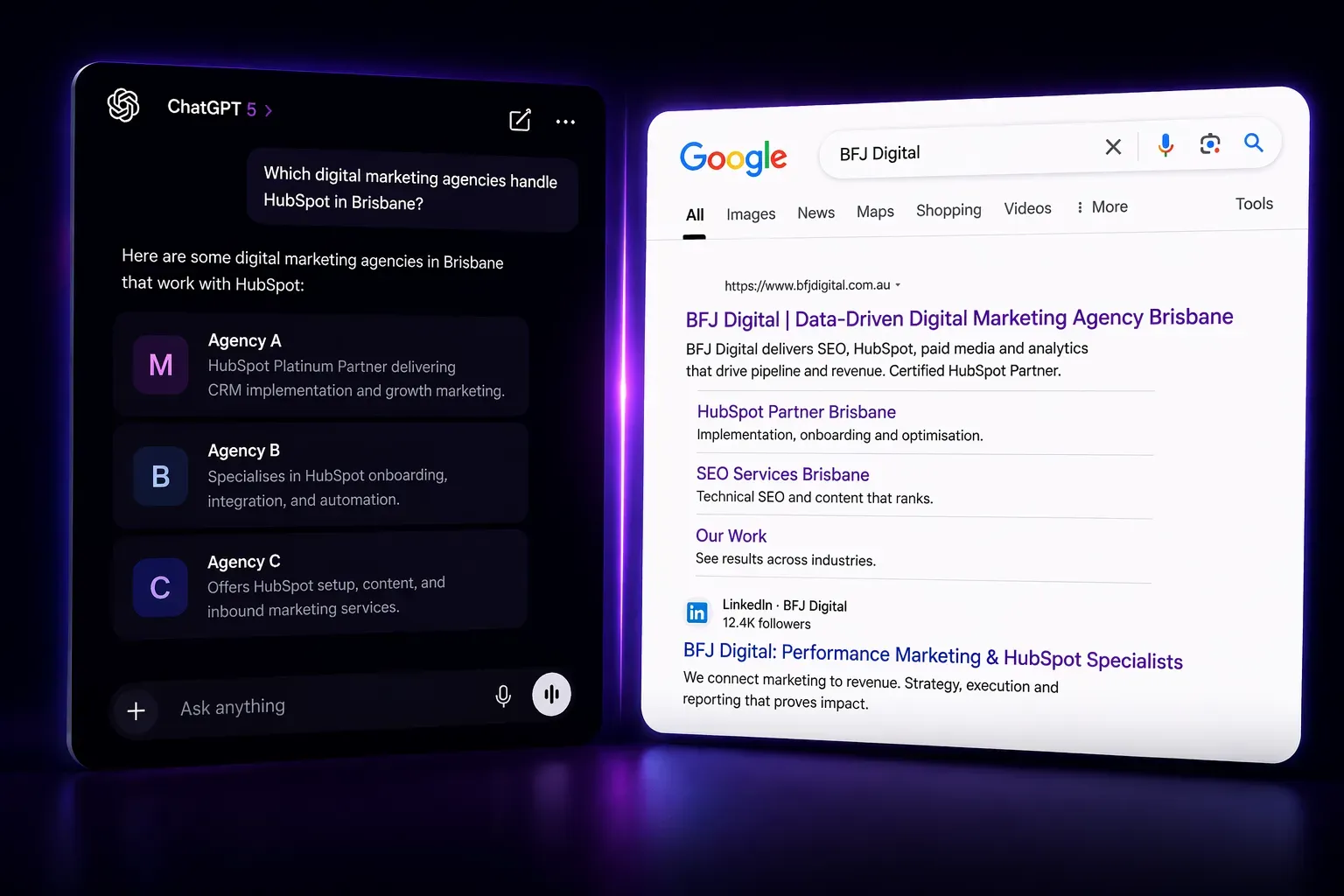
Contact us nowA prospective buyer opens ChatGPT and types: "Which digital marketing agencies handle HubSpot in Brisbane?" Within seconds, they have a shortlist. They've formed an opinion about three or four businesses, one of which may be your competitor before visiting a single website.
If your brand wasn't in that answer, you weren't in the running. This is how consumer behaviour has changed in recent years, including mid-market Brisbane buyers who actually research vendors, partners, and platforms right now.
This article covers two connected threads:
- What HubSpot users can now access with the new AEO feature inside Marketing Hub
- Why marketing managers who take Search Engine Optimisation seriously will find AEO (Answer Engine Optimisation) familiar because the content and technical foundations are largely the same
The Customer Journey Has Quietly Shifted and Here's the Data
Where Buyers Are Starting Their Research
In early 2026, SimilarWeb data shows ChatGPT still leading the space with 64.5% of global generative AI chatbot traffic. Gemini is gaining ground quickly, now at 21.5% after a 49% lift in just 12 weeks, while Perplexity’s query volume has surged over 400% year-on-year. The takeaway is clear. That visibility in ChatGPT alone isn’t enough. A growing share of your audience is researching across multiple AI platforms, and your presence needs to reflect that.
The honest counterpoint is that Google still dominates conversion-stage behaviour. SparkToro's research consistently shows Google driving the overwhelming majority of referral traffic to most websites, and that pattern hasn't shifted materially. Buyers use AI-powered answer engines to discover, shortlist, and form early brand impressions. They then use Google and your website to validate and convert. Both stages matter. Neither replaces the other.
To make that concrete, a marketing manager at a mid-sized business is evaluating Brisbane HubSpot partners. They open Perplexity and ask which agencies specialise in HubSpot implementation in Brisbane. They read a synthesised answer naming two agencies, then open Google to check one (or both) of them out. Your agency holds a strong Google ranking, but was never surfaced in the AI answer. You lost the shortlisting before you had a chance to compete.
Customer Platform Research Journey
Platform | Primary Role in Research Journey | 2026 Share Indicator | Conversion Stage Strength |
|---|---|---|---|
Google Search | Validation, comparison, conversion | ~85% of web referral traffic | High |
ChatGPT | Discovery, shortlisting, early research | 64.5% of AI chatbot visits | Low (no click-through) |
Gemini | Discovery, integrated with Google results | 21.5% of AI chatbot visits (↑49%) | Growing via Google integration |
Perplexity | Deep research, cited sourcing | ↑400% YoY query volume | Low to medium |
SEO Is Still Essential, But It's Not the Whole Story
Organic search remains the highest-ROI digital channel for most Brisbane businesses. Google rankings are still where most conversions are won or lost. The gap isn't in SEO, it's in the stage that now precedes it.
There’s now a pre-Google phase where brand perception is being shaped by AI-generated answers, and traditional SEO doesn’t fully reach that surface. Simply aiming for AI visibility isn’t enough. If the underlying content lacks depth, it won’t be surfaced. These models are effective at filtering out thin or generic material, and the shortcuts that worked in earlier SEO don’t carry across.
Being cited in AI responses comes back to fundamentals. Clear thinking, genuine expertise, and content that adds real value.
Here's the contrarian view worth sitting with. A brand that ranks poorly on Google but produces genuinely authoritative, well-sourced content may actually fare better in AI-generated answers than a competitor with stronger domain authority and thinner pages. Citation logic in these models doesn't always mirror PageRank. That should make some well-ranked businesses uncomfortable.
What HubSpot Just Shipped and Why It Matters for Brisbane Marketers
HubSpot AEO Is Now Native in Marketing Hub Professional and Enterprise (Currently in Beta)
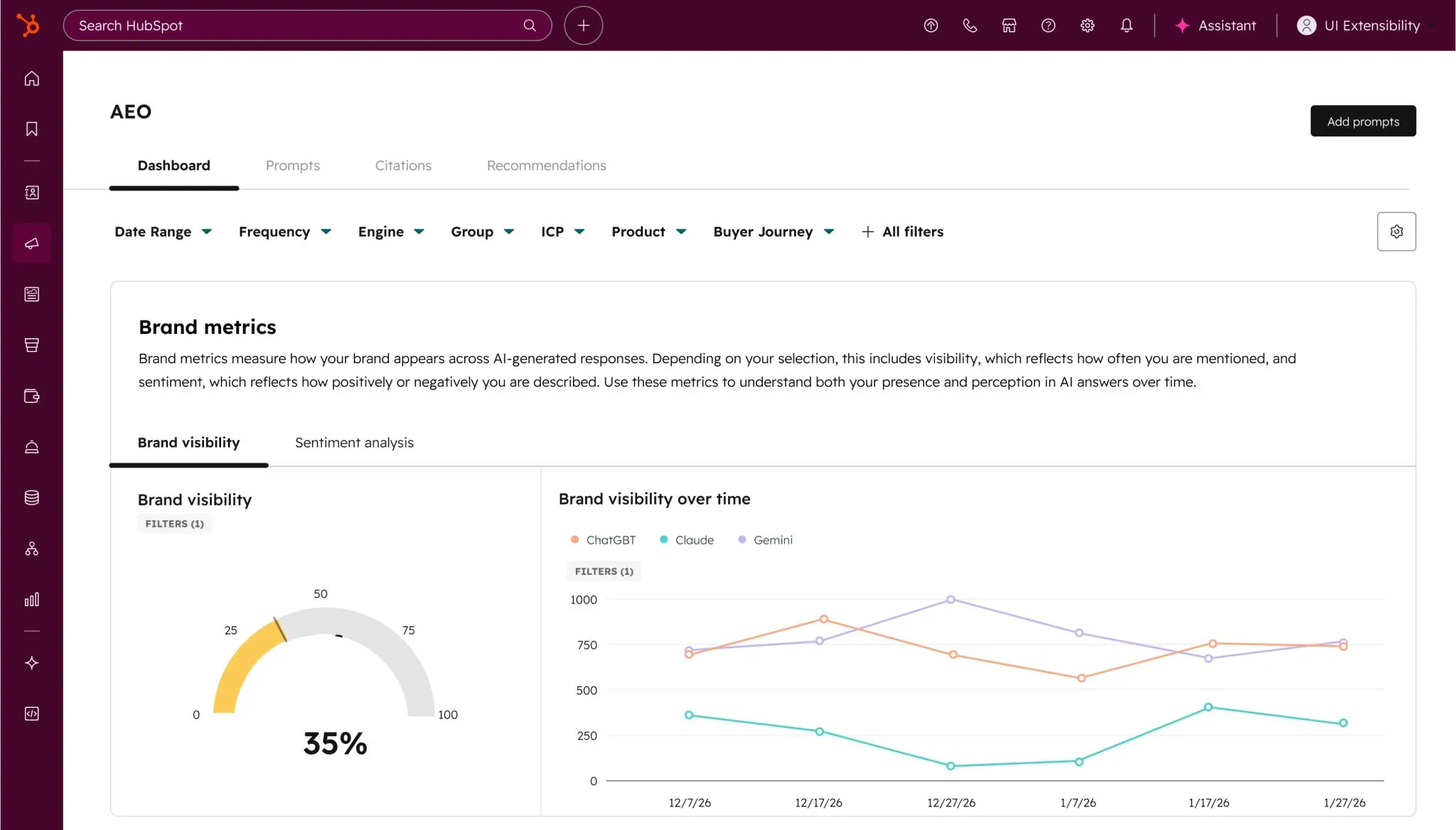
HubSpot has built answer engine optimisation tracking directly into HubSpot Marketing Hub Professional and Enterprise. It's currently available in beta, which means early adopters get to shape how they use it before the wider market catches up, a meaningful commercial advantage for HubSpot Brisbane users who move quickly.
In practical terms, the feature does the following:
- Tracks how often your brand appears in AI-generated answers across ChatGPT, Perplexity, and Gemini for prompts relevant to your business
- Shows where competitors are being recommended in those answers instead of you. Your gap list, built automatically from your existing CRM data
- Assigns each prompt to a buyer journey stage: Awareness, Consideration, Evaluation, or Decision so visibility metrics are interpreted in the right commercial context
- Surfaces content recommendations tied to specific prompts your brand is currently missing, based on citation pattern analysis rather than guesswork
- Pulls from your existing HubSpot data on industries, customer segments, and competitors from day one, so setup is fast and contextually accurate
The setup process is more considered than a typical dashboard activation. You confirm your brand name, domain, and name variations; review and configure competitors; select the products and Ideal Customer Profiles (ICPs) you want to track and then review the suggested prompt set.
Prompts are generated based on your brand identity and ICP data already in HubSpot. You can also add prompts manually or generate additional ones using AI, which matters for Brisbane-specific prompt coverage, where local context changes what buyers actually ask.
The Citations Layer Is Where It Gets Commercially Useful
Beyond brand mention tracking, the Citations tab shows which domains answer engines are drawing on when they generate responses about your category. This breaks down by content type by blog articles, comparison pages, top lists, user reviews, technical documentation, and by channel, distinguishing between your owned content, competitor sites, earned media, and user-generated sources.
This is genuinely useful for a marketing manager. If Perplexity is consistently citing a competitor's comparison article when someone asks about HubSpot partners in Brisbane, that's a content gap with a clear fix. The Recommendations tab surfaces exactly these kinds of actionable gaps, based on observed citation patterns rather than generic best-practice advice.
The Attribution Piece and Why It Matters Internally
The most commercially significant element for HubSpot users is revenue attribution. Because AEO sits natively inside HubSpot, you're not correlating data across disconnected platforms. The path from an AI mention to a contact record to a deal to closed revenue is structural, not reconstructed after the fact.
Most standalone AEO tools can surface mention counts and share-of-voice data. Connecting that to the pipeline requires manual effort and significant assumptions. Inside HubSpot, that connection already exists. For a marketing manager who needs to justify AEO investment to a CFO or CEO, that's a meaningful difference. We report on revenue, not impressions, and this is the first native tool that makes AI-driven visibility reportable in those terms.
Why the Timing Matters
Gemini's 49% growth over 12 weeks shows the AI search environment is shifting faster than most marketing plans are updated. Most platforms are still in reactive mode. HubSpot built a native solution inside a platform that already holds your CRM data, your content history, and your revenue reporting and released it in beta while the market is still forming habits.
Brand perception formed through AI summaries is difficult to reverse. If a buyer repeatedly sees your competitor recommended across multiple answer engines during their research phase, that impression doesn't simply dissolve when they eventually land on your Google listing. The longer a business waits to understand its AI visibility, the more ground competitors can quietly accumulate and shortlists formed early in the research process are rarely reopened.
AEO and SEO: Same Foundations, Different Surface
The Overlap Is Greater Than Most Agencies Will Tell You
There's a tendency in the agency market to position answer engine optimisation as an exotic new discipline requiring an entirely separate strategy and budget. It isn't. Our position at BFJ is that AEO is an extension of disciplined content and SEO work, applied to a new surface. If an agency is quoting you a completely separate AEO retainer with no connection to your existing content programme, that's worth scrutinising.
SEO vs AEO
Capability | SEO Brisbane | AEO Brisbane |
|---|---|---|
Clear, well-structured content | Essential | Essential |
Answering specific buyer questions | Core practice | Core practice |
Keyword and prompt research | Keyword-focused | Prompt and intent-focused |
Structured data and schema | Important | Critical for citation accuracy |
Third-party credibility signals | Backlinks and authority | Earned media, reviews, citations |
SEO optimises for search engine crawlers and ranking signals. AEO optimises for being cited as a credible, authoritative source in a synthesised AI answer. The content qualities that drive both are substantially the same: clear structure, specific answers to real questions, credible sourcing, and demonstrable subject matter expertise. Our article outlines how to write content for AI Mode as a starting point.
If your HubSpot content (service pages, blog articles, FAQs, case studies) already answers specific questions clearly and comprehensively, you are already partially optimised for AEO.
AEO FAQS
How do AI search engines choose which websites to cite?
AI tools prioritise content that:
- Directly answers the question
- Is clearly structured and easy to extract
- Appears consistently across trusted sources
Authority and clarity matter more than keyword density.
Is AEO replacing SEO?
No. AEO is an additional layer. AI tools drive discovery, while Google still drives validation and conversions. Businesses need both to compete effectively.
How do I optimise my content for AEO?
Focus on:
- Answering specific questions clearly
- Using structured headings and concise sections
- Creating authoritative, well-supported content
If a human can quickly find the answer, AI can too.
What type of content works best for AEO?
Content that performs best includes:
- FAQs
- Comparison pages
- Service pages answering specific queries
- In-depth articles with clear structure
Vague or generic content is rarely cited.
Can you track AEO performance?
Yes. You can manually test prompts in AI tools or use platforms like HubSpot to track brand mentions, competitor visibility, and content gaps across AI-generated answers.
Why is AEO important for B2B marketing?
B2B buyers are using AI tools to shortlist vendors before visiting websites. If your brand isn’t mentioned at that stage, you may never enter the consideration set when it comes to B2B Marketing.
Does Google use AI answers now?
Yes. Google integrates AI-generated answers through Gemini in search results. This means AEO impacts visibility even within traditional search.
What are examples of AEO keywords or prompts?
Examples include:
- “Best HubSpot agency Brisbane”
- “How much does HubSpot cost Australia”
- “Top CRM platforms for mid-sized businesses”
These are questions buyers are asking AI tools directly.
Is AEO only relevant for large businesses?
No. Smaller businesses can compete effectively if their content is clearer and more useful. AI models often prioritise quality of the answer over brand size.
How long does it take to see results from AEO?
It depends on content quality and competition, but improvements can be seen quickly once content aligns with real user prompts and is picked up by AI tools.
Sarah Halliday
Sarah Halliday is a Digital Account Manager at BFJ Digital, bringing ten years of experience across digital marketing, SEO, client management, and project delivery. Based in Brisbane, Sarah specialises in helping clients connect marketing performance to tangible business outcomes through strategic planning and execution.
Her career progression demonstrates her versatility and expertise, having previously served as an SEO Specialist and Account Manager, where she developed strategies that improved visibility, traffic, and conversions for diverse client portfolios. Earlier roles included Digital Marketing Manager, Client Marketing Manager, and Digital Projects Manager, where she coordinated websites, SEO initiatives, and creative deliverables across multiple concurrent projects.
Sarah's dual degree in Business and Creative Industries, with concentrations in Marketing and Art History and Design, provides her with a unique perspective that combines analytical rigour with creative thinking.
Known for her strong work ethic and people-first approach, Sarah excels at bridging technical execution with meaningful client relationships. Her professional interests span SEO, digital strategy, client engagement, and sustainable business growth, making her an invaluable partner for clients seeking both strategic insight and reliable project delivery.
Ready to See the Bigger Picture?
Want to understand how your digital and real-world marketing impact each other? Not sure if your CRM is supporting your paid media efforts? Just need some clarity and a clear plan to better ROI? Book your free strategy session today for an in-depth audit and action plan to double your digital marketing ROI.
- Meet with a strategy specialist to build a growth plan
- Increase your media performance by up to 200%
- Improve business efficiencies to increase ROI via automation and increase profit
- We cut to the chase. What digital marketing is actually working?