How Much Does a Digital Marketing Agency Cost in Australia? (Updated for 2026)

Sarah Halliday
Digital Account Manager at BFJ Digital
Keep ahead of the curve via our latest trends newsletter.
Contact us nowKey takeaways
- Most Australian businesses pay a digital marketing agency between $2,000 and $15,000 a month. Smaller single-channel work starts near $1,500, and larger multi-market programs run to $30,000 a month and beyond.
- The agency fee and your media spend are two different things. The fee pays for the strategy and the people. The media spend buys the ads, and on a healthy paid program it is usually the larger of the two.
- A cheap quote is often the most expensive option. A very low fee can mean junior staff, thin hours, or media spend quietly left out of the number.
- Judge cost against return, not the fee alone. Work backwards from what a customer is worth to you, and measure the work on leads, pipeline and sales rather than clicks and impressions.
- The right budget follows your stage. Startups can start at $1,500 to $5,000 a month, growing SMEs at $5,000 to $15,000, and established businesses at $15,000 to $30,000 or more.
We get asked about cost more than almost anything else. It usually comes out as one question: "What should we actually be paying?" There isn’t a single answer, because there are no other agencies that operate the way we do, even so, let's take a look at what it costs.
At BFJ Digital, CRMs like HubSpot sit at the core of our service lines. We’re not a performance agency that only delivers clicks, not an SEO agency that only delivers rankings, and not a web agency that only builds websites. We’re an agency that reports and drives revenue, using whatever mix of tools and channels our clients need.
That’s what makes us unique in Australia and why our clients see us as a partner in commercial outcomes, not just marketing. As a Brisbane Digital Marketing Agency, we have been in the national industry since 2009.
What does a digital marketing agency cost in Australia?
Here is the quick version by business size. These are typical 2026 retainer ranges across the Australian market. They cover the agency's fees and exclude GST and your media spend.
Business stage | Typical monthly retainer | What it usually covers
|
|---|---|---|
Small business or startup | $1,500 to $5,000 | One or two channels, account setup, basic reporting |
Growing SME | $5,000 to $15,000 | Multiple channels, CRM and reporting, active strategy |
Enterprise | $15,000+ | Multiple markets, advanced data and integration |
Two businesses of the same size can still land on very different numbers. A local trade business chasing leads in one city has a smaller job than a national brand competing across search, social and marketplaces. Your number largely depends on scope, competition and the outcome you need.
Agency fees versus media spend
This is the single most important thing to understand before you compare quotes. Your total marketing investment has two parts.
The agency fee pays for strategy, campaign management, creative, reporting and the people doing the work. The media spend is the budget that buys the ads, paid to Google, Meta, LinkedIn and similar platforms directly. In a healthy paid media program, the media spend is usually the larger share of the two.
Why does this matter, you ask? Because a cheap-looking quote often hides the split. An agency can quote a low management fee and stay quiet about the media budget you will still need to see results.
When you compare two agencies, always ask what the fee covers, what the expected media spend is, and what is billed separately. A clear answer here tells you a lot about how the agency works.
Where BFJ is different:
- Most agencies sell activities (ad clicks, SEO rankings, web builds).
- We design cross-channel strategies, then connect them into your CRM to measure pipeline and revenue.
- That means you can see what every marketing dollar actually returns.
- It also enables BFJ to build an ecosystem that manages the complete customer journey, all in one agency, - so as you can imagine the synergies are tremendous.
What do different digital marketing services cost?
Most agencies price by service or bundle several into a retainer. The table below shows typical 2026 Australian ranges for the management fee on each service. Where a service runs on ad budget, that media spend is on top.
Service | Typical monthly cost (AUD) | Notes
|
|---|---|---|
Search engine optimisation (SEO) | $1,500 to $7,000+ | Higher for competitive or national campaigns |
Google Ads management | $1,000 to $5,000, or 10% to 20% of ad spend | Media spend is separate |
Paid social management | $1,500 to $8,000 | Media spend is separate |
Content marketing | $1,000 to $8,000 (articles roughly $300 to $1,000 each) | Scales with volume and depth |
Email and marketing automation | $1,000 to $5,000 | Depends on platform and complexity |
CRM and HubSpot setup or integration | $2,500 to $15,000 as a project, plus the software licence | Licence is billed by the platform |
Basic website design and build | $8,000 to $25,000 as a one-off project | Brochure or lead generation site |
Complex or ecommerce website design and build | $20,000 to $100,000+ as a one-off project | Larger builds, ecommerce and custom functionality |
Hourly or ad hoc work | $150 to $300+ per hour | Senior specialists cost more |
SEO is search engine optimisation, the work that helps you rank in unpaid Google results. PPC is pay-per-click, the ads at the top of the page that you pay for on each click. We spell these out because the labels get thrown around a lot, and you should never feel talked down to by an agency using shorthand.
A quick note on buying services one at a time. You can, and sometimes it is the right call. Just know that channels perform better when they feed each other. Good SEO content also lifts your Google Ads quality, and both get sharper when the data flows into your CRM. Buying in isolation can cost less on paper and deliver less in practice.
Where BFJ is different:
- We don’t treat these as separate services. They’re part of one ecosystem.
- Our HubSpot team integrates media, SEO, and automation into a single revenue engine.
- That’s why we’re trusted by both business owners and marketing managers. We help prove ROI, not just activity.
How do digital marketing agencies charge?
Australian agencies use a handful of pricing models. Most will combine two of them. Knowing the models helps you read a quote and ask better questions.
- Monthly retainer. A fixed fee for an agreed scope of work each month. This is the most common model and it suits ongoing programs where the work continues month to month.
- Retainer plus a percentage of ad spend. A common model where an agency charges a base fee plus a percentage, often 10% to 20%, of the media budget they manage. Worth knowing because their fee climbs automatically as your spend grows, even when the work has not changed. We do it differently. Our fee reflects the work and the complexity of the campaign, not a slice of your budget, so a bigger media spend does not automatically mean a bigger fee.
- Hourly rate. Used for well-defined or ad hoc jobs. Rates commonly run $150 to $300 an hour, and higher for senior specialists.
- Project or fixed fee. A set price for a defined piece of work such as a website build, a strategy, an audit or a migration.
- Performance-based. Part of the fee ties to results, such as leads or revenue above a baseline. It can align incentives well, though it needs clear tracking and honest reporting to work fairly for both sides.
What affects the price?
When two quotes look far apart, the gap usually comes down to a few things.
- Scope. One channel costs less than a full funnel program across search, social and email.
- Competition. A competitive category or a national campaign needs more work than a local niche.
- Goals. Chasing aggressive growth costs more than holding a steady position.
- Your starting point. A clean website, a working CRM and decent creative all lower the setup effort. Gaps in these raise it.
- Seniority and location. Senior local strategists cost more than junior or offshore teams, and the quality difference usually shows.
- Reporting and technology. Proper tracking, attribution and automation take skill to set up, and they change what you can measure later.
What is normally included, and what is not?
A retainer usually includes strategy, campaign setup and management, reporting and a set number of hours or deliverables each month. Ask for that scope in writing.
These items are often billed separately, so check for them before you sign: your media or ad spend, software and platform licences such as HubSpot or an SEO tool, one off setup or onboarding fees, website or landing page builds, and content production above an agreed volume. GST of 10% also sits on top of Australian agency fees. None of these are hidden traps by default. They only become a problem when an agency stays quiet about them.
Agency fee, media spend and total marketing investment
Think in terms of total marketing investment, not the agency fee alone. The fee is only one line. Your real number is the fee, plus media spend, plus tools, plus any production.
A common rule of thumb helps you sense-check the total. Many B2B businesses spend around 2% to 5% of revenue on marketing, and many B2C businesses spend 5% to 10%. These are broad benchmarks, not rules, and they move with your growth stage and margins. A business chasing fast growth often spends at the top of the range or above it.
If you want a framework for splitting the budget, the 70-20-10 rule is a simple one. Put about 70% into the proven activities that already work, 20% into promising channels you are scaling, and 10% into new experiments. It keeps most of your money on what performs while still funding the next opportunity.
What should you budget at each stage?
Budgets tend to follow the maturity of the business rather than a fixed formula.
- A startup or small business testing the water can start around $1,500 to $5,000 a month in agency fees, usually on one or two channels with the basics set up properly.
- A growing SME ready to scale typically invests $5,000 to $15,000 a month across several channels, with a CRM and real reporting behind it.
- An established or larger business running a full funnel program with automation and attribution often sits at $15,000 to $30,000 a month, and enterprise programs across multiple markets go beyond that.
If your budget is tight, spend it deep rather than wide. One channel done well beats five channels done thinly.
Agency or in-house: which costs less?
This question comes up in almost every pricing conversation. A single in-house marketing specialist in Australia costs roughly $90,000 to $150,000 a year once you add superannuation, payroll tax, recruitment, software and management time. That buys you one person with one or two strong skills.
An agency retainer of similar size gives you a whole team for less than the cost of that single hire: a strategist, plus specialists in search, paid media, creative and data. The combined skill and experience across that team goes well beyond what any one employee can cover, and you get it without the recruitment, superannuation and management overhead of a permanent role.
There is a flexibility benefit too. If an agency is not delivering, you can give notice and move on quickly. Managing out a permanent hire is slower and far harder. That difference keeps a good agency honest, because they have to keep earning the relationship every month.
Below that, an agency usually gives you more capability for the money. Well above it, some businesses build a hybrid, keeping strategy in-house and using an agency for specialist delivery.
How do you judge whether an agency is good value?
Price on its own tells you very little. Value is the return you get for the total investment. Here are a few tips for you:
- Be careful with a quote that looks too cheap. A very low fee often means junior staff, thin hours, no real strategy, or the work being sent offshore. It can also mean media spend has been quietly left out of the number. Cheap work that produces nothing is the most expensive option there is.
- Work backwards from a customer. If a new customer is worth $5,000 to you and one in ten leads converts, you can afford to pay up to $500 for a lead and still win. That single sum turns marketing from a cost into a calculation. It also tells you fast whether a quote is realistic for your economics.
- Ask what you are being measured on. Impressions, clicks and rankings are activity. Leads, pipeline, sales and profit are outcomes. Plenty of agencies report the first group because it always looks busy. The number that matters is what the work returned against what it cost.
- Give it a fair timeline. New campaigns can take up to 90 days to get off the ground, and that is usually the point where you can start to read their performance and viability. Paid media tends to show signs sooner, while SEO usually takes three to six months to show and nine to twelve months to mature. Judge each channel on its own clock.
Cost should be measured against commercial return
Here is where I will be direct, because it is the heart of how we think at BFJ. The agency fee is close to meaningless on its own. The real question is what your total marketing investment produces for the business.
Most agencies sell activity. They run the ads, build the pages and send the reports, and the story stops at clicks, impressions or rankings. None of those guarantee a sale. We design the work to connect back to revenue as best we can, so you can see which activity produced leads, which leads became pipeline, and which pipeline turned into money.
We do that by putting a CRM at the centre, most often HubSpot, and wiring your channels into it. Paid media, SEO, email, automation and revenue attribution all report into one place. HubSpot is our most common recommendation, though we also work across other platforms like Salesforce, Zoho and Pipedrive. What matters is what suits your business and your existing tech stack, not forcing you onto a single tool. That turns marketing from a cost line into a profit centre you can actually manage. When you can see the return, the fee stops being the argument and the outcome takes over.
Why businesses choose BFJ Digital
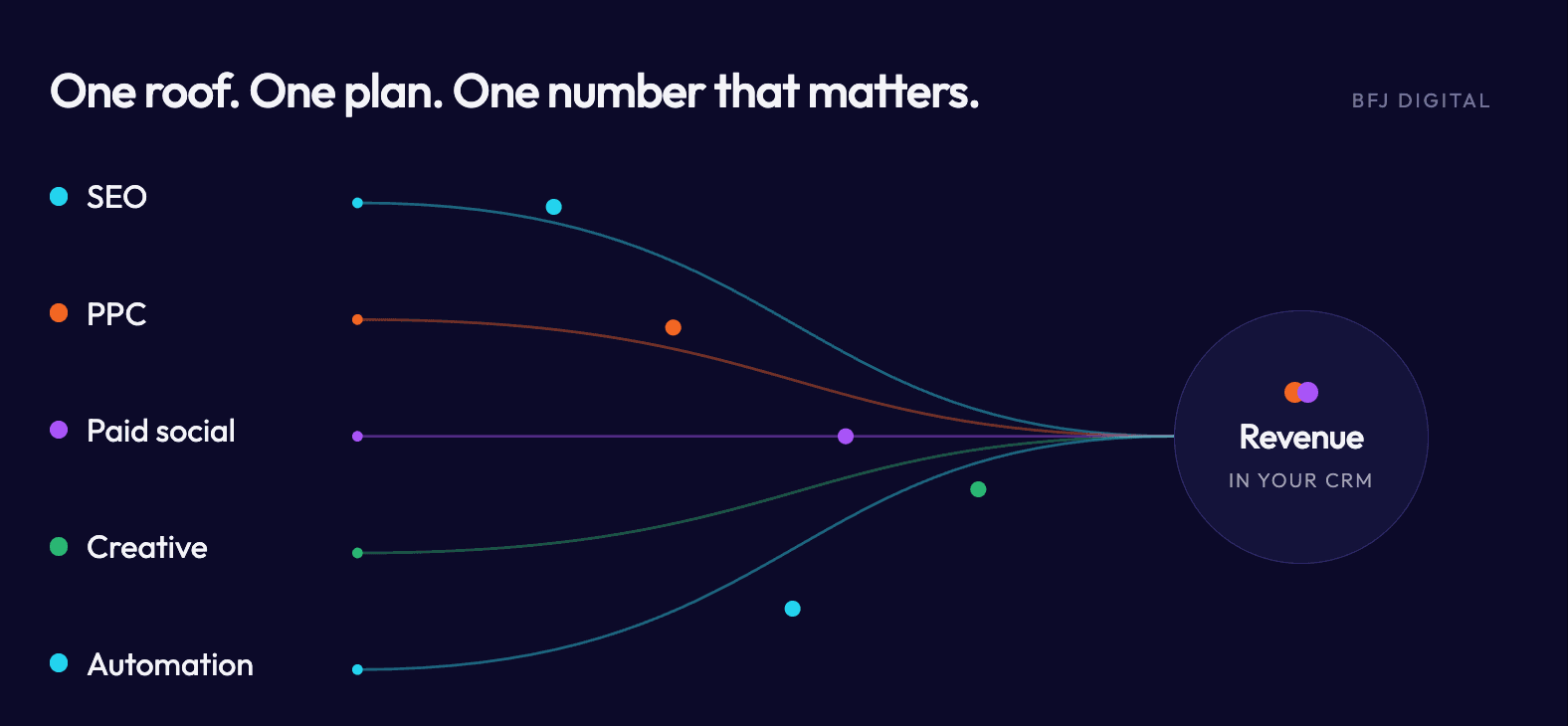
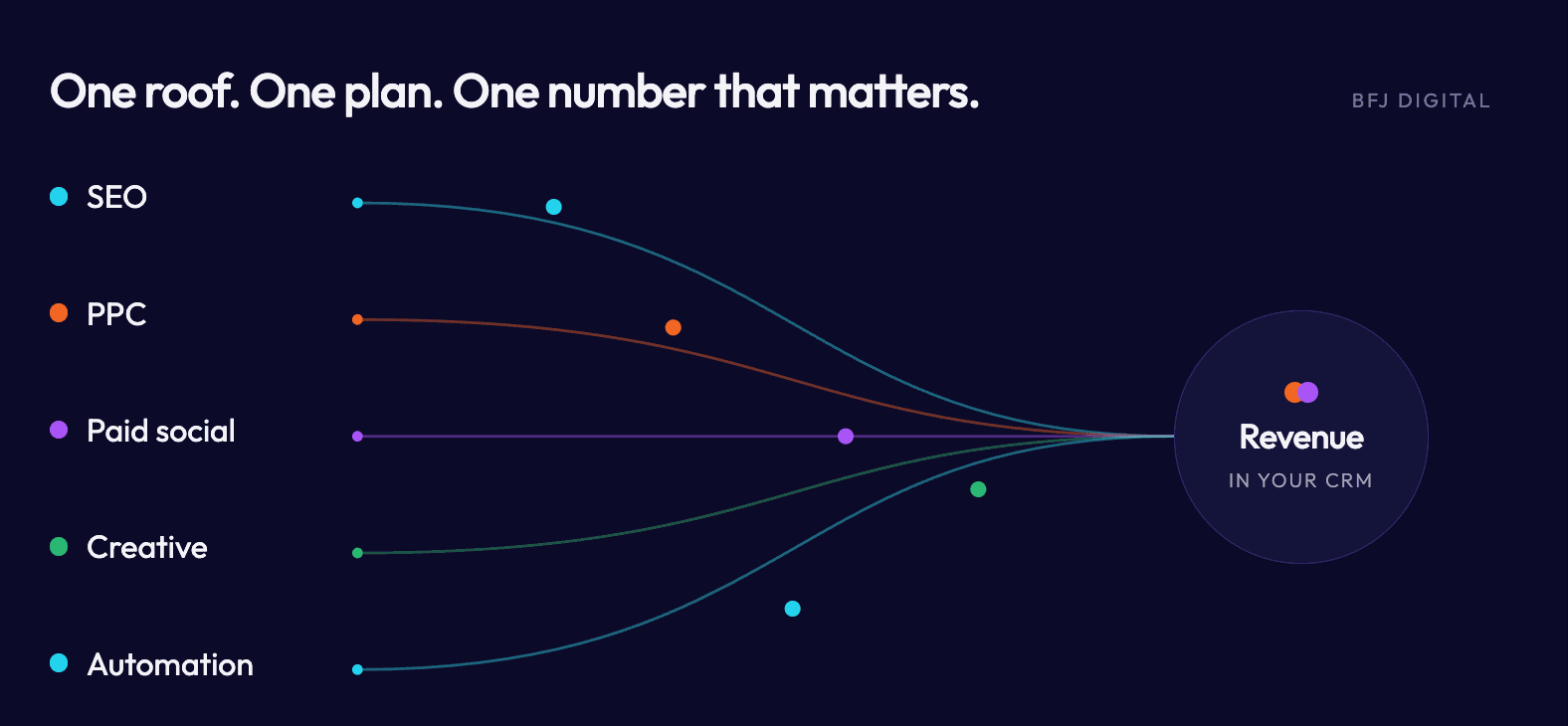
We bring the main digital channels together under one roof, so your search, paid media, creative and data work to the same plan instead of pulling in different directions. We build around your CRM so every campaign ties back to revenue, not vanity metrics.
Our team covers SEO, PPC, paid social, automation and creative, which means fewer suppliers to manage and less that falls through the gaps. Most of all, we report on the numbers your board cares about.
You can explore our digital marketing services.
If you want a clear view of what your marketing should cost and what it should return, book a free strategy session. We will look at your current spend, your goals and your numbers, and give you an honest read on where the money should go. Book your free strategy session.
Frequently asked questions
How much should I pay a digital marketing agency?
Most Australian businesses pay between $2,000 and $15,000 a month in agency fees, with smaller single channel work starting near $1,500 and larger programs running to $30,000 a month or more. The right number depends on your goals, your competition and the channels you need, and it sits separate from your media spend.
How much do digital marketing agencies charge per month?
Typical monthly retainers run $1,500 to $5,000 for small businesses, $5,000 to $15,000 for growing SMEs, and $15,000 to $30,000 or more for established and enterprise programs. Some agencies also charge a percentage of your ad spend on top, usually 10% to 20%.
What is the 70-20-10 rule for a marketing budget?
It is a simple way to split your budget. Put about 70% into proven activities that already deliver, 20% into promising channels you are scaling, and 10% into new experiments. It keeps most of your money working while still funding the next opportunity.
Can I just buy one service, like SEO?
Yes. Many businesses start with a single channel. Just keep in mind that channels perform better when they connect. SEO content strengthens your Google Ads, and both improve when the results feed your CRM. Buying in isolation can look cheaper and deliver less.
Do you work with small budgets?
We do our best work for businesses investing around $5,000 a month or more, because that is where we can build a program that shows a clear return. We can start smaller, and we will tell you honestly what is realistic at that level before you commit.
Is an agency cheaper than hiring in-house?
Often, yes. A single in-house specialist costs around $90,000 to $150,000 a year once you include on-costs, and gives you one skill set. An agency of similar or lower cost gives you a whole team whose combined skills go well beyond any one hire. An agency is also easier to move on from if it is not working, where managing out a permanent role is slower and far harder. Some larger businesses use a hybrid, keeping strategy in-house and using an agency for specialist delivery.
Why put a CRM like HubSpot at the centre?
Because it makes marketing accountable to revenue. A CRM ties every campaign to leads, pipeline and sales, so you can see what the work actually returned. Without it, you are left measuring clicks and hoping they turned into customers. You can read more about our revenue attribution.
Sarah Halliday
Sarah Halliday is a Digital Account Manager at BFJ Digital, bringing ten years of experience across digital marketing, SEO, client management, and project delivery. Based in Brisbane, Sarah specialises in helping clients connect marketing performance to tangible business outcomes through strategic planning and execution.
Her career progression demonstrates her versatility and expertise, having previously served as an SEO Specialist and Account Manager, where she developed strategies that improved visibility, traffic, and conversions for diverse client portfolios. Earlier roles included Digital Marketing Manager, Client Marketing Manager, and Digital Projects Manager, where she coordinated websites, SEO initiatives, and creative deliverables across multiple concurrent projects.
Sarah's dual degree in Business and Creative Industries, with concentrations in Marketing and Art History and Design, provides her with a unique perspective that combines analytical rigour with creative thinking.
Known for her strong work ethic and people-first approach, Sarah excels at bridging technical execution with meaningful client relationships. Her professional interests span SEO, digital strategy, client engagement, and sustainable business growth, making her an invaluable partner for clients seeking both strategic insight and reliable project delivery.
Ready to See the Bigger Picture?
Want to understand how your digital and real-world marketing impact each other? Not sure if your CRM is supporting your paid media efforts? Just need some clarity and a clear plan to better ROI? Book your free strategy session today for an in-depth audit and action plan to double your digital marketing ROI.
- Meet with a strategy specialist to build a growth plan
- Increase your media performance by up to 200%
- Improve business efficiencies to increase ROI via automation and increase profit
- We cut to the chase. What digital marketing is actually working?