 Read More
25 Oct 2026
|11 min
Dental Practice Marketing and the Cost of a Booked Treatment

Scott Macfarlane
Operations Manager at BFJ Digital

Keep ahead of the curve via our latest trends newsletter.
Contact us nowKey takeaways
- Cost per lead measures the top of the funnel and says nothing about how many leads become paying patients, so it can reward the wrong campaigns.
- Cost per booked treatment divides marketing spend by the number of treatments it generates, which ties the budget to a commercially meaningful outcome.
- The same acquisition cost can be strong for one treatment type and weak for another, so it must be read alongside treatment value, margin, acceptance rate and patient lifetime value.
- Advertising platforms optimise towards the conversion signals they receive, so shallow or poor-quality signals train the algorithm to produce cheaper enquiries that convert less.
- Front-desk performance, call handling and follow-up sit inside the same patient acquisition system as the advertising, and a strong campaign can be undone after the enquiry arrives.
- Attribution will never be perfect, and the goal is enough reliable data to make better budget decisions, not a flawless record of every patient journey.
Most dental practices can tell you what a lead costs. Their Google Ads account reports a cost per conversion, their agency sends a monthly figure for enquiries, and the number moves up or down each quarter. That figure feels like it measures marketing performance, and to a point it does. It also hides the question a practice owner needs answered, which is how much the practice is spending to generate a patient who sits in the chair and accepts treatment.
A lead is a signal of interest. It is not revenue, and it is not a booked treatment. The gap between the two is where most dental marketing budgets quietly leak, because the reporting stops at the enquiry and the commercial story keeps going without anyone watching it.
A campaign can look efficient in the ad platform and still produce very little treatment, and a campaign that looks expensive can be the one funding the practice.
This article makes the case for a more commercial measure. It looks at how a practice can connect marketing spend to enquiries, appointments, attendance, treatment acceptance and revenue, so decisions get made on what marketing produces and not on the price of a click.
The aim is to help you read your own numbers with a sharper commercial eye, so your dental marketing budget goes where the treatment comes from.
Why cost per lead stops short as a measure of dental marketing
Cost per lead is easy to calculate and easy to compare, which is why it dominates most reporting. Divide the spend by the number of enquiries and you have a number that any platform can produce automatically. The problem is what the number leaves out. It treats every enquiry as equal, and enquiries are not equal.
Two campaigns can report the same cost per lead and behave completely differently once the enquiries reach the practice. One might fill the diary with patients who attend and accept treatment, and the other might generate a stream of enquiries that never book, cancel, or want a service the practice does not prioritise. On the cost per lead line they look identical. In the bank account they are not.
The deeper issue is that optimising for cheaper leads can move a practice away from revenue. When a campaign is judged on lead cost alone, the pressure is always to drive that number down, and the easiest way to drive it down is to lower the bar for what counts as a lead. That produces more enquiries at a lower price and fewer patients at the end of the funnel, which is the opposite of what the practice wanted when it started advertising.
What is cost per booked treatment
Cost per booked treatment is a straightforward idea. It divides the marketing spend by the number of treatments that spend generated.
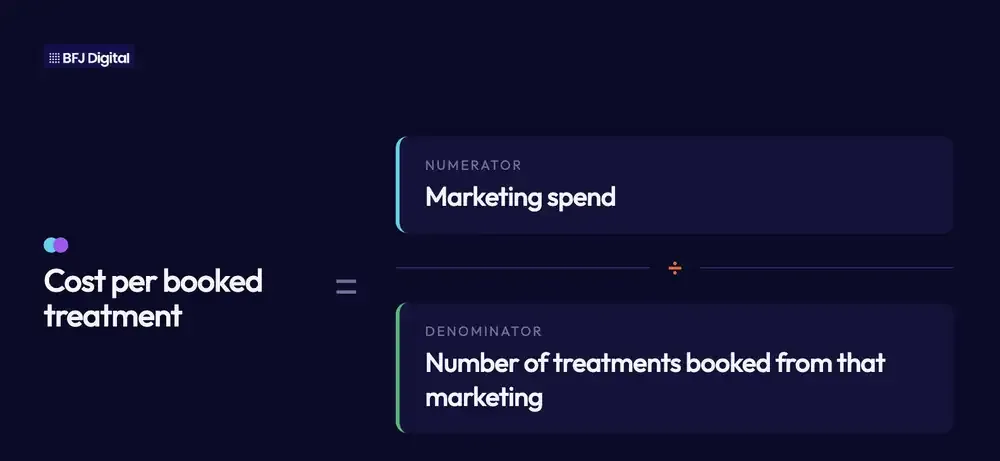
A worked example shows why the measure is useful. Suppose a practice spends $10,000 on a campaign over a period and the funnel plays out like this.
Stage | Result | What it costs |
|---|---|---|
Marketing spend | $10,000 | Total budget |
Enquiries generated | 200 | $50 per enquiry |
Appointments booked | 80 | $125 per appointment |
Consultations attended | 65 | $154 per attendance |
Treatments accepted and booked | 25 | $400 per booked treatment |
The cost per lead here is $50, which reads as efficient. The cost per booked treatment is $400, and that is the number that tells the practice what its marketing is really producing. The journey from 200 enquiries to 25 booked treatments is where the commercial performance lives, and the cost per lead figure cannot see any of it.
The $400 figure is more useful because it reflects the whole system working, from the ad through to the treatment plan being accepted. It moves the conversation from how cheaply the practice can generate interest to how efficiently it can generate patients. That is a conversation a practice owner can act on.
Why $400 per booked treatment can mean two very different things
Cost per booked treatment is a better measure, and it still needs context. A $400 acquisition cost is excellent for a $6,000 dental implant case and questionable for a $199 check-up and clean. The number on its own does not tell you which situation you are in, so it has to be read against the commercial value of what was booked.
Several factors decide what an acceptable acquisition cost looks like for a given practice.
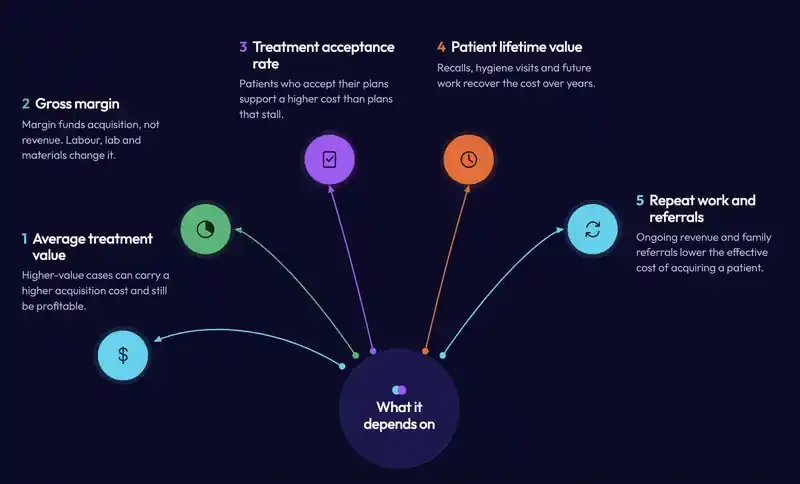
- Average treatment value. A higher-value treatment can carry a higher acquisition cost and still be profitable, so the acceptable number rises with the value of the case.
- Gross margin. Two treatments at the same price can have very different margins once labour, lab and materials are accounted for, and margin, not revenue, is what funds the acquisition cost.
- Treatment acceptance rate. A campaign that produces patients who accept their treatment plans supports a higher cost per booked treatment than one that produces plans that stall.
- Patient lifetime value. A new patient who returns for recalls, hygiene visits and future work is worth far more than a single treatment, so the acquisition cost is recovered over years.
- Repeat treatment, recalls and referrals. A patient acquired once can generate ongoing revenue and refer family members, which lowers the effective cost of acquiring them.
Because these factors differ so much across practices and treatments, there is no universal good number. A practice that builds its economics around high-value dentistry can justify an acquisition cost that would sink a practice built on volume general dentistry, and both can be right for their own model.
How treatment type changes the economics
The type of treatment a campaign targets changes the whole calculation, because value, urgency and consideration time all move together. The table below is directional, not a set of benchmarks, and it shows how the logic shifts across common treatment types.
Treatment type | Relative value | Buying behaviour | What it means for acquisition cost |
|---|---|---|---|
Check-up and clean | Low | Routine, price-sensitive, high volume | Low acceptable cost per booked treatment, recovered through recalls and lifetime value |
Emergency appointment | Low to moderate | Urgent, fast decision, high booking rate | Moderate acceptable cost, strong entry point to a longer patient relationship |
Crown | Moderate | Considered, often clinically driven | Higher acceptable cost supported by the treatment value |
Veneers | High | Elective, longer consideration, appearance-led | Higher acceptable cost, longer time from enquiry to acceptance |
Dental implant | High | Researched, multiple touchpoints before booking | High acceptable cost justified by case value |
Full-arch restoration or All-on-4 | Very high | Long sales cycle, several consultations | Much higher acceptable cost, measured over weeks or months |
A practice sets its own target. You establish an acceptable acquisition cost for each treatment type by working back from its value, its margin and how often enquiries turn into accepted plans.
Once you have that, cost per booked treatment becomes a number you can judge, because you know what good looks like for your practice.
The dental patient acquisition funnel
Connecting spend to revenue means seeing the full journey a patient takes, all the way through. The chain runs from marketing spend to enquiry, appointment booked, appointment attended, treatment plan presented, treatment accepted, treatment completed and revenue.
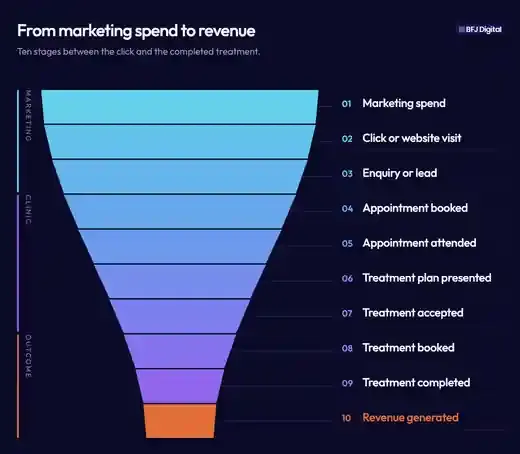
Most practices have clear visibility at the top and go dark somewhere in the middle. Google Ads reports the click and the form submission. Google Analytics 4 records a conversion. That is where the automated view usually ends, and the rest of the funnel is where the money is decided.
The platforms do not know what happened next. They cannot tell you if reception called the enquiry back, if the patient booked, if they attended, what treatment they came in for, if a treatment plan was presented, if the patient accepted it, or what the case was worth. Every one of those steps affects the return on the campaign, and none of them show up in the ad account. This is the visibility gap, and closing it is what turns marketing reporting into commercial reporting. It is also the reason connecting your advertising platforms, website analytics, call tracking and practice management data matters so much, because the answer to how your marketing is performing lives across all of them.
How cheap leads can cost you patients

Lead quality is where a lot of dental marketing budget is lost without anyone noticing, because the losses are invisible in the ad platform. A campaign can report strong conversion numbers while sending the practice enquiries that were never going to become patients.
The common culprits are worth naming, because most practices recognise them once they look.
- Low-intent form fills from people who were browsing and are not ready to book.
- Phone enquiries that never turn into appointments.
- Booking-button clicks counted as conversions even though no booking was completed.
- Duplicate enquiries from the same person across several channels.
- Existing patients counted as new-patient leads.
- Enquiries from outside the practice's service area.
- Enquiries for treatments the practice does not want to prioritise.
- Patients who book and then fail to attend.
There is a mechanism underneath this that practice owners need to understand, because it explains why the problem compounds. Platforms like Google Ads and Meta optimise towards the conversion signals you feed them. If you tell the platform that a form fill is the goal, it will get very good at producing form fills, and it will find the cheapest ones. If those cheap conversions are low-intent enquiries that never book an appointment, the algorithm has been trained to manufacture exactly the wrong outcome, efficiently and at scale.
The fix is to feed the platforms better signals. When the conversion you optimise for is a booked appointment, an attended appointment, or a booked treatment, the algorithm starts working towards patients who reach those stages. The quality of the signal decides the quality of the optimisation, so shallow signals produce shallow results no matter how good the campaign management is.
What a strong dental marketing measurement setup connects
Closing the visibility gap does not require a perfect data science operation. It requires the right systems talking to each other so the practice can follow a patient from the ad to the treatment. A capable setup usually connects the following.
- Google Ads and Meta Ads as the sources of paid demand, configured to receive conversion data back from later funnel stages.
- SEO and organic search tracked alongside paid, because a large share of dental enquiries come from search and reviews before anyone clicks an ad.
- Google Analytics 4 and conversion tracking as the layer that records website behaviour and ties actions to sources.
- Call tracking, because a high proportion of dental enquiries happen by phone and an untracked call is an invisible conversion.
- Online booking, practice management and patient relationship software, which may sit within the same platform. In many dental practices, systems such as Dental4Windows, EXACT or Core Practice can manage patient records, appointments, treatment information and ongoing patient communication.
- Offline conversion tracking and revenue attribution, which send booked and completed treatment data back to the ad platforms so campaigns can optimise towards outcomes that generate revenue.
The goal of connecting these systems isn’t to build a dashboard for its own sake. It’s to answer one question with confidence: what does a booked treatment cost by channel and campaign? Your practice management software, such as Dental4Windows, EXACT or Core Practice, holds the patient and appointment data that advertising platforms only see part of. Connecting that data back to your marketing helps close the gap between a lead and a booked treatment.
It is worth exploring the limits. Attribution will never be perfectly clean, and any agency that promises otherwise is overselling. A patient might see a Meta ad, search the practice name a week later, read reviews, visit the website twice, call the front desk, and book a fortnight after that. No model captures that path exactly. The point is not a flawless record. The point is enough reliable data to make better commercial decisions than you could make from cost per lead alone, and that is an achievable bar for any practice willing to connect its systems.
Reception is part of your marketing performance
Marketing performance does not stop when the enquiry arrives. It carries on through every interaction at the front desk, and this is one of the highest-leverage parts of the whole system. A practice can run an excellent campaign and lose the return after the phone rings, and no amount of ad optimisation will fix a leak that sits at reception.
The front-desk factors that move marketing ROI include speed to lead, missed calls, follow-up on enquiries that did not book first time, call handling, appointment availability, no-show management and the way treatment plans are followed up after the consultation. A patient who calls and cannot get through, or who leaves a message and never hears back, was a marketing cost with no marketing return.
None of this is about blaming reception teams, who are usually stretched across a dozen jobs at once. It is about recognising that the front desk and the advertising are the same acquisition system, and the practice only sees the full picture when it measures both. A campaign that looks like it is failing is often a campaign that is working, with the loss happening after the enquiry lands. Measuring the funnel all the way through is what tells the difference, because it shows you where patients are dropping out.
Better measurement changes where the budget goes
When a practice can see cost per booked treatment by campaign, the budget questions change. The question stops being which campaign has the cheapest leads and becomes which campaign produces the most booked treatments, the strongest acceptance, and the best revenue for the spend.
The difference is easiest to see in a comparison. Both campaigns below spend the same $10,000, and the ad platform makes Campaign A look like the clear winner. The practice data tells a different story.
Metric | Campaign A | Campaign B |
|---|---|---|
Marketing spend | $10,000 | $10,000 |
Cost per lead | $40 | $70 |
Enquiries generated | 250 | 143 |
Appointments booked | 75 | 79 |
Appointments attended | 50 | 67 |
Treatments accepted | 10 | 27 |
Cost per booked treatment | $1,000 | $370 |
Average treatment value | $900 | $1,400 |
Revenue generated | $9,000 | $37,800 |
Campaign A wins on cost per lead and lead volume, which is all the ad account shows. Campaign B wins on almost everything that pays the bills. It produces more attended appointments, far more accepted treatments, a much lower cost per booked treatment and more than four times the revenue. A practice optimising on cost per lead would pour more budget into Campaign A and starve the campaign that funds the practice.
Better measurement flips that decision. It lets a practice move budget towards the campaigns and channels that generate booked treatments and sustainable acquisition economics, pull budget from the campaigns that look efficient in the platform and perform poorly in the diary, and see exactly where in the funnel patients are dropping out so the fix is targeted. That is the commercial payoff of measuring past the lead. The budget follows the treatment, not the click.
Dental marketing still has to meet AHPRA rules
Any conversation about dental patient acquisition in Australia has to acknowledge the advertising rules, because dental services are regulated. Advertising a regulated health service sits under Section 133 of the National Law, administered by AHPRA and the Dental Board of Australia.
In practice, this means no misleading claims, no testimonials about the clinical aspects of a service in advertising the practice controls, no creating an unreasonable expectation of a beneficial outcome, and clear terms on any offer or inducement. For a broader breakdown of how these requirements apply across healthcare advertising and medical websites, read our guide to what AHPRA-regulated practices need to know.
None of this stops a practice from running strong, measurable marketing. It shapes how claims are written and how offers are presented, and a well-built acquisition system works comfortably inside those boundaries. The measurement approach in this article is fully compatible with compliant advertising, because tracking what a treatment costs to acquire has nothing to do with overstating what the treatment can do.
See what your marketing really produces
Most dental practices are measuring leads. Far fewer can tell you what those leads become once they reach the practice, and that gap is where budget decisions get made on the wrong numbers.
BFJ Digital works with dental practices to connect marketing activity to the patient journey and the commercial outcomes that follow, so decisions get made on data deeper than clicks and leads. We bring together paid media, SEO, websites, CRM, HubSpot, analytics and conversion tracking, and we build the measurement that shows what a booked treatment really costs to acquire.
If you are investing in Google Ads, Meta, SEO or a mix of channels and you are not certain which of them produces patients, talk to us. We will help you understand what your marketing is producing, so you can put your budget where the treatment comes from.
Frequently asked questions
What is cost per booked treatment in dental marketing?
Cost per booked treatment is the marketing spend divided by the number of treatments that spend generated. If a practice spends $10,000 and books 25 treatments from that campaign, the cost per booked treatment is $400. It measures marketing against a commercial outcome, which cost per lead does not, because it counts patients who accepted treatment, and not everyone who enquired.
How do you calculate dental patient acquisition cost?
Take the total marketing and advertising spend for a period and divide it by the number of new patients acquired in that period. For a sharper view, calculate it by treatment type or by channel, so you can see what it costs to acquire an implant patient compared with a check-up patient, or a patient from Google Ads compared with one from SEO. The more specific the calculation, the more useful it is for budget decisions.
What is a good cost per patient for a dental practice?
There is no single good number, because it depends on the value of the treatment, the margin, the acceptance rate and how much a patient is worth over their lifetime with the practice. A cost that is excellent for an implant case can be unworkable for a routine clean. The right approach is to set your own acceptable cost for each treatment type by working back from its value and profitability.
Why is cost per lead not enough to measure dental marketing?
Cost per lead only measures the top of the funnel. It counts enquiries, not patients, so it cannot tell you if those enquiries booked, attended or accepted treatment. Two campaigns with the same cost per lead can produce completely different revenue, and optimising for cheaper leads often lowers the quality of enquiries, which reduces the treatment the practice ends up booking.
How can a dental practice track marketing ROI?
Connect the systems that hold each part of the journey, which usually means the ad platforms, website analytics, call tracking, online booking, the CRM and the practice management software. When these share data, the practice can follow a patient from the ad through to the completed treatment and calculate real return. Offline conversion tracking then sends the treatment data back to the ad platforms so campaigns can optimise for revenue.
How do you know which marketing channel generates the most valuable patients?
Measure each channel by cost per booked treatment and by the value of the treatments it produces, not by lead volume or lead cost. A channel that generates fewer, higher-value patients who accept treatment can be far more valuable than one that generates a high volume of cheap enquiries. You can only see this when the treatment and revenue data is tied back to the channel that produced the enquiry.
Can attribution ever be completely accurate in dental marketing?
No, and it does not need to be. Patients take winding paths that involve ads, searches, reviews and phone calls over days or weeks, and no model captures every step. The goal is enough reliable data to make better commercial decisions than cost per lead allows. Practical, connected measurement beats perfect measurement that never gets built.
Scott Macfarlane has been with BFJ Digital for almost 10 years, and in that time, he's become the glue that holds complex projects together. As Operations Manager, Scott is the person who makes sure everything actually happens—from the big strategic moves down to the technical details that can make or break a campaign.
With more than a decade of experience in digital marketing, Scott brings a unique blend of creative thinking and technical expertise to every project.
His dual degree in Creative Industries and Information Technology provides him with comprehensive skills that bridge the gap between strategic vision and technical execution. Scott's expertise encompasses project and account management, strategic oversight of both paid and organic media channels, and technical implementation.
He is dedicated to building strong client partnerships and takes a hands-on approach to driving optimal performance across all campaigns.
Scott's ability to manage complex digital ecosystems while maintaining focus on client goals has made him an invaluable asset to the BFJ Digital team. His commitment to staying current with emerging technologies and marketing platforms ensures that clients benefit from cutting-edge solutions tailored to their specific business needs.
Ready to See the Bigger Picture?
Want to understand how your digital and real-world marketing impact each other?
Not sure if your CRM is supporting your paid media efforts? Just need some clarity and a clear plan to better ROI?
Book your free strategy session today for an in-depth audit and action plan to double your digital marketing ROI.