ROAS vs POAS: What's the Difference & Which Metric Should You Actually Optimise For?

Hardeep Gill
Performance Media Specialist at BFJ Digital

Not sure if your ads are profitable?
Contact us nowWhat if the metric you've been optimising for is actually hiding your real performance?
For years, ROAS (Return on Ad Spend) has been the gold standard for measuring paid advertising success. A 5x ROAS sounds impressive in any boardroom presentation.
But here's the uncomfortable truth: a campaign with a stellar ROAS can still lose money. And a campaign with a modest ROAS might be your most profitable.
The difference comes down to one overlooked factor: profit.
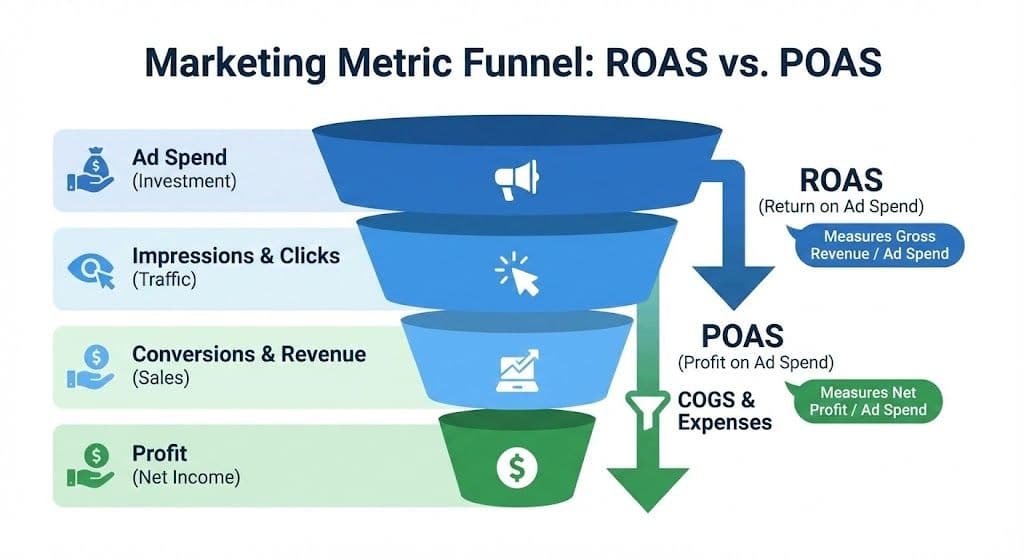
This is where POAS (Profit on Ad Spend) enters the conversation. While ROAS tells you how much revenue your ads generate, POAS reveals how much money you actually keep. And in a market where margins are tighter than ever, that distinction matters.
In this guide, you'll learn exactly how each is calculated, when to use ROAS versus POAS, and how shifting your focus to profit-based measurement can transform your advertising results.
We'll walk through real scenarios, provide formulas you can use today, and share the approach we use at BFJ Digital to help ecommerce and service businesses scale with confidence.
Let's get into it.
What is ROAS?
ROAS stands for Return on Ad Spend. It measures how much revenue you generate for every dollar spent on advertising.
The ROAS calculation is straightforward:
ROAS = Revenue from Ads ÷ Ad Spend
If you spend $1,000 on Google Ads and generate $5,000 in revenue, your ROAS is 5.0 (or 500%). Simple enough.
ROAS became the default performance metric because it's easy to track. Platforms like Google Ads and Meta Ads Manager report it automatically. It gives marketers a quick snapshot of campaign efficiency and makes comparisons between campaigns straightforward.
ROAS Calculation Example
Let's say you run an online furniture store. You spend $2,000 on a Facebook campaign promoting dining tables priced at $800 each. The campaign generates 10 sales.
- Revenue: $8,000 (10 tables × $800)
- Ad Spend: $2,000
- ROAS: $8,000 ÷ $2,000 = 4.0
A 4x ROAS looks solid. For every dollar spent, you're bringing in four dollars of revenue. But does that mean the campaign is profitable? Not necessarily. We'll explore why shortly.
Pros and Cons of ROAS
Advantages of ROAS
- Easy to calculate and track: Most advertising platforms report ROAS automatically.
- Universal benchmark: Makes it simple to compare performance across campaigns, channels, and time periods.
- Quick decision-making: Provides an immediate signal of whether ads are generating revenue.
- Stakeholder-friendly: Easy to explain in reports and presentations.
Disadvantages of ROAS
- Ignores product costs: Revenue isn't profit. A high-revenue campaign selling low-margin products can lose money.
- Doesn't account for variable costs: Shipping, fulfilment, and transaction fees vary by product and aren't factored in.
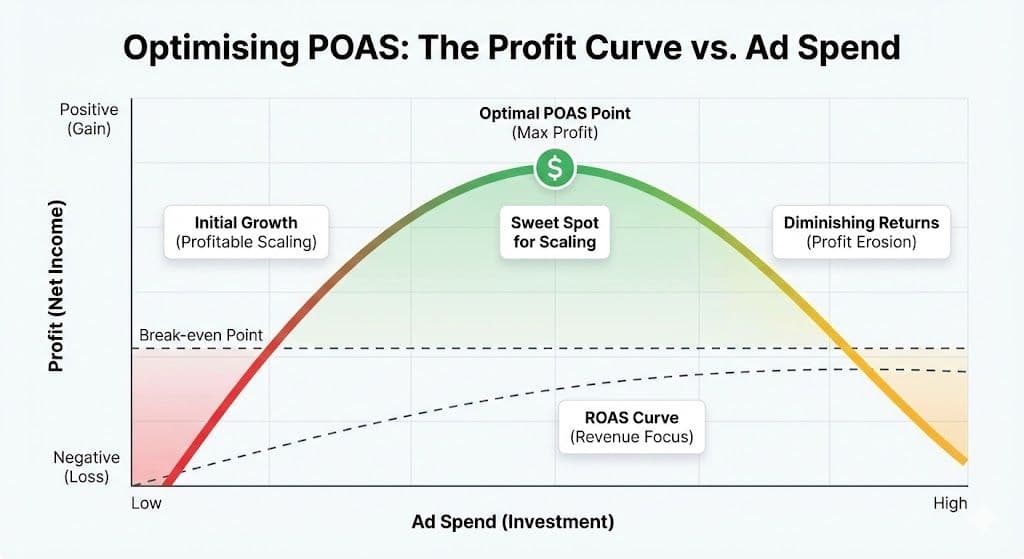
- Can mislead scaling decisions: Doubling spend on a high-ROAS campaign might double your losses if margins are thin.
- Treats all products equally: A $100 sale and a $100 sale aren't equal if one product has a 60% margin and the other has a 10% margin.
ROAS Inputs and Outputs at a Glance
Element | Description |
|---|---|
Input: Ad Spend | Total amount spent on advertising |
Input: Revenue | Total sales value generated from ads |
Output: ROAS | Revenue efficiency ratio (e.g., 4.0 = $4 revenue per $1 spent) |
What It Tells You | How efficiently ads drive revenue (not profit) |
What It Misses | Product costs, shipping, fees, and actual profitability |
What is POAS?
POAS stands for Profit on Ad Spend. Instead of measuring revenue, it measures how much actual profit you generate for every dollar spent on advertising.
The POAS formula is:
POAS = Gross Profit from Ads ÷ Ad Spend
Where Gross Profit = Revenue − Cost of Goods Sold (COGS) − Variable Costs
This is the metric that actually tells you whether your advertising is making money.
Why Ecommerce Brands Are Shifting to POAS
The shift to POAS reflects a broader maturation in digital marketing. As acquisition costs rise and margins tighten, revenue-based metrics no longer cut it.
Consider this: Two products might generate identical revenue, but if one costs $20 to produce and the other costs $80, they're not equally valuable to your business. POAS captures that difference.
Brands making the switch to POAS typically discover:
- Hidden unprofitable campaigns: Some "high-performing" campaigns are actually losing money once all costs are factored in.
- Undervalued winners: Some "underperforming" campaigns by ROAS standards are actually their most profitable.
- Better scaling decisions: Knowing true profitability lets you confidently increase spend where it matters.
- Aligned incentives: Marketing goals match business goals when everyone focuses on profit.
POAS Calculation Example
Let's revisit that furniture store example with a POAS lens.
You spent $2,000 on ads and sold 10 dining tables at $800 each. But each table costs:
- Manufacturing: $350
- Shipping to customer: $80
- Payment processing (3%): $24
- Total cost per unit: $454
- Gross profit per unit: $800 − $454 = $346
Now let's calculate POAS:
- Total Gross Profit: $3,460 (10 tables × $346)
- Ad Spend: $2,000
- POAS: $3,460 ÷ $2,000 = 1.73
A POAS of 1.73 means you're earning $1.73 in profit for every $1 spent on ads. That's a profitable campaign. But notice how different it looks from the 4.0 ROAS figure. Without the POAS calculation, you might think you have more room to scale than you actually do.
Revenue vs Profit Impact Comparison
Metric | High-Margin Product | Low-Margin Product | Why It Matters |
|---|---|---|---|
Sale Price | $100 | $100 | Same revenue |
Product Cost | $30 | $75 | Different costs |
Gross Profit | $70 | $25 | Different profits |
Ad Spend | $25 | $25 | Same ad spend |
ROAS | 4.0 | 4.0 | Identical ROAS! |
POAS | 2.8 | 1.0 | Very different POAS! |
Net Profit After Ads | $45 | $0 | The real difference |
This table tells the whole story. Two products with identical ROAS (4.0) have wildly different profitability. The high-margin product generates $45 profit after ad spend. The low-margin product breaks even. If you're only watching ROAS, you'd treat these campaigns the same. That's a costly mistake.
ROAS vs POAS: Side-by-Side Comparison
Let's put these metrics head-to-head so you can see exactly where each shines and where each falls short.
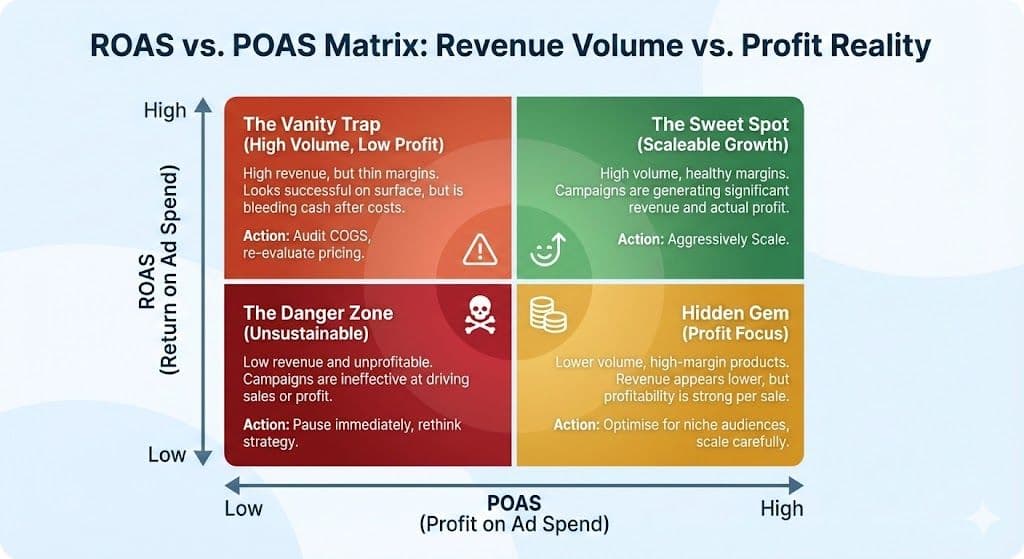
Factor | ROAS | POAS |
|---|---|---|
What It Measures | Revenue generated per dollar of ad spend | Profit generated per dollar of ad spend |
Formula | Revenue ÷ Ad Spend | Gross Profit ÷ Ad Spend |
Key Strength | Simple, universal, built into ad platforms | Shows true return, aligns with business goals |
Key Weakness | Ignores costs; can hide losses | Requires accurate cost data; more setup |
Best For | Quick performance checks; uniform-margin products | Scaling decisions; variable-margin products |
Scaling Decision | "We're getting 5x revenue" (but are we profitable?) | "We're making $1.80 for every $1 spent" (clear profit signal) |
Data Required | Ad spend + revenue (available in ad platforms) | Ad spend + revenue + COGS + variable costs |
When ROAS and POAS Tell Different Stories
Theory is useful. Practical examples are better. Let's walk through five scenarios that show exactly how these metrics diverge in the real world.
Scenario 1: High ROAS, Low Profit
The situation: An online electronics retailer runs a campaign promoting budget headphones. The campaign looks great on paper.
- Ad spend: $5,000
- Revenue: $25,000 (500 units at $50 each)
- ROAS: 5.0 (impressive!)
The reality: Each unit costs $42 to source and ship, leaving just $8 gross profit per sale.
- Total gross profit: $4,000 (500 × $8)
- POAS: 0.8 ($4,000 ÷ $5,000)
- Net result: $1,000 loss
The lesson: A 5x ROAS campaign lost money. Without POAS tracking, this retailer would have scaled the campaign and amplified their losses.
Scenario 2: Modest ROAS, Strong Profit
The situation: A skincare brand promotes their premium anti-ageing serum. The ROAS seems underwhelming.
- Ad spend: $3,000
- Revenue: $7,500 (50 units at $150 each)
- ROAS: 2.5 (below their 3.0 target)
The reality: The serum costs just $25 to produce and ship, yielding $125 gross profit per unit.
- Total gross profit: $6,250 (50 × $125)
- POAS: 2.08 ($6,250 ÷ $3,000)
- Net profit: $3,250
The lesson: This "underperforming" campaign by ROAS standards was actually highly profitable. A ROAS-focused team might have paused it. A POAS-focused team would scale it.
Scenario 3: Scaling Decision Gone Wrong
The situation: A home goods retailer sees a 4.0 ROAS on their cushion campaign and decides to double the budget from $2,000 to $4,000.
Before scaling:
- Revenue: $8,000 | Gross profit: $2,400 | POAS: 1.2
After scaling: Due to audience saturation, efficiency drops.
- Revenue: $12,000 | ROAS: 3.0 | Gross profit: $3,600 | POAS: 0.9
The result: The campaign went from $400 profit to $400 loss. The 3.0 ROAS still looked acceptable, but POAS revealed the campaign was now losing money.
The lesson: Scaling based on ROAS alone is risky. POAS provides the guardrail you need.
Scenario 4: The Product Mix Problem
The situation: A sports retailer runs two campaigns with identical ROAS.
Campaign A (Running Shoes):
- Ad spend: $1,000 | Revenue: $4,000 | ROAS: 4.0
- Margin: 25% | Gross profit: $1,000 | POAS: 1.0
Campaign B (Sports Supplements):
- Ad spend: $1,000 | Revenue: $4,000 | ROAS: 4.0
- Margin: 55% | Gross profit: $2,200 | POAS: 2.2
The result: Campaign B generates 120% more profit with identical ROAS. If the budget is limited, supplements should get priority.
The lesson: When you sell products with different margins, POAS reveals where your ad dollars work hardest.
Scenario 5: Service Business Application
The situation: A commercial cleaning company runs lead generation ads. Their cost structure is different from that of ecommerce.
- Ad spend: $2,000
- New contracts won: 8
- Average contract value: $1,200/month
- First-month revenue: $9,600 | ROAS: 4.8
The POAS calculation:
- Labour and supplies per job: $720/month
- Profit per contract: $480/month
- First-month gross profit: $3,840
- POAS: 1.92
The lesson: Service businesses can (and should) use POAS. The key is defining your "business model unit" clearly and tracking the costs associated with each conversion.
When Should You Switch from ROAS to POAS?
Not every business needs to abandon ROAS entirely. The right approach depends on your business model, product mix, and growth stage.
Ecommerce Brands
Switch to POAS when:
- You sell products with varying profit margins
- You're scaling ad spend and need confidence in profitability
- Your business model includes significant shipping or fulfilment costs
- You're competing in categories with thin margins
Stay with ROAS when: All products have similar margins and you just need a quick efficiency check.
Lead Generation Brands
Switch to POAS when:
- You have clear data on lead-to-customer conversion rates
- You know the profit margin on your services
- You want to optimise for qualified leads, not just volume
Note: Lead gen businesses often use Cost Per Acquisition (CPA) or Customer Acquisition Cost (CAC) as primary metrics. POAS can complement these by showing the profitability of acquired customers.
Subscription and Retention-Focused Brands
Consider POAS alongside LTV when:
- Customer lifetime value varies significantly by acquisition channel
- You're investing in long-term customer relationships
- Retention rates differ based on how customers were acquired
The approach: Calculate POAS based on projected lifetime profit, not just first purchase profit.
High-Margin vs Low-Margin Products
High-margin products (50%+ gross margin): ROAS and POAS often tell similar stories. A 4x ROAS likely means solid profitability.
Low-margin products (under 30% gross margin): POAS is essential. A 4x ROAS can easily mean break-even or loss.
Mixed catalogues: Use POAS to identify which product categories deserve more ad investment.
How to Calculate POAS Correctly: A Step-by-Step Guide
Getting POAS right requires accurate cost data. Here's how to set up your calculation properly.
Step 1: Identify Your Variable Costs Per Sale
Variable costs change with each sale. These typically include:
- Cost of Goods Sold (COGS): What you pay to produce or source the product
- Shipping and fulfilment: Packaging, delivery, warehouse picking
- Payment processing fees: Usually 2-3% of transaction value
- Platform fees: Marketplace commissions if applicable
- Returns allowance: Factor in your average return rate
Step 2: Calculate Gross Profit Per Product
Gross Profit = Sale Price − Total Variable Costs
Do this for each product or product category. Store these values in your ecommerce platform or a spreadsheet for reference.
Step 3: Track Gross Profit at Campaign Level
For each campaign, calculate:
Total Campaign Gross Profit = Sum of (Units Sold × Gross Profit Per Unit)
Step 4: Calculate POAS
POAS = Total Campaign Gross Profit ÷ Campaign Ad Spend
Sample POAS Calculation Worksheet
Item | Amount |
|---|---|
Sale Price | $120.00 |
COGS | ($45.00) |
Shipping Cost | ($12.00) |
Payment Processing (3%) | ($3.60) |
Returns Allowance (5%) | ($6.00) |
Gross Profit Per Unit | $53.40 |
Units Sold (Campaign) | 75 |
Total Campaign Gross Profit | $4,005.00 |
Campaign Ad Spend | $2,000.00 |
POAS | 2.0 |
A POAS of 2.0 means you're making $2 profit for every $1 spent on ads. That's a profitable campaign worth scaling.
A Note on Fixed Costs
The POAS calculation above uses gross profit, which excludes fixed costs like rent, salaries, and software subscriptions. This is intentional.
Fixed costs don't change based on ad performance. Including them would make campaign comparison difficult and cloud your scaling decisions. Use POAS to evaluate campaign efficiency. Use your overall P&L to ensure total profitability.
How BFJ Digital Uses POAS to Scale Ecommerce and Performance Campaigns
At BFJ Digital, we've built our performance marketing approach around profit-based measurement from the ground up. Here's what that looks like in practice.
Data-Driven Profit Attribution
We integrate your product cost data directly into campaign tracking. This isn't a monthly spreadsheet exercise. It's real-time profit visibility.
Our approach connects your ecommerce platform, advertising accounts, and cost data into a unified view. When a sale happens, we know not just the revenue, but the profit. Immediately.
Custom Profit Dashboards
Standard ad platform reports show ROAS. Our custom dashboards show POAS alongside other profit metrics.
You'll see:
- Campaign-level POAS and profit contribution
- Product category profitability by channel
- Margin trends over time
- Scaling thresholds where campaigns remain profitable
Machine-Learning Assisted Bid Strategies
Google and Meta's smart bidding algorithms optimise for conversions or conversion value by default. We train them differently.
By passing profit data back to ad platforms through conversion value adjustments, we help machine learning understand which conversions are actually valuable. The algorithm learns to find more customers like your profitable ones, not just your high-revenue ones.
Profit-First Scaling Framework
Scaling profitably requires discipline. Our framework sets clear guardrails:
- Establish baseline POAS: What's your minimum acceptable profit return on ad spend?
- Test scaling incrementally: 20-30% budget increases with performance monitoring
- Monitor efficiency decay: As spend increases, at what point does POAS drop below target?
- Reallocate to winners: Shift budget from low-POAS campaigns to high-POAS opportunities
- Expand channels strategically: Use profit data to inform new channel investments
This isn't about chasing the highest possible POAS. It's about finding the optimal balance between profit rate and profit volume.
Rethink Your Primary Metric
ROAS has served marketers well. It's simple, universal, and readily available. But as digital advertising matures and margins compress, revenue-based metrics no longer tell the full story.
The shift to POAS represents a fundamental upgrade in how brands measure advertising success. Instead of asking "how much revenue did our ads generate?" you ask "how much profit did our ads create?"
That single question changes everything:
- Scaling decisions become confident, not hopeful
- Product mix optimisation becomes data-driven
- Marketing and finance finally speak the same language
- Campaign performance aligns with business performance
You don't need to abandon ROAS entirely. Use it for quick checks and campaign monitoring. But when it comes to the decisions that matter, when you're choosing where to invest, what to scale, and what to cut, let POAS be your guide.
Ready to Optimise for Profit?
If you're running paid advertising and want to understand your true return on investment, we'd like to hear from you. At BFJ Digital, we help ecommerce and service businesses in Brisbane and beyond build advertising strategies that deliver measurable profit, not just impressive-sounding metrics.
Get in touch for a no-obligation conversation about your current performance and where the opportunities lie.
Hardeep Gill
Hardeep Gill is a Performance Media Specialist at BFJ Digital, bringing expertise in SEM, digital advertising, and strategic campaign management. As a versatile digital marketer, Hardeep excels at crafting and executing comprehensive digital strategies that deliver measurable business growth.
His expertise spans the technical intricacies of search engine marketing and programmatic advertising, enabling precise audience targeting at scale. Hardeep possesses a hands-on understanding of Meta advertising and the broader landscape of digital marketing, allowing them to leverage multiple channels effectively.
While skilled in strategic account management, Hardeep's core strength lies in his ability to harness diverse digital channels to drive tangible results. His approach combines technical proficiency with strategic thinking, ensuring that every campaign is optimised for maximum performance and return on investment.
With a Bachelor of Business majoring in Marketing, Hardeep brings both academic foundation and practical expertise to their role. His comprehensive understanding of the digital advertising ecosystem, from search to social to programmatic, makes them a valuable asset for clients seeking integrated performance media solutions that deliver real business impact.
Ready to See the Bigger Picture?
Want to understand how your digital and real-world marketing impact each other? Not sure if your CRM is supporting your paid media efforts? Just need some clarity and a clear plan to better ROI? Book your free strategy session today for an in-depth audit and action plan to double your digital marketing ROI.
- Meet with a strategy specialist to build a growth plan
- Increase your media performance by up to 200%
- Improve business efficiencies to increase ROI via automation and increase profit
- We cut to the chase. What digital marketing is actually working?