How to Write Content for AI Mode: A Complete Breakdown of Google's AI Search

Aysha Muhammed
Digital Content & SEO Producer at BFJ

Keep ahead of the curve via our latest trends newsletter.
Contact us nowIf you've been watching your organic traffic fluctuate and wondering what's happening behind the scenes, this article is for you.
Google's AI Mode has brought about a fundamental shift in how content gets discovered, processed, and presented to users.
What Is Google AI Mode and Why Should You Care?
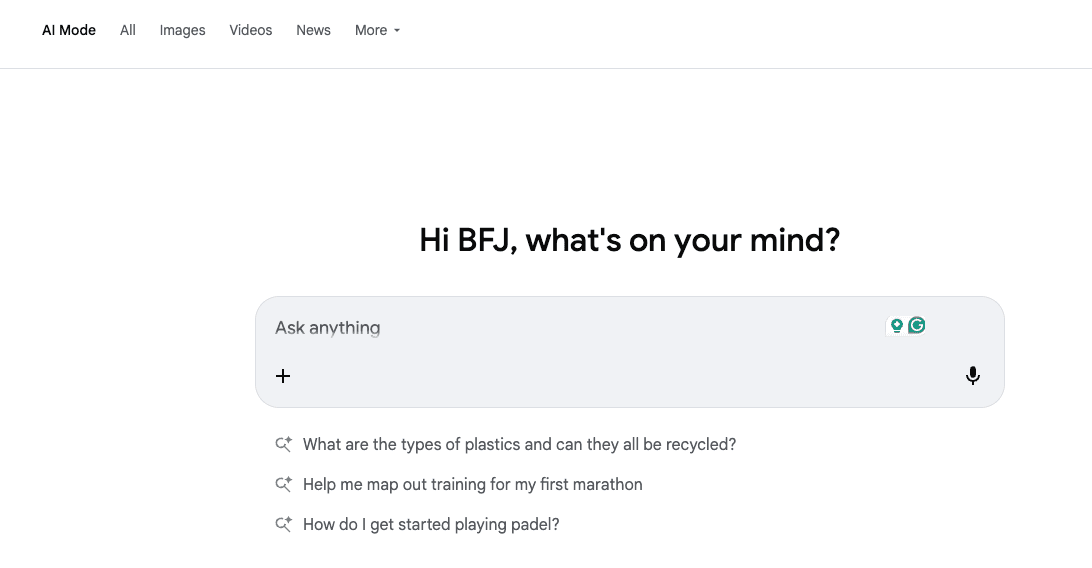
AI Mode is Google's most significant evolution since mobile-first indexing. Launched across the United States in mid-2025, it represents a shift from traditional search to AI-powered answer generation.
Instead of showing you a list of blue links, AI Mode provides synthesised answers that pull information from multiple sources across the web. It's designed to handle complex, multi-faceted questions that traditional search struggled with.
According to Google's official documentation, AI Mode uses their most advanced Gemini models combined with a technique called query fan-out to deliver comprehensive responses.
The numbers tell an interesting story. Google reports that AI Overviews (AI Mode's predecessor) has driven over 10% increase in search usage for queries where it appears. People are searching more, asking more complex questions, and spending more time engaging with AI-generated results.
Here's another critical insight: Google has confirmed that clicks from AI search results tend to be higher quality. Users who click through from AI results spend more time on sites and engage more deeply with content. The volume might shift, but the value of each visitor increases.
You Might Also Like: Generative Engine Optimisation: The New Wave of Search Engine Marketing?
What is Query Fan-Out?
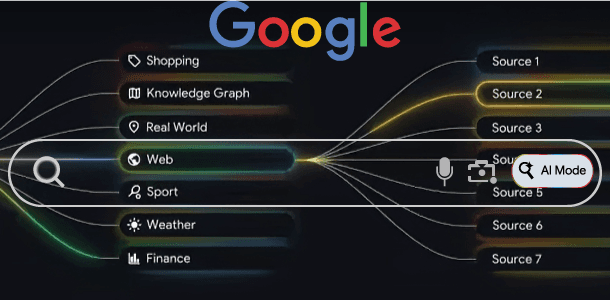
Query fan-out is the technique that makes AI Mode fundamentally different from traditional search. Understanding how it works is essential for creating content that gets cited.
Here's how it works: when you type a question into AI Mode, Google's system doesn't just search for your exact query. It analyses your question, identifies the underlying intent, and generates dozens (sometimes hundreds) of related sub-queries.
These sub-queries are dispatched simultaneously across Google's entire index. The AI then collects the most relevant information from each search and synthesises everything into a single, comprehensive response.
Let's say someone searches: "What's the best CRM for a small accounting firm?"
Behind the scenes, AI Mode might generate sub-queries like:
- Best CRM software for accountants
- CRM pricing for small businesses
- CRM features accountants need
- Salesforce vs HubSpot for professional services
- CRM integration with accounting software
- Client management software reviews 2025
Your content doesn't need to rank for the original query. It needs to provide valuable, citable information for one or more of these sub-queries.
This is why comprehensive content suddenly has a major advantage. A well-structured page that addresses multiple facets of a topic can get pulled into AI responses for queries you never specifically targeted.
What Google Actually Needs
Let's clear up some confusion. Google has been explicit that there are no special technical requirements for AI Mode. If your content can appear in traditional search, it can appear in AI results.
According to Google's documentation, to be eligible for AI Mode citations, your page must:
- Be indexed by Google. Your page needs to be discoverable and indexed before it can be cited.
- Be eligible for snippets. If you've blocked snippets via meta tags, your content won't appear in AI responses.
- Meet Search Essentials. Follow Google's standard webmaster guidelines.
- Allow Googlebot access. Ensure your robots.txt doesn't block crawling.
Google has specifically stated: "You don't need to create new machine readable files, AI text files, or markup to appear in these features.
The fundamentals of good SEO remain your foundation.
How to Structure Content for AI Extraction
While there are no special technical requirements, how you structure your content significantly impacts whether AI systems can effectively extract and cite it.
AI Mode doesn't read your entire article and summarise it. It scans for short, self-contained passages that directly answer specific questions. This is passage-level retrieval, and it changes how you should think about content structure.
Lead with the Answer
AI systems prefer content that gets straight to the point. Start sections with direct answers, then expand with supporting detail.
Instead of: "There are many factors to consider when evaluating CRM software for your business. The market has evolved significantly over the past decade, and today's options range from enterprise solutions to small business tools..."
Write: "HubSpot CRM offers unlimited contacts on its free plan, making it ideal for small businesses. Salesforce provides more advanced automation but starts at $25/user/month. For accounting firms, Zoho CRM integrates directly with Xero and QuickBooks."
The second version provides specific, citable information in a format AI can extract directly.
The 40-60 Word Sweet Spot
Research from SEO practitioners indicates that AI Mode typically extracts passages between 40-60 words. Each passage should:
- Stand alone without requiring context from the surrounding text
- Answer one specific question directly
- Include specific data, names, or comparisons where relevant
- Avoid vague language like "might," "could," or "various"
Think of each paragraph as a potential standalone answer that AI could extract and present to users.
Use Specific Entity Names
AI systems map entities. They understand that "Salesforce" is a CRM, "Brisbane" is a city, and "AHPRA" is a regulatory body. Vague references don't help AI connect your content to relevant queries.
Weak: "The leading project management tool offers robust features for teams."
Strong: "Asana tracks tasks with timeline views and workload management. Monday.com provides visual project boards with automation. Whilst Asana suits complex project workflows; Monday.com works better for visual thinkers."
Back Claims with Sources
AI Mode prioritises content with credible references. When you include data, statistics, or claims, cite the source.
Example: "According to Gartner's 2025 CRM Market Guide, Salesforce holds 23% market share, followed by Microsoft Dynamics at 17% and HubSpot at 12%."
This isn't just good practice for readers. It signals to AI systems that your content is research-backed and trustworthy.
Optimising for Sub-Queries (The Fan-Out Strategy)
Since AI Mode breaks queries into sub-queries, your content strategy needs to anticipate and address those related questions.
Step 1: Map the Sub-Query Landscape
For any topic you're targeting, identify the implicit questions users might have. Tools like AlsoAsked, AnswerThePublic, and Google's People Also Ask can reveal these patterns.
But don't stop there. Think about:
- Implicit questions: "Is this worth the investment?" becomes "ROI of [product]"
- Comparative questions: "How does [A] compare to [B]?"
- Feature-specific questions: "What's the [specific feature] of [product]?"
- Context questions: "[Product] for [specific industry/use case]"
Step 2: Create Section-Based Content
Structure your content with clear sections that each address a specific sub-query. Use descriptive headings that match how people ask questions.
Instead of generic headings like "Features" or "Benefits," use question-based or specific headings:
- "HubSpot vs Salesforce: Which CRM Suits Small Businesses?"
- "Typical CRM Implementation Timeline for Professional Services"
- "CRM Integration Requirements for MYOB and Xero"
Each section should begin with a direct answer to that specific question.
Step 3: Use Tables and Structured Comparisons
AI systems can extract data from well-formatted tables. When comparing options, specs, or features, structure the information clearly:
CRM | Free Plan Contacts | Starting Paid Price |
HubSpot | Unlimited | $20/user/month |
Salesforce | No free plan | $25/user/month |
Zoho CRM | 3 users | $14/user/month |
Tables like this give AI systems clear, extractable data points to cite.
E-E-A-T Signals
AI Mode doesn't just look for relevant content. It evaluates whether your content deserves to be cited based on expertise, experience, authoritativeness, and trustworthiness.
This isn't new, but it's more important in AI search. When AI systems synthesise information from multiple sources, they need to distinguish between reliable expertise and random opinions.
Demonstrate Real Expertise
- Include author bylines with relevant credentials
- Reference specific client work or case studies (with permission)
- Share original data or research from your own work
- Include industry certifications and partnerships
Show Real-World Experience
Content that demonstrates hands-on experience performs better in AI search. Instead of generic advice, share specific implementations, challenges faced, and lessons learned.
Generic: "CRM implementation requires careful planning."
Experience-based: "In our recent HubSpot implementation for a 50-person accounting firm, data migration took three weeks longer than estimated because their legacy system stored client notes in an incompatible format. We solved this by creating a custom migration script that preserved historical context."
Build Topical Authority
AI systems recognise when a site consistently covers a topic in depth. Rather than writing one comprehensive piece, build content clusters around your core topics.
Internal linking between related pieces helps AI understand your site's expertise areas and can improve citation chances across the cluster.
Content Formats That Perform Well in AI Mode
Research into AI search citations reveals certain content formats consistently perform better.
Q&A Format Content
Content structured as questions and direct answers aligns naturally with how AI Mode processes information. FAQ sections, help documentation, and Q&A posts get cited frequently.
The key is ensuring each answer can stand alone. Don't write "Yes, that's correct" as an answer. Write complete, self-contained responses.
Comparison Content
"X vs Y" comparisons naturally address multiple sub-queries that AI Mode generates. When someone asks for a recommendation, AI often breaks that into comparative sub-queries.
Structure comparisons with clear criteria, specific data points, and definitive recommendations for different use cases.
How-To Guides with Clear Steps
Step-by-step content performs well because AI can extract individual steps to answer specific procedural questions.
Number your steps clearly. Start each step with an action verb. Include estimated timeframes or difficulty levels where relevant.
Lists with Context
"Best of" lists and ranked recommendations get frequent AI citations. But don't just list items. Provide specific context for why each item made the list and who it's best suited for.
What Google Says: Official Guidance for AI Search
Google's official position on AI Mode optimisation is refreshingly straightforward. From their documentation:
"Focus on your visitors and provide them with unique, satisfying content. Then you should be well positioned as Google Search evolves, as our core goal remains the same: to help people find outstanding, original content that adds unique value."
They've also clarified that:
- Traditional SEO best practices remain relevant for AI features
- No special optimisations are required specifically for AI Mode
- AI features can surface "new opportunities for more types of sites to appear"
- Clicks from AI results tend to be higher quality with better engagement
The message is clear: create genuinely helpful content, structure it well, and the AI features will work in your favour.
Common Mistakes to Avoid
In the rush to optimise for AI Mode, some content writers and marketers are making mistakes that hurt rather than help.
Over-Optimising for Keywords
AI Mode uses semantic understanding, not keyword matching. Stuffing keywords into content that doesn't naturally address the topic won't help. In fact, it may hurt readability and trust signals.
Creating Shallow Content at Scale
Publishing large volumes of thin, AI-generated content to capture more queries backfires. AI Mode evaluates content quality, and shallow content lacking genuine expertise gets filtered out.
Ignoring Page Experience
Google has confirmed that page experience matters for AI results. Slow-loading pages, poor mobile experiences, and intrusive ads can reduce your chances of being cited.
Blocking AI Crawling
Some publishers have blocked AI crawlers, thinking they're protecting their content. But Googlebot is the crawler for both traditional search and AI features. Blocking it means losing visibility entirely.
Your AI Mode Content Checklist
Before publishing content intended for AI search visibility, run through this checklist:
Content Structure
- Does each section start with a direct answer?
- Can key paragraphs stand alone without context?
- Are passages between 40-60 words where possible?
- Do headings match how people ask questions?
Specificity
- Are you using specific entity names (products, brands, places)?
- Do you include concrete data points and statistics?
- Are claims backed by credible sources?
- Have you avoided vague qualifiers like "might" or "various"?
Query Coverage
- Have you mapped likely sub-queries for your topic?
- Does your content address comparative questions?
- Are implicit questions answered?
- Have you included context for different use cases?
Trust Signals
- Is there an author byline with credentials?
- Does content demonstrate hands-on experience?
- Are sources cited for statistics and claims?
- Is the content part of a broader topical cluster?
Wrapping up
AI Mode represents a significant evolution in search, but it doesn't require you to abandon everything you know about content marketing.
The fundamentals remain: create genuinely helpful content that demonstrates real expertise. What changes is how you structure that content. Short, specific, answer-first passages. Clear section headings that match user questions. Comprehensive coverage that anticipates the sub-queries AI will generate.
The businesses that succeed in AI search will be those that focus on providing genuine value rather than gaming algorithms. Google's systems are designed to find and elevate helpful content. Your job is to create it.
Start with your most important pages. Audit their structure. Ensure each section leads with a direct answer. Build out coverage of likely sub-queries. Strengthen your E-E-A-T signals.
The opportunity is significant for businesses willing to adapt. AI Mode is surfacing content from sources that might not have ranked on page one in traditional search. If your content genuinely helps users, AI Mode can help you reach them.
Need help optimising your content for AI search? BFJ Digital's content team specialises in creating SEO-driven content that performs across both traditional and AI search. Get in touch to discuss your content strategy.
Aysha Muhammed
Aysha’s journey into marketing started the way a lot of great careers do—accidentally. She began with her own blog, just writing because she genuinely loved it. Then she tripped into marketing and never left.
Her career took off in SaaS as a Product and Growth Marketer, where she learned how to drive real business outcomes through content, building marketing channels that consistently brought in hundreds of thousands of visitors and qualified leads every month. After proving she could scale content operations in the fast-paced SaaS world, she moved to agency life, and that's where her versatility really shines.
Now, as a Content Specialist at BFJ Digital, Aysha brings something pretty special: she's both a creative writer and a data nerd, which is a rare combination. What makes Aysha brilliant at what she does is her ability to chameleon her writing style for any audience and style. She gets excited about both the perfect turn of phrase and the analytics that show it's working.
Her Bachelor's in English Literature and Journalism gave her the writing chops, but it's her genuine fascination with technology and her constant upskilling that keep her ahead of the curve.
Ready to See the Bigger Picture?
Want to understand how your digital and real-world marketing impact each other? Not sure if your CRM is supporting your paid media efforts? Just need some clarity and a clear plan to better ROI? Book your free strategy session today for an in-depth audit and action plan to double your digital marketing ROI.
- Meet with a strategy specialist to build a growth plan
- Increase your media performance by up to 200%
- Improve business efficiencies to increase ROI via automation and increase profit
- We cut to the chase. What digital marketing is actually working?