Aged Care Marketing in Australia: What Actually Works in 2026

Scott Macfarlane
Operations Manager at BFJ Digital
Keep ahead of the curve via our latest trends newsletter.
Contact us nowAged care marketing sits in a category of its own. You're not selling a product. You're helping families make one of the most emotionally charged decisions of their lives — often under pressure, often with incomplete information, and almost always with someone they love at the centre of it. Get the marketing wrong and you don't just miss a lead. You lose trust at the worst possible moment.
At the same time, the commercial realities are real. The Australian aged care market was valued at USD 32.2 billion in 2024 and is projected to nearly double to USD 61 billion by 2033 — driven by a population where more than 22% of Australians will be aged over 65 by 2026. That growth is attracting more providers, more competition, and more pressure on occupancy. The number of home care providers alone has risen to 873 nationally. Marketing has to perform. It can't just be warm and reassuring — it has to generate enquiries, guide families through long consideration cycles, and convert interest into admissions.
This guide covers what aged care marketing actually involves, what works, what wastes budget, and how providers can build a digital marketing system that performs consistently — not just when someone runs a campaign.
The Problem With Most Aged Care Marketing
Most aged care marketing stops at enquiry. A family fills out a form, gets counted as a lead, and the campaign is deemed a success. What happens next — whether that enquiry was followed up within the hour or left in an inbox over a long weekend, whether it converted to an assessment or went cold — rarely makes it back into the marketing data.
This matters more than ever. Residential aged care occupancy sits at 88% nationally — the highest since 2020 — with 63,639 admissions recorded in 2023–24. On the home care side, the national priority waitlist has grown to over 96,700 people waiting at their approved level, a 41% increase in a single year. Demand is outpacing supply. That makes every enquiry more commercially significant, and every dropped lead a real cost.
That's the gap. BFJ's focus is enquiry to admission, not lead volume. That means connecting your marketing activity to your CRM, your follow-up process, and your occupancy outcomes — so every dollar spent is measured against what it actually produced commercially, not just what it clicked.
It's a problem we've solved directly in the aged care sector. Working with Arcare, one of Australia's largest aged care providers, we built an offline revenue attribution system connecting digital media — Google, social, and programmatic — through to admissions that were occurring entirely offline. The result was an 80% increase in attribution coverage and a 30% increase in measurable revenue attribution. When you can finally see which campaigns are producing admissions rather than just clicks, every budget decision becomes more defensible — and more effective.
Why Aged Care Marketing Is Different
Most marketing theory is built around shorter buying cycles. Someone searches, clicks, converts. Aged care doesn't work like that. The decision to move a parent or family member into residential care, or to engage home care services, can take months. It involves multiple family members, emotional resistance, financial complexity, and deep uncertainty.
The person doing that 11pm Google search for "in-home aged care Brisbane" is often what researchers call the sandwich generation — managing their own children, a career, and now an aging parent, frequently across competing time pressures and without a clear starting point. They're not just researching a service. They're trying to understand an entirely unfamiliar system while managing guilt, logistics, and grief simultaneously. Marketing that respects their time — clear information, fast response, no runaround — earns trust where generic campaigns don't.
That means your marketing has to do more than generate clicks. It needs to educate, reassure, and stay present across a long consideration window. If your content helps them understand what to expect, and your follow-up system keeps you visible without being pushy, you're the provider they think of when they're ready.
This is why aged care providers who invest in lead generation as a system — not just ad spend — tend to outperform those running disconnected campaigns. The leads need to be nurtured, not just captured.
Who Actually Makes the Aged Care Decision
Most aged care marketing talks to "families." That's not specific enough to be useful. In practice, the decision to engage aged care services involves distinct people with different emotional states, different information needs, and different points of entry into your marketing funnel. Getting this wrong means running campaigns that technically reach the right demographic but land with the wrong message at the wrong moment.
There are four decision-maker types that show up consistently in aged care enquiries.
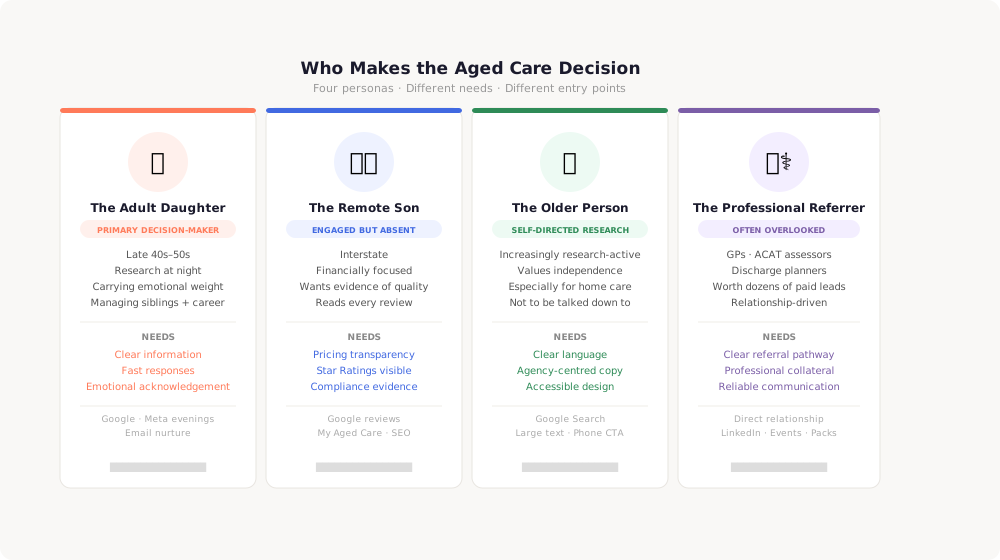
The Adult Daughter (Primary Decision-Maker)
Statistically, the most common aged care decision-maker is a woman in her late 40s or 50s, often managing the logistics on behalf of siblings who may live interstate or be less involved. She's doing the research at night, carrying the emotional weight, and frequently managing her own family and career simultaneously. She needs clear information, fast responses, and to feel like the provider understands the human complexity of what she's going through — not just the service options. Generic marketing loses her. Content that acknowledges the emotional reality of the decision earns her trust.
The Remote Son (Engaged But Absent)
The interstate or geographically removed family member who wants to be involved but is operating from a distance. Often more financially focused than emotionally focused. Wants pricing transparency, quality indicators, and evidence of safety and compliance. Star Ratings on My Aged Care matter to this person. So does how quickly and clearly your team communicates. He will Google your facility name and read every review before he's involved in a decision.
The Older Person Themselves
Increasingly, older Australians are entering the research process directly — particularly for home care services where the decision is less crisis-driven. This person values independence, dignity, and not being talked down to. Marketing that centres their agency ("support to live well at home on your terms") performs better than messaging that positions the service as a concession to decline. Accessibility matters: clear fonts, simple navigation, no jargon.
The Professional Referrer
GPs, hospital discharge planners, ACAT assessors, and social workers are an often-overlooked acquisition channel in aged care. A single GP who trusts your service can be worth dozens of paid leads over a year. This isn't a digital channel — it requires relationship-building, clear referral pathways, and collateral that makes it easy for a clinician to recommend you with confidence. Providers who invest here reduce their dependence on paid media and build a more stable enquiry base.
Understanding which persona is driving an enquiry — and having content, follow-up, and messaging calibrated for each — is what separates a connected aged care marketing system from a generic lead generation campaign.
Key Points in Aged Care Marketing
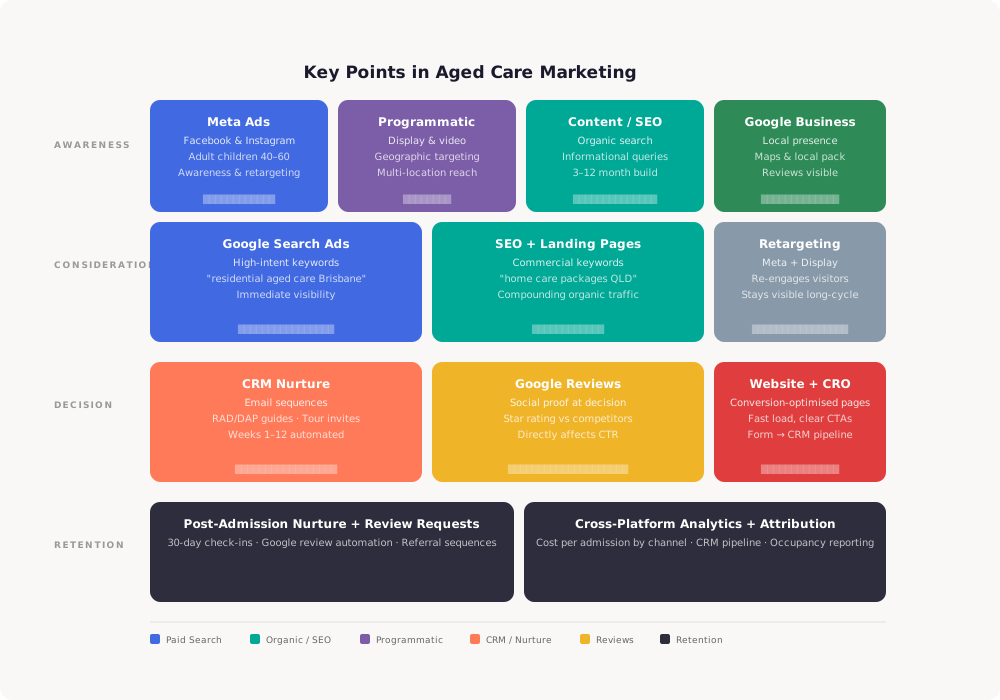
1. Search Is Still the Primary Channel
Families researching aged care options start with Google. That's not changing. Whether it's "residential aged care near me", "NDIS home care providers Brisbane", or "what is a RAD payment" — the search intent is high, and the competition is growing.
Effective aged care marketing requires both paid search and organic SEO working together. Paid gives you immediate visibility for commercial terms. SEO builds compounding results over time, so you're not permanently dependent on ad spend to stay visible. Neither channel alone is sufficient for a serious operator.
As a Google Partner, we see the data across accounts — aged care cost-per-lead through paid search has risen significantly over the past two years as more providers entered the space. That makes it more important than ever to have strong quality scores, tight keyword targeting, and post-click conversion paths that actually convert.
2. Your Website Is a Managed Asset, Not a Brochure
Many aged care providers have websites that were built once and left to age. Pages that don't load properly on mobile. Forms that don't connect to anything. Content that was accurate three years ago but is no longer relevant post-reform.
A website today needs to function as a managed asset — something that's regularly updated, technically sound, and built around conversion. That means clear calls to action on every key page, fast load times, accessible design for older users and their families, and content structured to answer the questions people are actually asking.
It also means your website needs to feed data into a CRM so you know what's happening with every enquiry after it arrives. If you're running aged care marketing without visibility over what happens post-enquiry, you're making decisions on incomplete information.
3. CRM and Follow-Up Are Non-Negotiable
This is where most aged care marketing breaks down. A family submits an enquiry. Someone in admin gets an email. It might get followed up that day, or it might sit in an inbox over a long weekend. By the time someone calls back, the family has already spoken to two other providers.
A properly configured CRM — we work primarily with HubSpot as an accredited HubSpot partner — changes this completely. Enquiries are logged automatically. Follow-up sequences are triggered immediately. Staff can see the full history of every contact. And leadership can see pipeline at a glance, not just guess at it.
The performance loop matters here. Enquiry comes in, gets tracked, gets followed up, outcome is recorded, and that data feeds back into media and content decisions. Without that loop, you're spending on marketing without really knowing what's working.
4. Content That Answers Real Questions Builds Real Trust
Families researching aged care have specific, complex questions. What does a RAD actually cover? What's the difference between a home care package and private in-home care? What should we look for when visiting a facility? How do we know when it's time?
Content that answers those questions honestly — without jargon, without sales pressure — builds the kind of trust that turns a cold web visitor into an enquiry. It also builds organic search authority over time, which reduces reliance on paid media.
The key is writing for the person doing the searching, not for SEO robots. Short sentences. Plain language. Genuine usefulness. That content also gives your team something to share with families who are mid-consideration — a resource that helps rather than sells.
5. Reviews and Reputation Are Part of the Channel Mix
Google reviews matter in aged care more than almost any other category. Families are making high-stakes decisions and they look for social proof. A provider with 12 reviews and a 3.8 average is going to lose enquiries to a competitor with 60 reviews and a 4.6 average, even if the actual quality of care is equivalent.
Reputation management — proactively asking satisfied families to leave reviews, responding thoughtfully to all reviews including negative ones, and monitoring your profile — is a legitimate part of aged care marketing. It directly affects click-through rates and conversion rates. It's not a nice-to-have.
6. Paid Social Fills the Awareness Gap
Most families aren't thinking about aged care until they need to. Paid social — particularly Meta (Facebook and Instagram) — is effective at reaching the adult children demographic with content that builds awareness before the crisis moment arrives.
This isn't about hard sells. It's about positioning. Useful content, genuine stories, and clear service information served to the right audience at the right time. When the moment comes — and it often comes suddenly — you're the provider they already know.
For providers operating across multiple locations, programmatic advertising also offers precise geographic and demographic targeting that's difficult to achieve through standard social channels alone.
Aged Care Marketing Channel Comparison
Channel | Best For | Time to Results | Consideration Cycle Fit |
|---|---|---|---|
Google Search Ads | High-intent enquiries from families ready to act | Immediate | Late-stage consideration |
SEO / Organic Search | Long-term visibility, reducing paid dependency | 3–6 months+ | All stages |
Meta Paid Social | Awareness and retargeting adult children | Fast (awareness) | Early to mid-stage |
Email / CRM Nurture | Keeping warm leads engaged over long cycles | Ongoing | Mid to late-stage |
Google Reviews / Reputation | Converting interest into enquiry | Ongoing investment | Decision stage |
Programmatic Display | Multi-location reach and retargeting | Medium | Early to mid-stage |
Content Marketing | Building trust and answering research questions | 3–12 months | All stages |
From Aged Care Enquiry to Advocacy: What a Connected Marketing System Actually Does
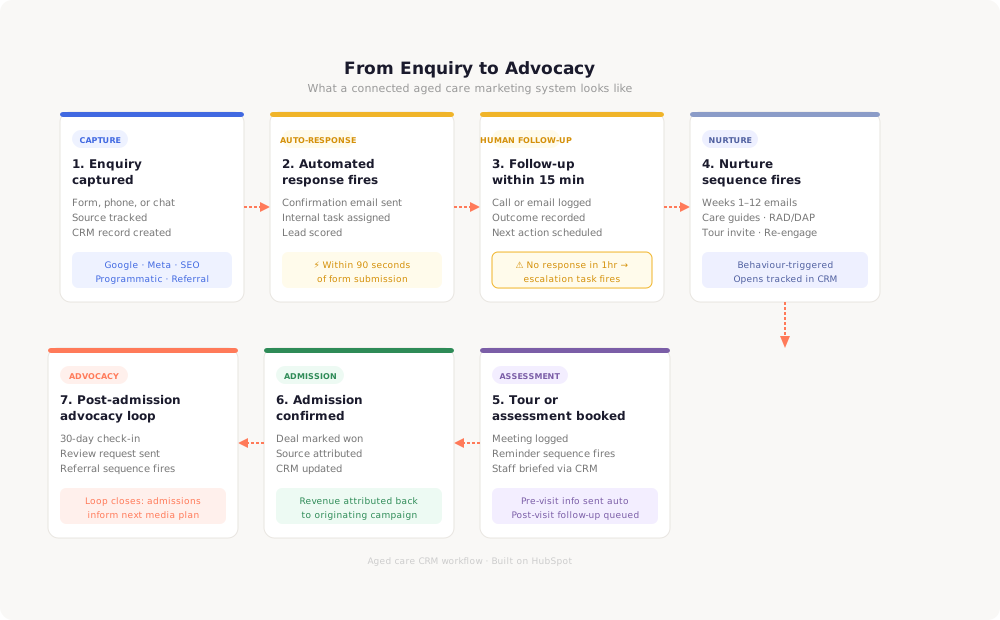
Knowing which channels to use is only half the picture. The other half is what happens after someone raises their hand. Most aged care providers lose enquiries not because their marketing is weak — but because there's no connected system to carry a family from first contact through to admission and beyond. The enquiry arrives, gets manually handled (or doesn't), and the data trail ends there.
A properly configured CRM changes this. Every stage becomes trackable, automated where appropriate, and visible to leadership. Here's what the full aged care lead journey looks like when it's built properly.
Stage 1: Awareness — Family enters the funnel
Before a family ever fills out a form, the system is already working. Every paid and organic channel is UTM-tagged so the source of every contact is captured on first touch. Retargeting pixels fire for families who visit but don't enquire — keeping your brand visible during the extended consideration window that defines aged care decision-making.
Stage 2: Enquiry — Form submitted or call received
The moment an aged care enquiry lands, the CRM creates a contact, opens a deal, records the source channel, and assigns an owner — without manual input. The family receives an instant acknowledgement. The team gets an immediate task. No enquiry sits in an inbox unnoticed over a long weekend.
Stage 3: Response — Human follow-up within 15 minutes
Speed of response is one of the highest-leverage variables in aged care conversion. Families researching options are often contacting multiple providers simultaneously — whoever responds first sets the frame. The CRM surfaces the task immediately and tracks whether it was actioned. If no response is logged within one hour, an escalation task fires automatically to the team manager.
Stage 4: Nurture — Long-cycle sequence activates
Aged care consideration cycles are long. A family that enquires in March may not be ready to act until June. Automated nurture sequences keep providers visible and useful throughout that window — delivering educational content on RADs, DAPs, home care packages, and what to look for during a facility visit. Engagement signals update the contact's lead score and can trigger personalised follow-up from the care team.
Stage 5: Assessment — Tour or assessment booked
When a family books a tour, the system logs the meeting, sends reminders, and automatically dispatches a pre-visit information pack. Staff see the full history of the contact before they arrive — what content they've engaged with, how long they've been considering, what questions they've asked. The post-visit follow-up sequence is already queued before the family walks through the door.
Stage 6: Admission — Deal closed, cost-per-admission calculated
When a family confirms, the CRM records the admission and attributes it back to the originating channel. This is the data that tells you whether your Google Ads, SEO investment, or Meta spend drove commercial outcomes — not just clicks. The onboarding sequence activates automatically, welcoming the family and setting expectations for the transition.
Stage 7: Advocacy — Review request and referral sequence
Thirty days post-admission, the system triggers a check-in and, if sentiment is positive, a Google review request. A referral sequence follows — families who've had a good experience are the highest-quality source of new aged care enquiries. The contact re-enters a long-term nurture pool, so the relationship compounds rather than ending at admission.
This is what a connected aged care marketing system looks like in practice. Not a series of campaigns, but a single automated lifecycle that carries families from first search to long-term advocacy — with every stage tracked, every source attributed, and cost per admission visible at any point.
What Aged Care Marketing Measurement Should Look Like
The biggest gap we see in aged care marketing isn't strategy — it's measurement. Providers often know how many enquiries came in but can't tell you which campaign generated them, how long the lead took to convert, or what the cost per admission was by channel.
That gap is what our Labs platform is built to close. Cross-platform data pulled into one view — paid media, CRM, website behaviour, and conversion outcomes — means every decision is grounded in evidence, not gut feel. For aged care providers managing multiple locations or service types, that kind of visibility is the difference between scaling what works and spreading budget evenly across things that may not.
It's exactly what we built for Lutheran Services, a Queensland aged care and community services provider with a long and complex customer journey. By connecting digital marketing channels to HubSpot and building proper attribution across offline conversions, we delivered a 65% increase in lead attribution and a 45% increase in conversions year-on-year — while generating more than 250 qualified leads per month. The commercial lever wasn't more spend. It was measurement and follow-up built properly.
Measurement in aged care marketing should include:
- Cost per enquiry by channel and campaign
- Enquiry-to-assessment conversion rate
- Lead response time (this directly affects conversion rates)
- Occupancy pipeline by facility or service type
- Attribution across multi-touch journeys — because families rarely convert on first contact
If you're only looking at website traffic and form fills, you're missing the data that actually tells you whether marketing is working commercially. Understanding the full funnel — especially what happens post-enquiry — is where most providers have room to improve.
The New Aged Care Act and What It Means for Marketing
The new Aged Care Act commenced on 1 July 2025, representing the most significant reform to Australia's aged care system in decades. For providers, the compliance and operational implications are substantial. For marketing, the implications are often underestimated.
The most immediate change is Star Ratings. Families can now compare residential aged care providers directly on the My Aged Care website — with publicly visible ratings across compliance, residents' experience, staffing, and quality measures. For marketing purposes, this means your Star Rating is now a search result. A family Googling your facility name will see your rating before they reach your website. Providers with strong ratings have a new proof point to market actively. Providers with weaker ratings have a new objection to manage.
The rights-based framework introduced under the new Act also shifts the language expectations for aged care marketing. Messaging that centres provider capability ("our award-winning facility") is increasingly out of step with a regulatory environment that explicitly centres older people's rights, dignity, and autonomy. Marketing that reflects this shift — positioning services around the older person's life, choices, and independence rather than the provider's credentials — is both more compliant and more effective with the audiences researching it.
The reform context also creates genuine content opportunity. The new Act, Support at Home program changes, updated funding structures, and transition from home care packages are generating thousands of searches from confused families trying to understand what's changed. Providers who publish clear, accurate guides to the reforms earn both organic search visibility and trust from families who find them useful. This is a narrow window — as the sector settles, the content advantage diminishes.
What Most Aged Care Providers Waste Their Marketing Budget On
The intro to this article promised to cover what wastes budget. Here it is.
Brand awareness campaigns with no conversion path
Display and social campaigns that build "awareness" but lead to a homepage with no clear next step, no form, and no CRM connection. Awareness without a capture mechanism is just spend. Every campaign needs a defined path from click to enquiry to follow-up.
Google Ads with broad keyword targeting
Aged care providers regularly appear for search terms that will never convert — broad matches on "care homes," "nursing," or generic health terms that attract entirely the wrong audience. Tight, intent-matched keyword lists with strong negative keyword management are what make paid search efficient. Without them, you're paying for clicks from people who will never become residents.
Websites that aren't connected to anything
A form that sends an email to a generic inbox, with no CRM logging, no owner assignment, and no follow-up sequence. Enquiries arrive, get handled inconsistently, and the conversion data never feeds back into marketing decisions. The website looks like it's working — traffic is coming, forms are being submitted — but no one can tell you what happened to those leads.
Ignoring the post-enquiry window
Spending heavily on lead generation while under-investing in lead response and nurture. In aged care, a family that doesn't hear back within a few hours will call the next provider on their list. The fastest and cheapest way to improve marketing ROI is often to fix what happens after the enquiry arrives — not to spend more generating more enquiries.
Agency retainers without commercial reporting
Monthly reports showing traffic, impressions, and click-through rates — but no data on enquiries generated, cost per enquiry by channel, or what happened to those enquiries after they arrived. If your agency can't tell you your cost per admission, they're optimising for vanity metrics rather than commercial outcomes.
The Referral Channel Most Providers Underinvest In
Digital channels dominate aged care marketing conversations, but the highest-converting aged care leads often don't come from Google. They come from GPs, hospital discharge planners, ACAT assessors, social workers, and community nurses — professionals who are regularly asked "where should mum go?" by the families they work with.
A single GP who trusts your service and recommends you consistently can be worth more annual admissions than a mid-tier Google Ads campaign. Unlike paid leads, professional referrals arrive with established trust, a clear care need, and often a faster decision timeline. They're also effectively free — the cost is relationship-building, not media spend.
Investing in the referral channel means making it easy for professionals to refer to you: clear referral pathways, prompt responses to referral enquiries, clinical collateral that gives a GP confidence in recommending you, and regular communication that keeps your service visible to the referrer network. For home care providers in particular, where the decision is less crisis-driven and professional guidance carries more weight, this channel often outperforms digital in both volume and conversion rate.
It won't show up in your Google Analytics. But it should show up in your CRM — and if it doesn't, you're not measuring it, which means you're not managing it.
Compliance and Sensitivity in Aged Care Marketing
Aged care advertising operates in a regulated environment. The Aged Care Quality and Safety Commission sets clear expectations around what providers can claim. There are also ACCC guidelines around misleading and deceptive advertising that apply, and specific rules around government-funded services and how they can be described.
Beyond compliance, there's a sensitivity requirement. The families you're marketing to are often distressed. Using high-pressure urgency tactics, overstating care quality, or making promises about outcomes that aren't guaranteed can damage trust quickly — and in aged care, trust is almost impossible to rebuild once lost.
Effective aged care marketing is honest marketing. It shows real environments, real staff, realistic outcomes, and genuine values. That approach also happens to produce better long-term results, because it attracts families who are genuinely suited to what you offer — reducing churn and improving reviews.
Frequently Asked Questions
How much should an aged care provider spend on marketing?
There's no universal answer, but the right question is: what's the commercial value of one additional admission or long-term home care client? For most providers, that number is significant — which means underinvestment in marketing is often the more expensive mistake. Our insights article on digital marketing agency costs in Australia gives a useful framework for thinking about budget in context.
How long does it take to see results from aged care marketing?
Paid search can generate enquiries within days of going live. SEO and content typically take three to six months to build meaningful organic traction. CRM and nurture improvements can have an immediate impact on lead-to-conversion rates, which is often the fastest commercial lever available. The most effective programmes run all three in parallel.
Do I need a specialist aged care marketing agency?
You need an agency that understands long consideration cycles, CRM integration, and how to measure commercial outcomes — not just clicks and impressions. Sector-specific experience in aged care marketing means less time explaining your audience and more time making decisions based on data that's actually relevant to your business. Generic campaign management without that context tends to produce generic results.
Conclusion
Aged care marketing works when it's built as a system — not a series of disconnected campaigns. That means search and social working together, a website that converts and feeds data into a CRM, follow-up sequences that keep warm leads engaged, and measurement that tells you what's actually driving admissions rather than what's generating the most clicks.
The providers winning in this space aren't necessarily spending the most. They're the ones who've connected their marketing to their operations, closed the gap between enquiry and response, and built a performance loop that compounds over time.
If you don't know your cost per admission, your marketing isn't working. That's the number that tells you whether your budget is producing commercial outcomes or just activity. Talk to us about building a system that measures what actually matters — from the first click through to admission.
Scott Macfarlane
Scott Macfarlane has been with BFJ Digital for almost 10 years, and in that time, he's become the glue that holds complex projects together. As Operations Manager, Scott is the person who makes sure everything actually happens—from the big strategic moves down to the technical details that can make or break a campaign.
With more than a decade of experience in digital marketing, Scott brings a unique blend of creative thinking and technical expertise to every project.
His dual degree in Creative Industries and Information Technology provides him with comprehensive skills that bridge the gap between strategic vision and technical execution. Scott's expertise encompasses project and account management, strategic oversight of both paid and organic media channels, and technical implementation.
He is dedicated to building strong client partnerships and takes a hands-on approach to driving optimal performance across all campaigns.
Scott's ability to manage complex digital ecosystems while maintaining focus on client goals has made him an invaluable asset to the BFJ Digital team. His commitment to staying current with emerging technologies and marketing platforms ensures that clients benefit from cutting-edge solutions tailored to their specific business needs.
Ready to See the Bigger Picture?
Want to understand how your digital and real-world marketing impact each other? Not sure if your CRM is supporting your paid media efforts? Just need some clarity and a clear plan to better ROI? Book your free strategy session today for an in-depth audit and action plan to double your digital marketing ROI.
- Meet with a strategy specialist to build a growth plan
- Increase your media performance by up to 200%
- Improve business efficiencies to increase ROI via automation and increase profit
- We cut to the chase. What digital marketing is actually working?